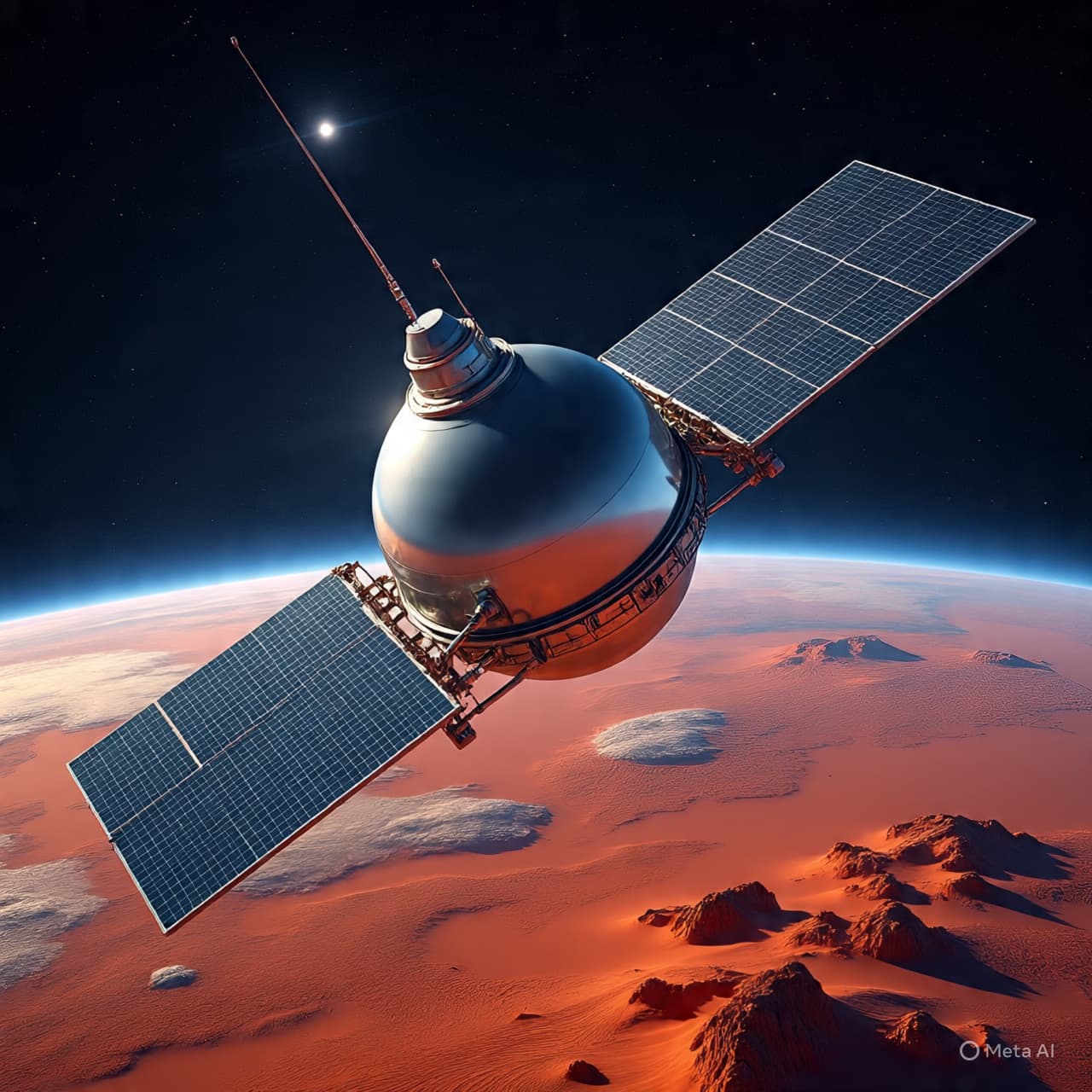
In the hushed corridors of mission control, where every dawn brings a watchful eye to distant radio waves, there’s a particular quiet these days that feels oddly like holding one’s breath. Scientists often liken space exploration to listening for whispers across a grand cosmic hall — sometimes the universe speaks loudly in bursts of light and discovery, and other times it hums quietly, asking us simply to listen. For more than a month now, NASA has waited in that stillness, searching for a familiar signal from its faithful MAVEN orbiter — a spacecraft that has circled Mars like a trusted sentinel for over a decade.
The Mars Atmosphere and Volatile EvolutioN mission, better known as MAVEN, has been more than a study in atmospheric science; it has been a bridge of communication and understanding between our world and the Red Planet. Yet on December 6, 2025, just as MAVEN passed behind Mars in its regular orbit — a moment when direct communication is temporarily blocked by the planet itself — something unexpected happened. When the spacecraft should have reemerged into connection with Earth, the silence that greeted NASA’s Deep Space Network was unlike the familiar pause. Attempts to reach the orbiter brought only static and unanswered calls.
Telemetry before the blackout showed MAVEN’s systems operating smoothly, giving engineers confidence that its hardware remained sound. But the fragment of tracking data recovered around the time of signal loss suggested an unusual rotation just as the spacecraft came back into view. This subtle shift hinted that MAVEN might not be exactly where it was expected to be, complicating efforts to reestablish contact.
In the weeks that followed, NASA’s team did not simply wait. Using all channels available — including an imaginative attempt to picture MAVEN using the Curiosity rover’s Mastcam — they searched for a trace of the craft against the vast canvas of Martian skies. Those visual gestures, though creative, confirmed what the radio silence already told them: MAVEN remained out of reach.
Compounding the challenge was a cosmic alignment known as a solar conjunction, during which the sun stands directly between Earth and Mars, rendering radio communication unreliable. In accordance with safety protocols, NASA paused all Mars mission contacts until mid-January 2026 to avoid corrupted commands. With this pause lifted, engineers are once again peering across millions of miles of space, hoping that a familiar voice will respond.
MAVEN’s mission, launched in 2013 and arriving at Mars a year later, was initially planned to last just one Earth year. Instead, it became an enduring presence, helping scientists unravel the mysteries of Martian atmospheric loss and serving as a vital relay for data from rovers on the surface. Now, as the agency renews its effort to hail this silent explorer, the scientific community watches with mixed hope and realism, mindful both of the fragility of spacecraft that have spent years in the harsh space environment and of the legacy they leave behind.
Whether MAVEN will respond once more or remain silent in its Martian orbit is not yet clear. What remains certain is that the effort to reconnect — patient, meticulous, and filled with quiet persistence — reflects the human desire to reach outward and understand, even when the reply is uncertain.
In the coming days, as antennas sweep the skies and engineers listen for any sign of recognition, NASA’s renewed call to MAVEN stands as both a technical endeavor and a poetic echo of humanity’s steadier yearning to connect across space and time
AI Image Disclaimer “Visuals are created with AI tools and are not real photographs.”
Sources:
Space.com DailyGalaxy.com PBS News / Associated Press NASA wiki / mission history The Watchers
Published by Banx Network. This article is part of the Banx decentralized media programme, powered by the BXE token on the XRP Ledger.