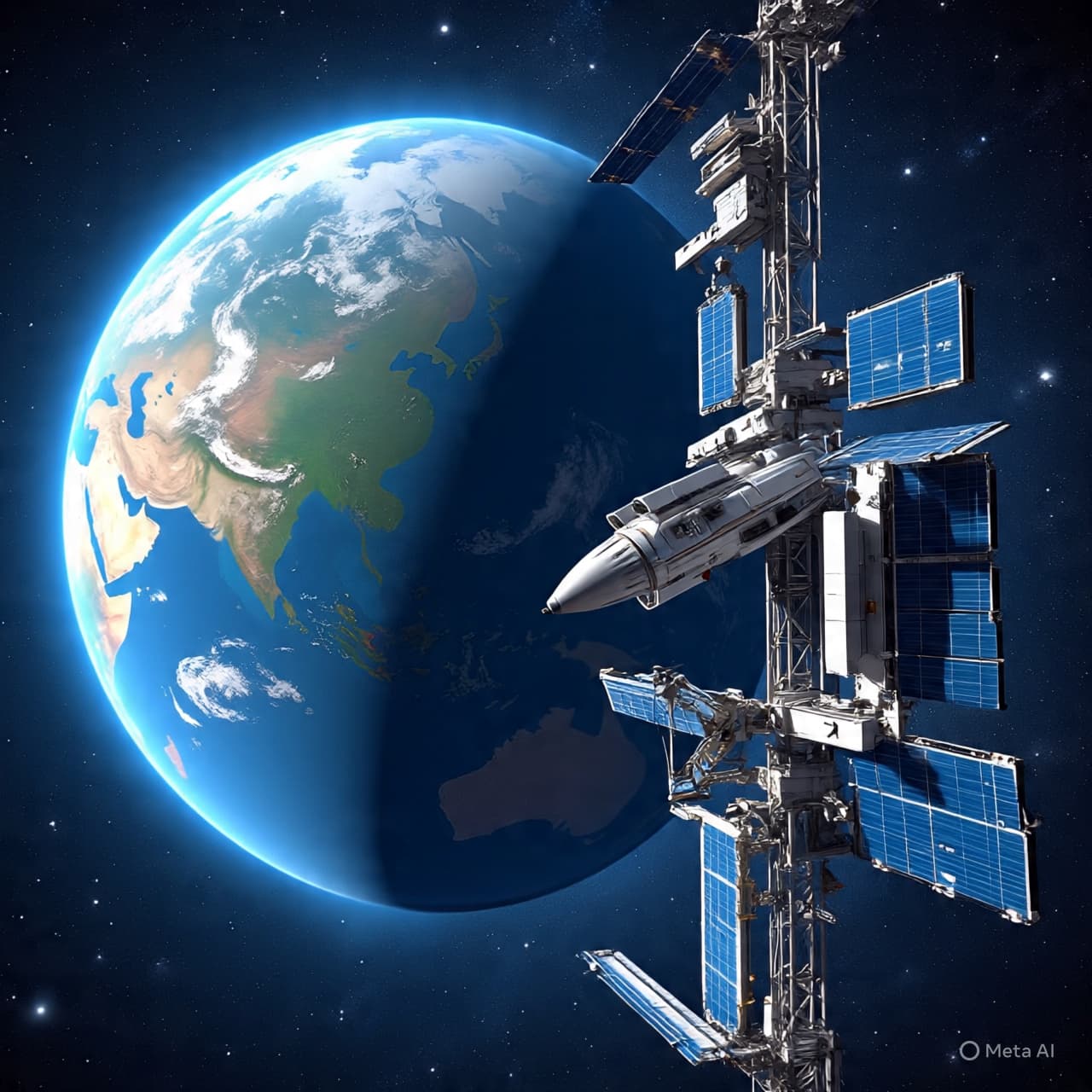
As dawn slips quietly over the curve of Earth, there are moments when human endeavor feels less like conquest and more like careful choreography. High above the blue horizon, where sunrise comes sixteen times a day, another chapter in that choreography unfolded. Four astronauts, carried skyward by science and patience, arrived at the orbiting outpost we know as the . Their arrival followed the earlier-than-planned departure of the previous crew, a reminder that even in space, timing is a delicate companion.
The journey began under the steady hum of engines and anticipation, as a spacecraft developed by lifted toward orbit as part of NASA’s Crew-12 rotation mission. Each launch is a testament not only to technology but to trust—trust in calculations, in teams on the ground, and in the quiet resolve of those strapped inside the capsule. After orbital maneuvers measured in patience rather than speed, the spacecraft performed its rendezvous with the station, approaching with a grace that belied the complexity behind it.
Docking day is never merely procedural. It is a moment suspended between Earth and infinity, where two machines traveling at more than 17,000 miles per hour align with near-surgical precision. When the hatch finally opens, there is often laughter—small, buoyant gestures in microgravity—marking the reunion of colleagues who live and work in a laboratory the size of a football field.
This particular arrival carried added resonance. The prior crew’s early departure, prompted by operational adjustments, had shortened their stay in orbit. Such changes are not uncommon in the evolving cadence of spaceflight, yet they underscore the careful balancing act required to maintain continuous human presence in space. Logistics, weather, spacecraft readiness, and scientific priorities all weave together into a schedule that must remain flexible without losing focus.
The four newcomers now begin their rotation aboard the station, where experiments await in fields ranging from biomedical research to materials science. In the station’s modules—each a testament to international collaboration—astronauts will study how the human body adapts to microgravity, test technologies designed for future lunar missions, and observe Earth’s changing systems from a vantage point few will ever know. The station itself, a partnership led by and joined by agencies across Europe, Japan, and Canada, continues to serve as both laboratory and symbol.
For the astronauts, the transition from launch to orbit to daily routine is swift. There are safety briefings to review, experiments to hand over, maintenance tasks to assume. Yet amid the checklists, there is also the quiet ritual of looking out the cupola windows. Continents drift by without borders. Storm systems spiral in silent symmetry. At night, city lights trace constellations of their own.
The early departure of their predecessors may have shifted the rhythm, but the melody continues. Crew rotations are the heartbeat of the station, ensuring that research progresses and that knowledge gathered in microgravity returns home to benefit life on Earth. Each arrival marks both continuity and renewal.
As of docking day, all four astronauts are safely aboard the International Space Station, beginning their planned mission in orbit. Operations teams report a smooth rendezvous and hatch opening, and the crew will now transition into scheduled scientific and maintenance activities in the days ahead.
AI Image Disclaimer: Illustrations were produced with AI and serve as conceptual depictions.
Source Check: NASA Space.com Reuters Associated Press BBC News
Published by Banx Network. This article is part of the Banx decentralized media programme, powered by the BXE token on the XRP Ledger.