There is something humbling about imagining the first moments after existence itself stirred awake. Not an explosion in the way fireworks fracture a quiet sky, but a swelling—dense, luminous, and immeasurably hot. If we listen closely to the language of physics, it does not describe sharp edges or defined shapes. Instead, it whispers of heat and motion, of particles mingling so intensely that the early universe resembled something far more familiar: a simmering cosmic soup.
In recent simulations conducted by physicists working with data from facilities such as CERN and Brookhaven National Laboratory, scientists recreated the conditions that followed the Big Bang. What they found was not chaos in the everyday sense, but a kind of fluid state—an ultra-hot plasma where quarks and gluons moved freely, unbound by the forces that later locked them inside protons and neutrons. In those first microseconds, the universe was less like a collection of objects and more like a broth of fundamental ingredients, swirling at temperatures trillions of degrees above anything we encounter today.
This state is known as quark–gluon plasma. In today’s universe, quarks are confined, tucked securely inside atomic nuclei. But rewind the cosmic clock by nearly 13.8 billion years, and confinement had not yet taken hold. Matter had not settled into atoms, let alone stars or galaxies. Instead, everything existed in a dense, opaque fluid—so uniform and energetic that distinctions between particles blurred. The simulations suggest this plasma flowed with remarkably low viscosity, behaving almost like a perfect liquid. It was not a violent spray of fragments; it was a cohesive, dynamic medium.
To explore this ancient condition, researchers accelerate heavy ions to near light speed and collide them, briefly recreating pockets of early-universe temperatures. In those fleeting instants, detectors capture patterns in the debris—patterns that mirror what advanced computer simulations predict. The aftermath of these collisions behaves less like scattered dust and more like ripples in a pond. Energy propagates collectively. Particles move in correlated waves. The metaphor of soup is not poetic indulgence; it is an attempt to describe a fluid reality at the smallest scales.
There is quiet elegance in this discovery. For decades, popular imagination pictured the universe’s birth as a fiery detonation flinging matter outward. Yet the emerging portrait is softer, though no less profound. The early cosmos appears to have been governed by flow and interaction rather than fragmentation alone. It thickened and cooled gradually, allowing quarks to bind into protons and neutrons. From there, atoms formed, light decoupled, and eventually gravity gathered matter into stars.
Organizations such as NASA continue to observe the cosmic microwave background—the faint afterglow of that primordial era—offering complementary evidence that the early universe was astonishingly uniform, like a well-stirred mixture. The simulations deepen that picture, showing how microscopic behavior shaped the macroscopic architecture we inhabit today.
If the universe was once soup, it was not a simple recipe. It was a cauldron of fundamental forces negotiating balance. The strong nuclear force began asserting dominance, stitching quarks together. Expansion cooled the plasma, changing its texture. What began as a nearly seamless fluid eventually differentiated into the building blocks of everything: planets, oceans, and the quiet breath of living beings.
There is something gently reassuring in this image. We are not merely fragments from an explosion; we are the cooled remnants of an ancient, flowing whole. The same laws that governed that luminous broth continue to guide galaxies in their orbits and particles in their dance.
The simulations do not close the story of cosmic origins. Instead, they refine it. They suggest that in the beginning, before structure and silence, before gravity sculpted the heavens, the universe moved as one continuous, radiant substance—less like shattered glass, more like a vast and glowing sea.
As research advances, scientists will continue refining their models, comparing experimental collisions with theoretical predictions. Each step brings greater clarity to those first fleeting moments. And in that clarity, the metaphor lingers: the cosmos, once a soup of energy and matter, slowly cooled into the intricate universe we now call home.
AI Image Disclaimer
Illustrations were produced with There is something humbling about imagining the first moments after existence itself stirred awake. Not an explosion in the way fireworks fracture a quiet sky, but a swelling—dense, luminous, and immeasurably hot. If we listen closely to the language of physics, it does not describe sharp edges or defined shapes. Instead, it whispers of heat and motion, of particles mingling so intensely that the early universe resembled something far more familiar: a simmering cosmic soup.
In recent simulations conducted by physicists working with data from facilities such as CERN and Brookhaven National Laboratory, scientists recreated the conditions that followed the Big Bang. What they found was not chaos in the everyday sense, but a kind of fluid state—an ultra-hot plasma where quarks and gluons moved freely, unbound by the forces that later locked them inside protons and neutrons. In those first microseconds, the universe was less like a collection of objects and more like a broth of fundamental ingredients, swirling at temperatures trillions of degrees above anything we encounter today.
This state is known as quark–gluon plasma. In today’s universe, quarks are confined, tucked securely inside atomic nuclei. But rewind the cosmic clock by nearly 13.8 billion years, and confinement had not yet taken hold. Matter had not settled into atoms, let alone stars or galaxies. Instead, everything existed in a dense, opaque fluid—so uniform and energetic that distinctions between particles blurred. The simulations suggest this plasma flowed with remarkably low viscosity, behaving almost like a perfect liquid. It was not a violent spray of fragments; it was a cohesive, dynamic medium.
To explore this ancient condition, researchers accelerate heavy ions to near light speed and collide them, briefly recreating pockets of early-universe temperatures. In those fleeting instants, detectors capture patterns in the debris—patterns that mirror what advanced computer simulations predict. The aftermath of these collisions behaves less like scattered dust and more like ripples in a pond. Energy propagates collectively. Particles move in correlated waves. The metaphor of soup is not poetic indulgence; it is an attempt to describe a fluid reality at the smallest scales.
There is quiet elegance in this discovery. For decades, popular imagination pictured the universe’s birth as a fiery detonation flinging matter outward. Yet the emerging portrait is softer, though no less profound. The early cosmos appears to have been governed by flow and interaction rather than fragmentation alone. It thickened and cooled gradually, allowing quarks to bind into protons and neutrons. From there, atoms formed, light decoupled, and eventually gravity gathered matter into stars.
Organizations such as NASA continue to observe the cosmic microwave background—the faint afterglow of that primordial era—offering complementary evidence that the early universe was astonishingly uniform, like a well-stirred mixture. The simulations deepen that picture, showing how microscopic behavior shaped the macroscopic architecture we inhabit today.
If the universe was once soup, it was not a simple recipe. It was a cauldron of fundamental forces negotiating balance. The strong nuclear force began asserting dominance, stitching quarks together. Expansion cooled the plasma, changing its texture. What began as a nearly seamless fluid eventually differentiated into the building blocks of everything: planets, oceans, and the quiet breath of living beings.
There is something gently reassuring in this image. We are not merely fragments from an explosion; we are the cooled remnants of an ancient, flowing whole. The same laws that governed that luminous broth continue to guide galaxies in their orbits and particles in their dance.
The simulations do not close the story of cosmic origins. Instead, they refine it. They suggest that in the beginning, before structure and silence, before gravity sculpted the heavens, the universe moved as one continuous, radiant substance—less like shattered glass, more like a vast and glowing sea.
As research advances, scientists will continue refining their models, comparing experimental collisions with theoretical predictions. Each step brings greater clarity to those first fleeting moments. And in that clarity, the metaphor lingers: the cosmos, once a soup of energy and matter, slowly cooled into the intricate universe we now call home.
AI Image Disclaimer
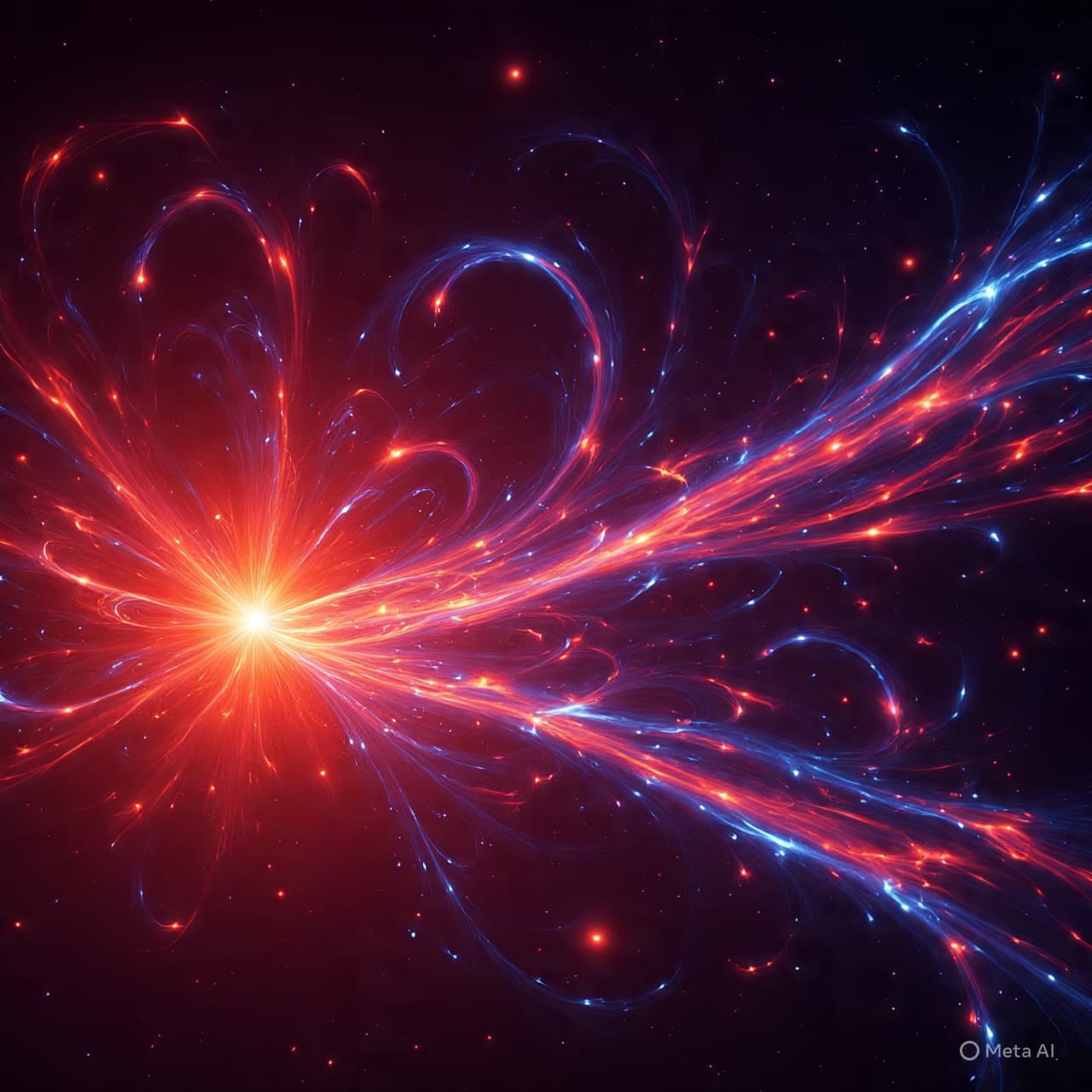
Illustrations were produced with AI and serve as conceptual depictions
Sources
ScienceAlert Live Science Space.com Nature Physics Physical Review Letters
Published by Banx Network. This article is part of the Banx decentralized media programme, powered by the BXE token on the XRP Ledger.