There is a rhythm to the universe that we are only beginning to hear. At the heart of nearly every galaxy lies a supermassive black hole, and when it feeds, it does not do so quietly. It launches jets—twin streams of particles accelerated to near the speed of light, stretching hundreds of thousands of light-years into the void. Most galaxies have two jets. Some, for reasons not fully understood, have more. And now astronomers have found something rarer still: a galaxy that appears to have erupted not once, not twice, but four separate times, each outburst leaving behind a pair of hotspots like footprints in cosmic dust.
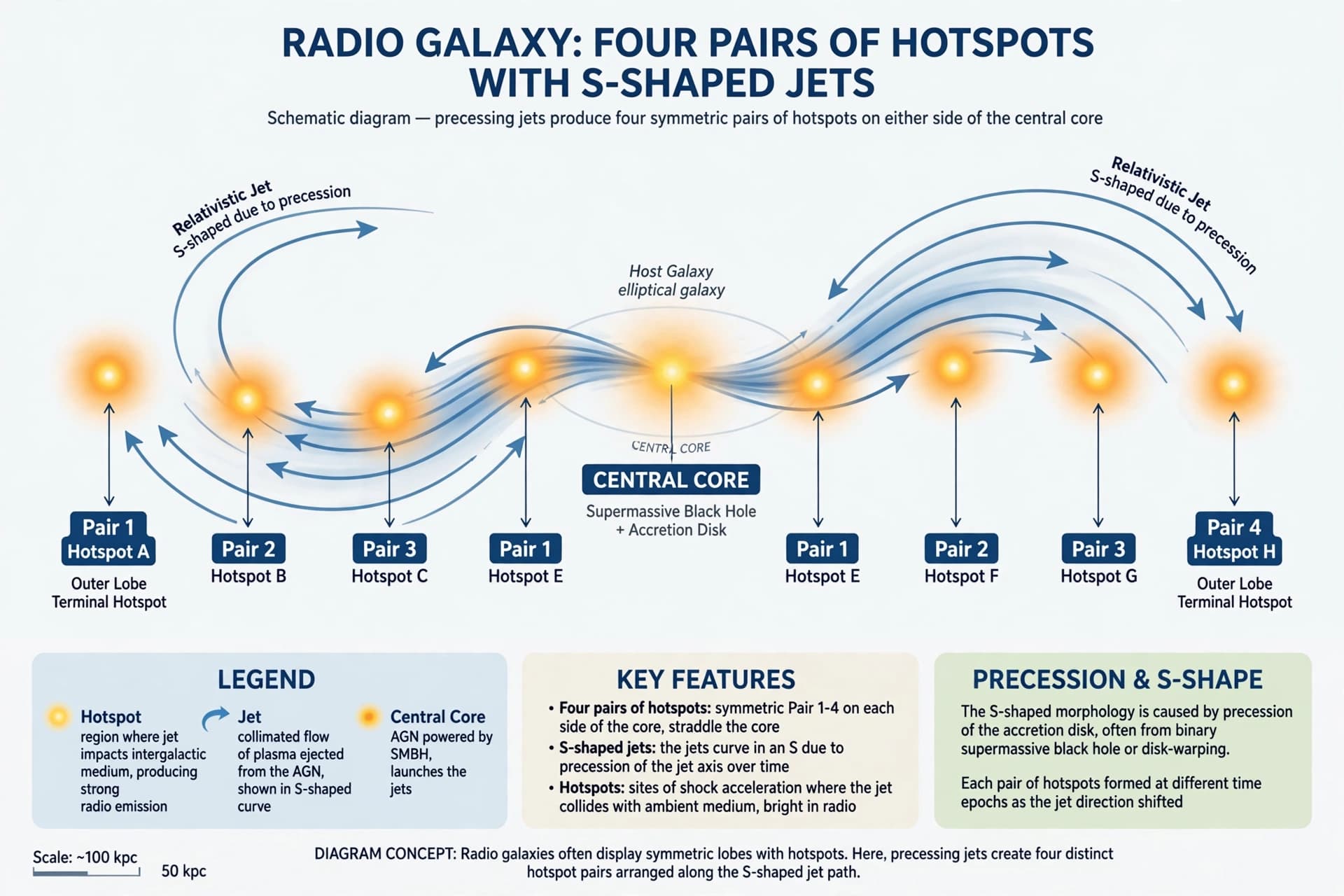
The object is called J023721.13-010528.5, a giant radio galaxy hosted by a bright cluster galaxy at a redshift of 0.372, meaning its light has traveled for billions of years to reach us . Using the upgraded Giant Metrewave Radio Telescope in India, along with MeerKAT in South Africa and the Very Large Array in New Mexico, researchers observed the galaxy across multiple radio frequencies and found four distinct pairs of components straddling its core . Each pair appears to be a hotspot—the region where a jet of particles slams into surrounding gas, creating a local maximum of radio emission .
What makes this finding compelling is not just the number of episodes, but the evidence for their sequence. The researchers measured spectral ages across the hotspots and found a clear pattern: the outermost pairs are the oldest, with ages estimated between 4 and 21 million years, while the innermost pairs are the youngest . This progression—older structures farther from the core, younger ones closer—is exactly what one would expect if the black hole had switched on and off repeatedly, launching new jets as older ones faded .
The galaxy is also one of the largest S-shaped radio sources known, with a projected linear size exceeding 1.2 megaparsecs—roughly four million light-years across . The S-shape, formed by the progressive rotation of the jet axis over successive episodes, makes the different generations of hotspots easier to distinguish. The position angles of the hotspot pairs rotate systematically from the innermost to the outermost, with offsets of about 7, 16, and 24 degrees . This rotation, the researchers suggest, may be linked to changes in the black hole’s spin axis or the dynamics of the accretion disk feeding it.
The discovery places J023721.13-010528.5 in a new category: the quadruple-double radio galaxy, or QDRG. Double-double radio galaxies, with two episodes of jet activity, are themselves rare—only about 192 are known . Triple-double radio galaxies are rarer still. A galaxy with four episodes, the researchers write, is “one of the rarest of the rare” . The paper presenting the finding, led by researchers using data from multiple radio observatories, has been published on the arXiv preprint server .
Why does this matter? Because galaxies like this preserve a record of activity that spans millions of years, offering a way to study how black holes cycle through periods of feeding and dormancy. The timescales involved are immense, far beyond what any human experiment could observe directly. But by finding more galaxies with multiple episodes—and studying the ages and orientations of their jet remnants—astronomers can piece together the duty cycle of active galactic nuclei and how they shape the galaxies around them.
Astronomers have identified a giant radio galaxy, J023721.13-010528.5, showing evidence of four separate episodes of jet activity. The finding, based on multi-frequency radio observations, makes it a prototype for a new class called quadruple-double radio galaxies. The study is available on arXiv.
AI Image Disclaimer: The images in this article are AI-generated and are for illustrative purposes only. They do not depict actual radio observations.
Sources: arXiv, Phys.org, Cool Papers, Space Today
Published by Banx Network. This article is part of the Banx decentralized media programme, powered by the BXE token on the XRP Ledger.