There is a certain violence in the quietest corners of the universe. At the heart of nearly every large galaxy, a supermassive black hole sits in stillness, holding the center like a stone at the bottom of a well. But when two galaxies merge, their black holes can spiral toward each other, emit gravitational waves, and—if the waves are uneven—receive a kick powerful enough to send the survivor reeling. The question has always been whether we could ever see such a thing.
A decade after the idea was first modeled, researchers at Eötvös Loránd University in Hungary have found statistical evidence that some supermassive black holes are indeed displaced from their galactic centers. Their study, published in the Monthly Notices of the Royal Astronomical Society, analyzed roughly 100,000 quasars from the Sloan Digital Sky Survey and found the signature that had been predicted years earlier .
The physics is elegant in its brutality. When two black holes merge, the gravitational waves they emit are not always symmetric. Like a gun recoiling when a bullet is fired, the remnant black hole can be kicked away at speeds reaching millions of kilometers per hour. If the kick is not strong enough to escape the galaxy entirely, the black hole falls back, oscillates around the nucleus like a pendulum, and passes through the dusty center at its fastest .
The prediction, made in 2016 by Peter Raffai, Zoltán Haiman, and Zsolt Frei, was that quasars hosting fast-moving black holes should appear redder on average. The reason is simple: the black hole moves fastest where the dust is densest, so its light should be more obscured. The new analysis, led by Bence Bécsy, found exactly that relationship. Among the dustiest quasars, those with the fastest-moving black holes were three times more common than among the least obscured .
The researchers were careful. They checked their results against different data-selection methods, and the correlation held. When they looked only at gas clouds that do not move with the black hole, the signal vanished, as it should. The most natural explanation is that some quasars contain black holes displaced by past mergers, though the authors emphasize that other physical processes cannot be entirely ruled out .
What makes the finding significant is not the confirmation of a single object but the demonstration of a population. Individual candidates have been identified before, but alternative explanations always lingered. A statistical signal across tens of thousands of quasars is harder to dismiss. It suggests that the aftermath of black hole mergers leaves traces that persist for millions of years, written in the colors and motions of the gas around them.
The work also looks forward. The European Space Agency’s LISA mission, planned for the 2030s, will directly detect gravitational waves from supermassive black hole mergers. The traces the Hungarian team has found in quasar light are, in a sense, the visible echo of the events LISA will one day hear. For now, the evidence remains statistical, and confirmation will require further observation. But the prediction made a decade ago has met the data, and the data have answered in the affirmative.
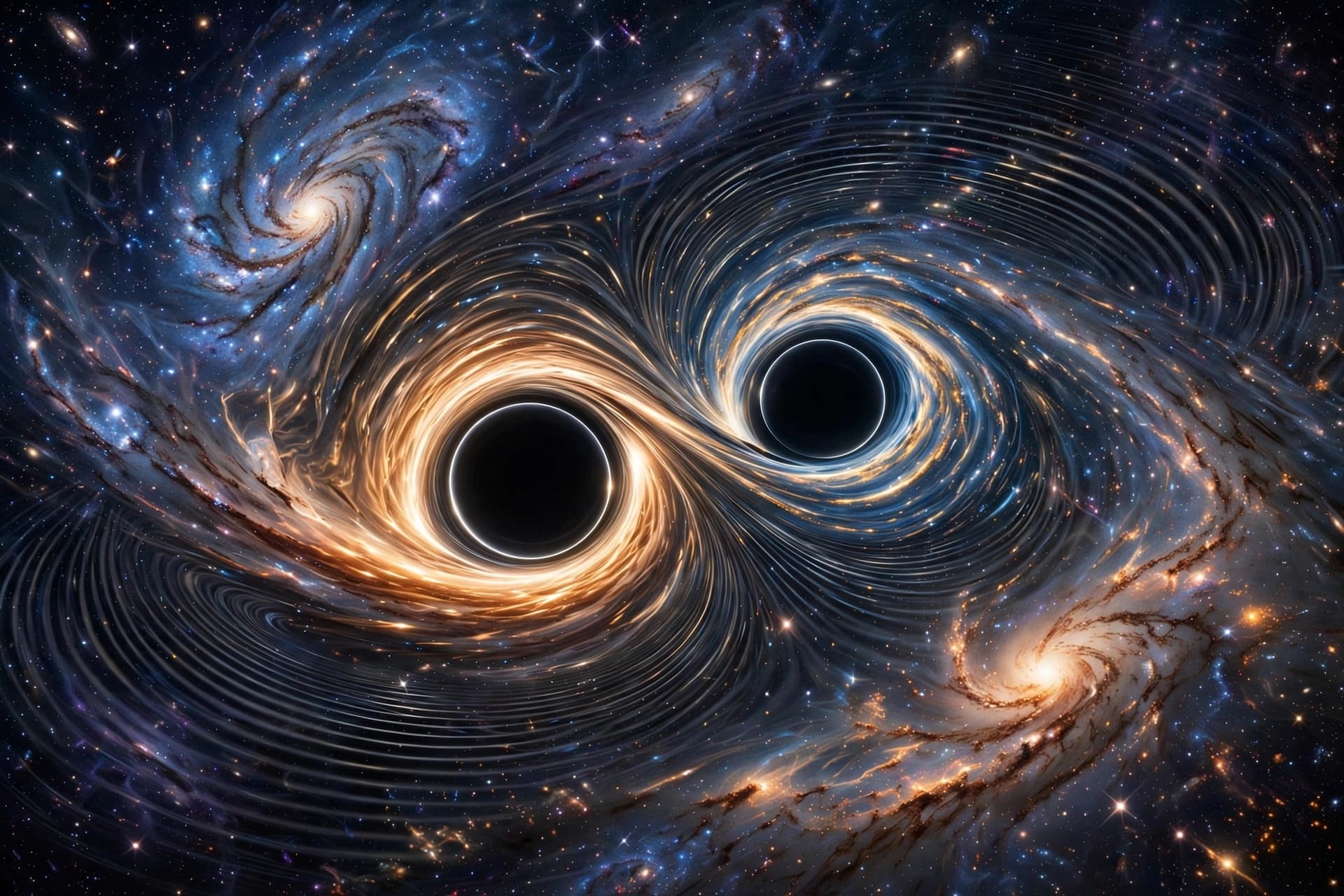
Image note: The visual accompanying this article is an AI-generated illustration and does not depict actual observational data.
Sources: EurekAlert!, Monthly Notices of the Royal Astronomical Society, Universe Space Tech, SIMBAD
Published by Banx Network. This article is part of the Banx decentralized media programme, powered by the BXE token on the XRP Ledger.