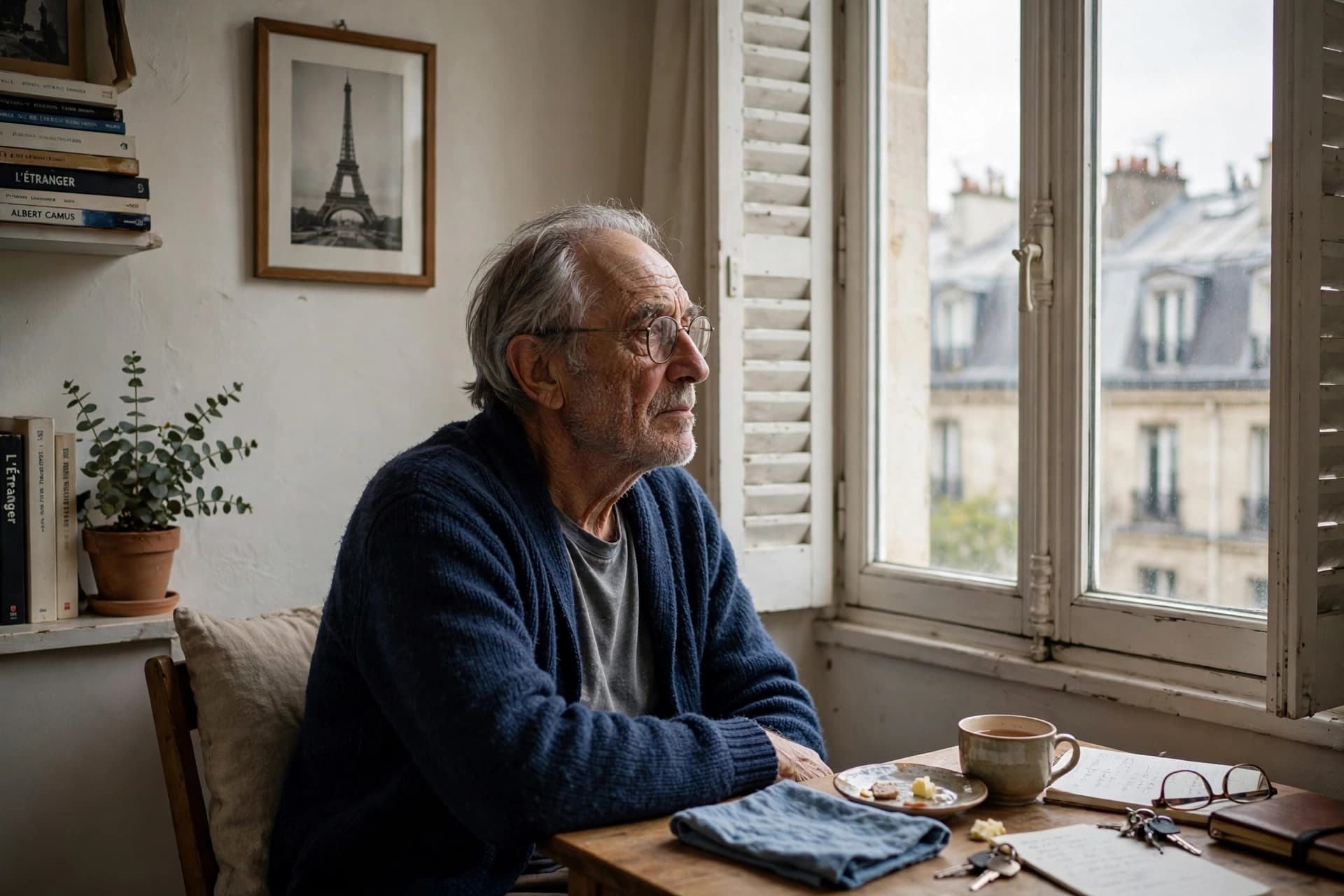
A person can walk through a crowded Paris street and still feel completely alone. Around them, cafés remain busy, trains continue moving, and conversations fill public spaces, yet none of those sounds necessarily guarantee a sense of belonging.
France has increasingly examined loneliness as a public-health issue. Recent reporting and research have highlighted the experience among different age groups, particularly young people and older adults, whose circumstances can make social connection more difficult.
Loneliness is not simply the absence of other people. Researchers generally distinguish between social isolation, which concerns the amount of contact a person has, and loneliness, which is the subjective feeling that one's social relationships are insufficient.
That distinction helps explain why the issue can be difficult to see. Someone who lives alone may feel content and connected, while another person surrounded by colleagues, classmates, or relatives may still experience profound disconnection.
Among younger people, changes in education, employment, digital communication, and urban life can influence the way relationships are formed and maintained. Online communication can make contact easier, but it does not always replace the experience of sustained face-to-face relationships.
Older adults face different circumstances. Retirement, reduced mobility, bereavement, and changes in family structures can gradually reduce everyday interactions. For someone whose social world once revolved around work or a partner, the transition can alter the rhythm of an entire week.
Health researchers have increasingly studied whether persistent loneliness is associated with physical and mental-health outcomes. International research has linked prolonged social disconnection with a range of health risks, although the relationship between loneliness and individual outcomes can be complex.
France is also seeing greater attention to community-based responses. Social activities, volunteering, local associations, educational programs, and other forms of regular participation can create opportunities for people to establish connections outside traditional family structures.
The challenge is partly one of visibility. Loneliness does not necessarily produce an obvious sign that can be measured from the outside. A person can continue working, studying, shopping, and moving through ordinary routines while privately experiencing a lack of meaningful connection.
As France considers the health consequences of social disconnection, the conversation increasingly moves beyond the idea that loneliness is simply a personal experience. It has become part of a broader discussion about how communities, workplaces, schools, healthcare institutions, and families create opportunities for people to remain connected.
AI Image Disclaimer The accompanying visuals were generated with AI as conceptual illustrations and do not represent real people or actual locations.
Published by Banx Network. This article is part of the Banx decentralized media programme, powered by the BXE token on the XRP Ledger.