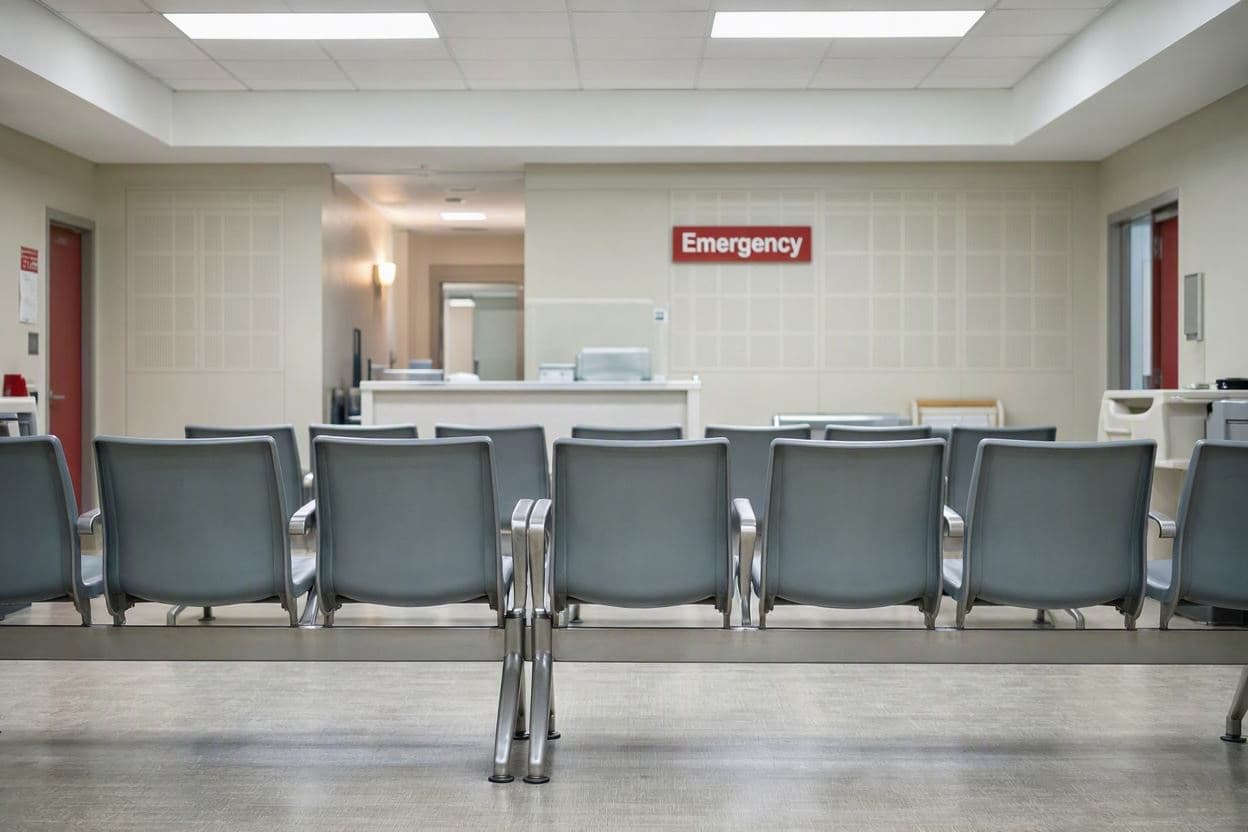
There is a particular kind of exhaustion that settles into an emergency department when the system meant to catch people at their most vulnerable begins to buckle. At St Vincent’s Hospital in Sydney, a clinical director recently did something that speaks louder than any policy paper: he asked a court to stop sending people accused of crimes to his already overwhelmed emergency room. Sometimes, the most honest words come not from a press release, but from someone standing at the edge of what they can bear.
The request was made informally to Downing Centre Local Court on Monday, concerning people magistrates deemed mentally ill or disordered. At the time, St Vincent’s emergency department was caring for 17 mental health patients. Fifteen of them were waiting to be admitted to mental health units that were already full. Two had been in the emergency department for 10 days .
“That is a huge number of patients,” said Dr. Pramudie Gunaratne, chief executive of the Australian Society of Psychiatrists. She described it as symptomatic of a broader failure—specifically, that community-based mental health services are not working well enough if so many people end up in emergency departments .
The mechanism at the center of this is Section 19b of the Mental Health and Cognitive Impairment Forensic Provisions Act. It allows magistrates to send people who may be mentally ill or impaired to public hospitals, where they are detained and undergo psychiatric assessment . The number of people dismissed by NSW lower courts due to being mentally ill or disordered rose from 435 in 2021 to 561 in 2025. Most of these people were under Section 19b orders and were diverted to emergency departments .
Forensic psychiatrists say these orders are also used for non-violent, vulnerable people whose psychiatric conditions deteriorated because community mental healthcare services were overwhelmed and under-resourced . For some, the first meaningful contact they have with the mental health system comes only after they have deteriorated so badly that something happens, the police get involved, and they end up before a magistrate .
A St Vincent’s spokesman said the hospital has advised the local court that the staff member’s informal request was no longer required. The spokesman acknowledged that, like all emergency department mental health services, St Vincent’s experiences surges of demand . Professor Matthew Large, a senior Sydney psychiatrist, suggested that where possible, most people should be diverted to their local health district rather than the hospital closest to the bail courts—a change that would make coordinating care far more feasible . Mental Health Minister Rose Jackson said the state government acknowledges the pressures and has increased the mental health budget by more than 20 percent, much of it directed toward community-based care .
A clinical director at St Vincent’s Hospital asked a Sydney court to stop sending patients accused of crimes to its emergency department amid overwhelming demand. The hospital later said the informal request was no longer required. The incident highlights ongoing pressures on NSW’s mental health system.
AI Image Disclaimer: The images in this article are AI-generated and used for illustrative purposes only.
Sources: WAtoday, Australian Society of Psychiatrists, Bureau of Crime Statistics and Research, NSW Mental Health Minister’s Office
Published by Banx Network. This article is part of the Banx decentralized media programme, powered by the BXE token on the XRP Ledger.