
There is a gentle paradox at work in the world’s most intricate systems: the smallest thread can sometimes tug at the entire tapestry. In a forest, a few trees losing their leaves signal the coming of autumn; in a social network, a whisper can swell into a roar; and according to new research, in our interconnected infrastructures, tiny patterns of interaction can set in motion shocks that ripple outward with surprising force.
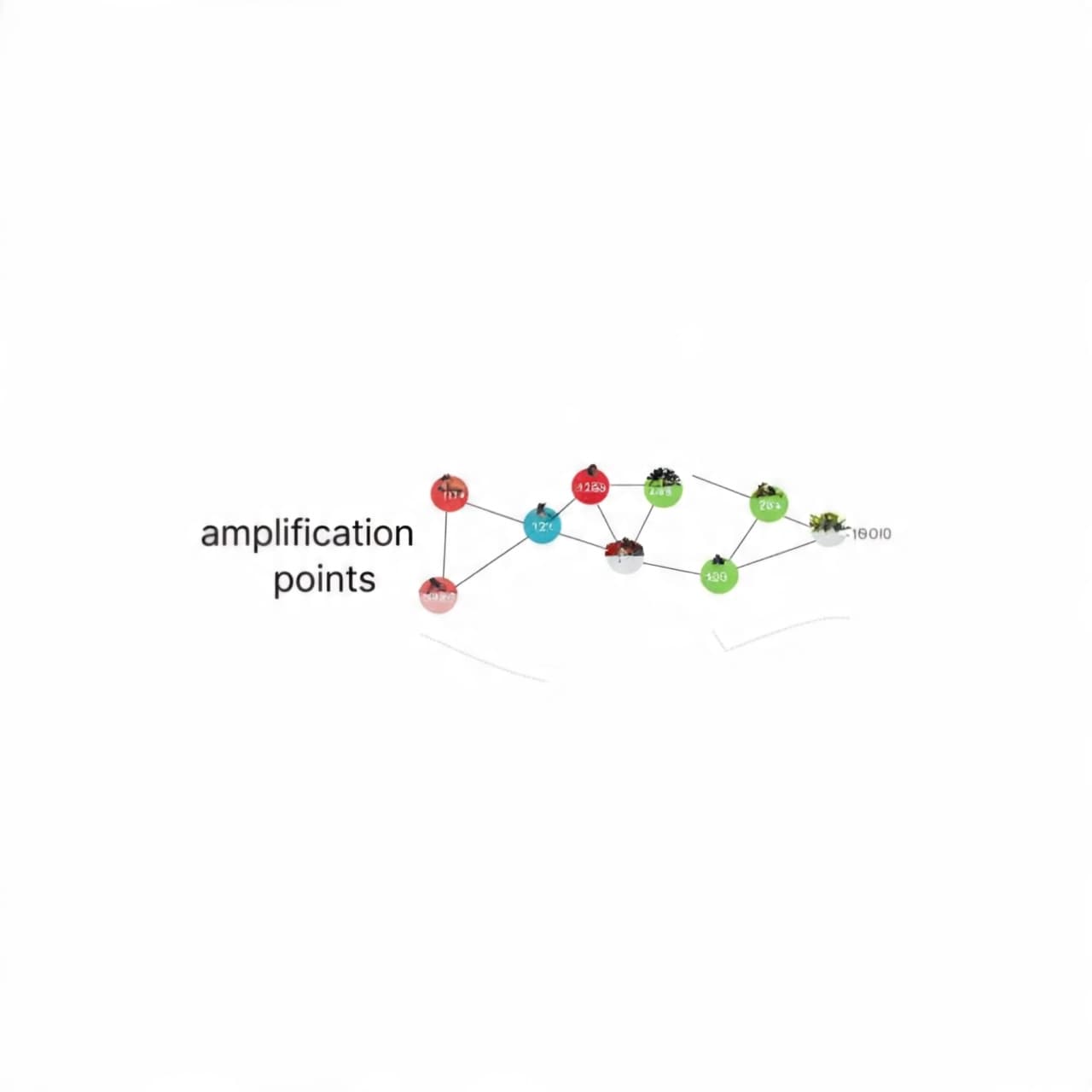
A new study involving researchers from Florida Atlantic University, the Carl von Ossietzky University of Oldenburg, and the University of California, Merced has shown that very small clusters within complex systems — known as network motifs — can play an outsized role in determining how a system responds to minor disturbances. These motifs, often involving just a few interacting parts, act not as the entire engine of stability, but as amplifiers of immediate reactions following a shock.
At the heart of the study is a question that spans disciplines: why do some systems collapse or surge suddenly after what seems like a trivial disturbance? A single transmission line failure may cascade into a widespread power outage. A delayed shipment may ripple through supply chains and empty shelves hundreds of miles away. A local spike in infection can blossom into an epidemic. Complex systems — whether ecological, infrastructural, or social — are not simply aggregates of their parts. They are architectural tapestries of connections and dependencies that often defy simple prediction.
Using mathematical models and computer simulations, the researchers tested thousands of small interaction patterns embedded within larger networks. What emerged was a surprising insight: while small clusters rarely dictate whether a system eventually remains stable or breaks down, they frequently shape how intensely a system reacts in the moments after it is perturbed. This property, known as “reactivity,” describes a system’s short-term response — a temporary surge, swing, or destabilization — even if the system is stable in the long run.
The implications echo far beyond the specific systems studied. In ecological food webs, motifs involving just two or three species can explain a large portion of sudden ecosystem responses following environmental shifts. Similarly structured interactions exist in power grids, where small patterns of nodes can influence how disturbances propagate, or in social networks, where clusters of tightly connected individuals can accelerate the spread of information or disease.
Rather than trying to map and monitor entire complex systems at once, this research suggests a more targeted approach: identify and understand those critical motifs that act as trigger points for rapid change. In practice, this could mean pinpointing vulnerable clusters in electrical networks that might initiate cascading blackouts, or recognizing subgroups in social structures that could speed the spread of misinformation or illness.
The study also underscores the subtlety of stability. A system can be stable overall, yet still susceptible to sharp, potentially disruptive reactions to small shocks. Such reactivity does not necessarily mean collapse — but it does mean that certain parts of the system can act as echo chambers, amplifying minor disturbances into significant fluctuations.
For engineers, ecologists, public health officials, and others who work with complex networks, the findings offer both a conceptual lens and a practical focus. Rather than viewing systems only in their entirety, stakeholders may benefit from understanding the microstructures that shape macro-behavior.
In analytical terms, the researchers found that these small network motifs often control immediate system response after a disturbance more than the broad network as a whole does. Identifying them could improve predictions of how systems react to minor shocks and inform strategies for mitigating cascading failures across interconnected networks of all kinds.
AI IMAGE DISCLAIMER Visuals are created with AI tools and are not real photographs.
SOURCE CHECK
Credible media reporting on this specific study exists from: Reuters BBC Associated Press Phys.org/Florida Atlantic University news release Newswise science release
Published by Banx Network. This article is part of the Banx decentralized media programme, powered by the BXE token on the XRP Ledger.


.jpg&w=3840&q=75 "Qantas Grounds Plane After Passengers Report Bedbug Bites")
