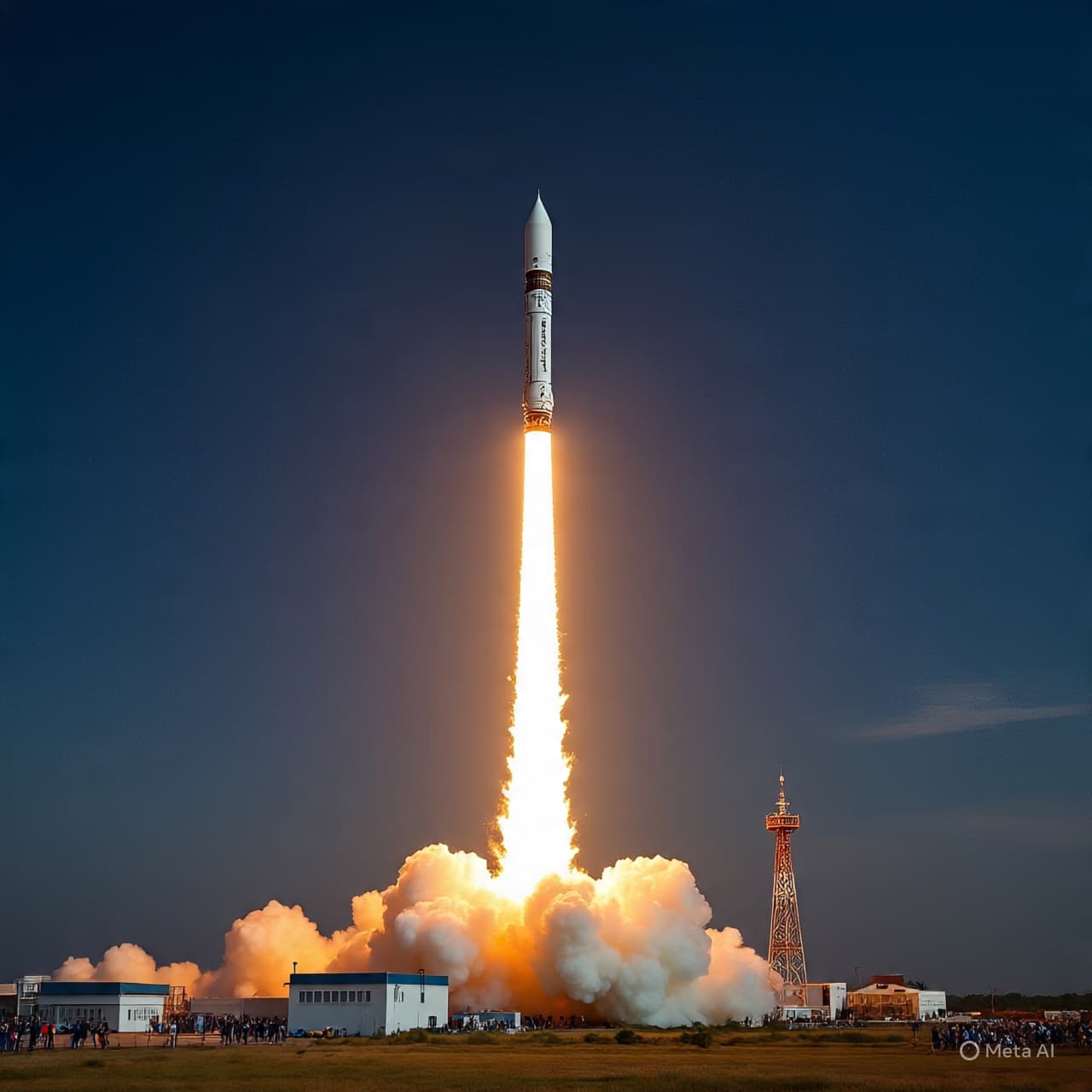
The sky has become a quiet canvas for ambition. In two corners of the world, the story of rocketry is being told anew—with different voices yet the same horizon. In Canada, the government is turning pages on the familiar narrative of imports and partnerships, choosing instead to craft a home-grown launch capability. Meanwhile, in India, a heavy satellite has lifted off, and with it a quiet yet firm declaration of self-reliance.
In Ottawa, tucked amidst defence budgets and industrial strategy, lies a modest line item: about C$182.6 million over three years to establish a sovereign space launch capability. It is not flashy, but it matters. This commitment signals a shift: access to orbit is not merely a service to be bought, but a domain to be owned and operated. A partnership between MDA Space and Maritime Launch Services, investing some CAD 10 million, further grounds that aspiration in bricks and bolts. Canada is saying: we too will build the runway to the stars.
Half a world away, in the launch pads near Sriharikota, the Indian Space Research Organisation ignited its heavy lifter and sent its heaviest ever communications satellite into orbit. The rocket soared as if not just carrying a payload, but carrying a story—one of decades, from humble beginnings to lift-off in the night. The mission doesn’t shout about dominance; it quietly affirms a capability forged through years of incremental progress.
These two moves—Canada’s industrial leap and India’s orbital stride—are different in pace and shape, but they share a common grammar: sovereignty, capability, and motion. For Canada, the canvas is still broad and mostly white: what launch services will look like, what vehicles will fly, and how the ecosystem of spaceports, ground systems and supply-chains will knit together. For India, the climb has already begun and the next ridge looms: heavier satellites, more frequent launches, ambitious targets.
Yet, neither story is without its nuances. Canada’s investment is a strategic commitment rather than a first flight. Building a spaceport on the Atlantic coast, developing a domestic value-chain and attracting global clients are long-term tasks. Some of the partnerships are nascent; the runway is still being laid. On the Indian side, the success of launching a heavier satellite is real and meaningful—but the global space stage is crowded, competition stiff, and the next targets (deep-space, crewed missions, large constellations) will test resilience.
Still, there is something poetic in the symmetry. One country planting seeds of launch capacity, the other reaping a harvest of satellite heft. Both pointing skyward, as if to say: our place is not just down here, but up there in orbit too. And as the silence of space opens its doors, those who build the access, and those who lift the payloads, both take their seats in the gallery of nations.
In that sense, this is not just about rockets. It is about identity, about agency, about who pulls the trigger and who rides the vehicle. Canada asking: “Can we launch from our land?” India answering: “We did—and we will lift more.” The sky may look the same for all of us, but the ways in which we approach it tell distinct stories.
Canada’s step toward a domestic orbital launch capacity and India’s successful deployment of its heaviest satellite mark two meaningful movements in the global space-ecosystem. Both reflect ambition molded into action, each in its own cultural and strategic context. As these journeys progress, they will shape not just the rockets and satellites, but the roles these nations play in the expanding theatre of space access.
AI Image Disclaimer: “Visuals are created with AI tools and are not real photographs.”
Sources: Ars Technica, SpaceQ, Economic Times, Phys.org, Satellite Today
Published by Banx Network. This article is part of the Banx decentralized media programme, powered by the BXE token on the XRP Ledger.