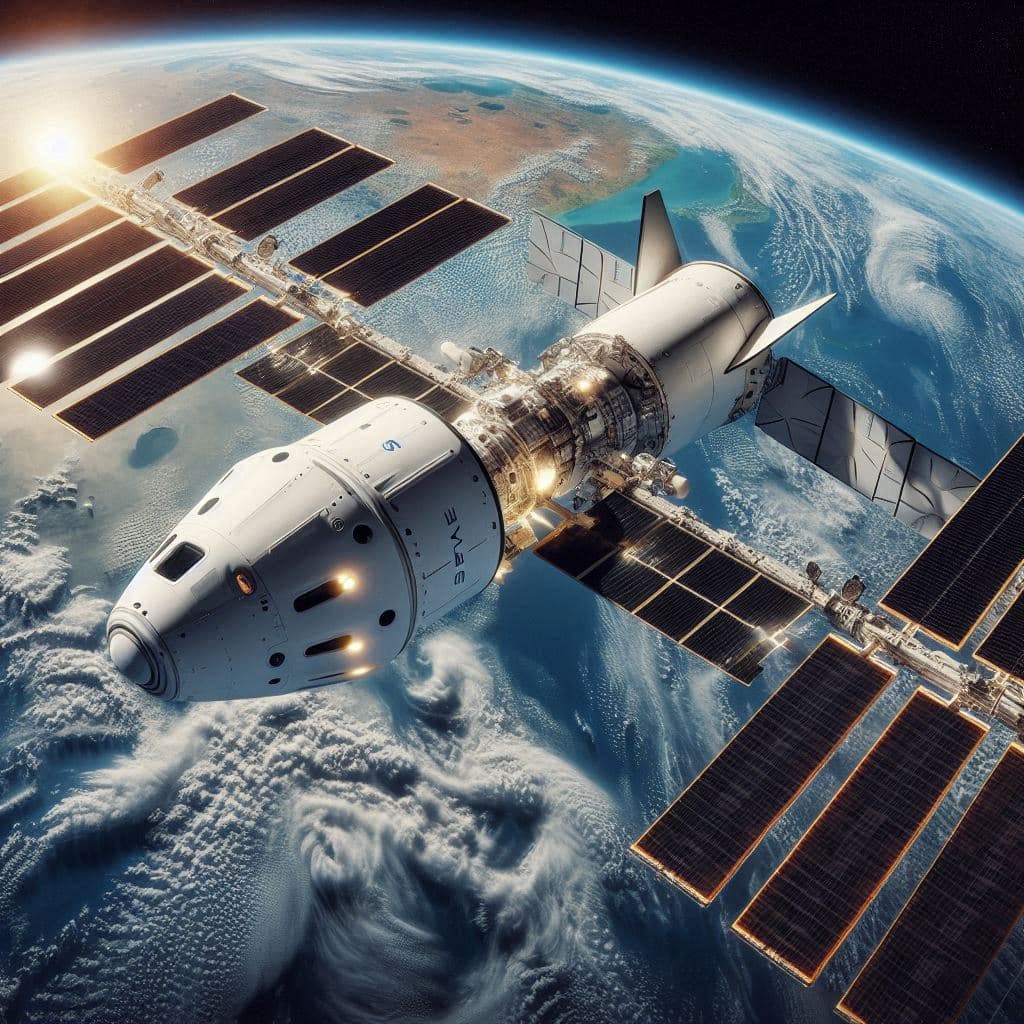
There are moments in human history that unfold like the silent turning of a page — we do not always hear the rustle, yet the world feels different afterward. In the realm just beyond our blue horizon, the orbiting International Space Station has been such a page for decades: a quiet laboratory suspended above Earth, a testament to collaboration between nations, and a waystation toward deeper exploration. Lately, however, new chapters are being written not from government corridors alone, but from private ventures eager to help define what tomorrow’s space economy might become.
In recent years, NASA’s invitation to commercial partners to carry private astronaut missions to the ISS has brought an unexpected rhythm to the station’s schedule. For companies like Houston-based Axiom Space, it has been an opportunity to transform long-held dreams into repeated reality. Since its first private crew flight to the ISS in 2022, Axiom has flown four chartered missions of private astronauts, blending seasoned space veterans with international explorers for days spent in microgravity, scientific experimentation, and human connection to Earth below.
This work has not only created revenue streams and experience for private actors, it has also showcased how the orbiting laboratory — once the exclusive realm of national space agencies — can support broader participation. NASA’s recent selection of Axiom for a fifth private astronaut mission, expected no earlier than January 2027, reinforces that reality. In this selection, the agency once again chose a partner with the deepest track record in commercial human spaceflight over newer entrants.
Still, at the edge of what is known, another voice aspires to join the chorus. Vast — a California-based startup — is finalizing plans for its own commercial space station module called Haven-1, slated to launch in 2026 and designed from the ground up for research and manufacturing in orbit. While it has not yet secured a NASA charter to fly private astronauts to the ISS, the company has invited researchers to propose experiments for its own upcoming platform — a sign of competition and diversification in a once very narrow field.
It is worth noting that these private missions are not simply about tourism but about expanding human presence in low Earth orbit, fostering scientific research, and training the next wave of operators. NASA’s continued encouragement of private astronaut missions — now planning for both fifth and sixth flights — shows a strategic shift: the agency sees its role not solely as conductor, but as enabler of a symphony with many instruments.
This interplay between experience and innovation, between well-traveled organizations and ambitious newcomers, mirrors the broader story of human progress: backward glances at what worked, forward leaps toward what might. Above the blue curve of our planet, the ISS will eventually complete its mission around 2030, and the space above may feel both familiar and transformed by then. Whatever comes next — whether modules built by pioneers like Axiom become hives of work and exploration, or new stations built by newcomers like Vast take up the mantle — the story will carry the cumulative hopes of those still lifting their eyes upward.
Across those kilometers of emptiness, private dreams and public foresight are quietly shaping the orbit where Earth meets the stars
AI Image Disclaimer
Visuals are created with AI tools and are not real photographs.
---
Sources
NASA official releases (NASA)
Aviation Week Network
AP News
Times of India
Space.com / SpaceNews
Published by Banx Network. This article is part of the Banx decentralized media programme, powered by the BXE token on the XRP Ledger.