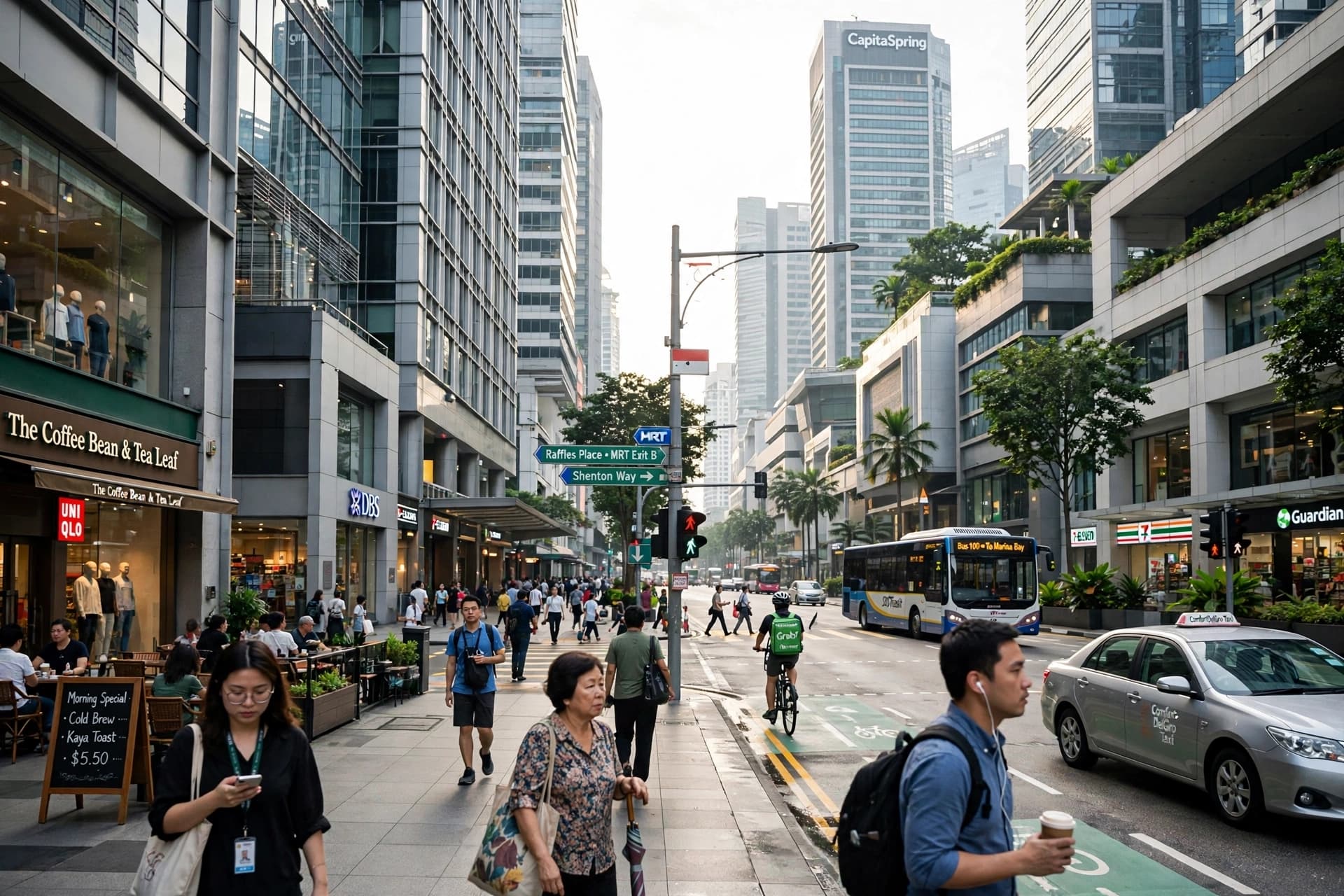
There are moments when the movement of an economy can be felt without appearing on a stock exchange screen. It can arrive quietly in a meal, a train journey, a pair of shoes in a shop window, or the price of a service that once seemed unchanged. In Singapore, August brought one of those moments, as the latest inflation figures showed prices continuing to move upward.
Singapore’s core inflation rose to 2.2 percent year-on-year in August, up from 2 percent in July, according to figures released by the Monetary Authority of Singapore and the Ministry of Trade and Industry on Sept. 23. The reading marked the highest level since September 2024, placing another small marker in the country’s evolving economic landscape.
The increase was not driven by one single corner of the economy. Services inflation climbed to 2 percent from 1.7 percent in July, with airfares and point-to-point transport services contributing to the change. Retail and other goods inflation also rose, reaching 1.8 percent from 1.4 percent a month earlier, as prices for clothing, footwear, and personal care products increased.
Food prices moved in the same direction, although more modestly. Food inflation reached 2.3 percent in August, compared with 2.2 percent in July. The increase reflected higher food services inflation even as prices for non-cooked food moderated, creating a mixed picture beneath what might otherwise appear to be a simple upward line.
Elsewhere, some parts of the household cost picture remained relatively steady. Accommodation inflation stayed at 0.8 percent, while electricity and gas inflation remained at 8.7 percent. The authorities noted that electricity tariff movements were influenced in part by higher global energy prices recorded earlier in the year.
The broader consumer price index, which includes accommodation and private transport, rose 2.3 percent year-on-year in August from 2.2 percent in July. On a month-to-month basis, overall consumer prices increased 0.6 percent, while core prices rose 0.3 percent.
Private transport offered a different direction. Inflation in that category eased to 7.5 percent in August from 8 percent in July, reflecting a smaller increase in car prices. The movement meant that weaker private transport pressures partly offset the broader rise coming from core components of household consumption.
For people moving through Singapore’s dense urban landscape, these numbers are ultimately more than percentages. They describe the changing background against which businesses set prices and households make daily choices. A slightly more expensive service, a higher restaurant bill, or a change in retail prices can each seem small when viewed separately, yet together they form the wider rhythm captured by inflation data.
The August figures therefore leave Singapore with a picture of renewed price pressure, particularly across services, retail goods, and food. Official data showed the core measure at 2.2 percent and headline inflation at 2.3 percent, giving policymakers and businesses another set of figures to watch as the economy moves toward the final months of 2026.
Image Disclaimer Visuals are AI-generated conceptual representations and do not depict actual photographs.
Sources Channel NewsAsia Ministry of Trade and Industry Singapore The Straits Times The Business Times
Published by Banx Network. This article is part of the Banx decentralized media programme, powered by the BXE token on the XRP Ledger.