There are moments in astronomy when the universe seems to lean in and quietly unsettle our confidence. For decades, planet formation has been described as a patient, orderly process: dust grains gathering in protoplanetary disks, colliding, clumping, and slowly assembling into worlds. The story has felt almost architectural—layer by layer, orbit by orbit. Yet every so often, the cosmos introduces a curveball.
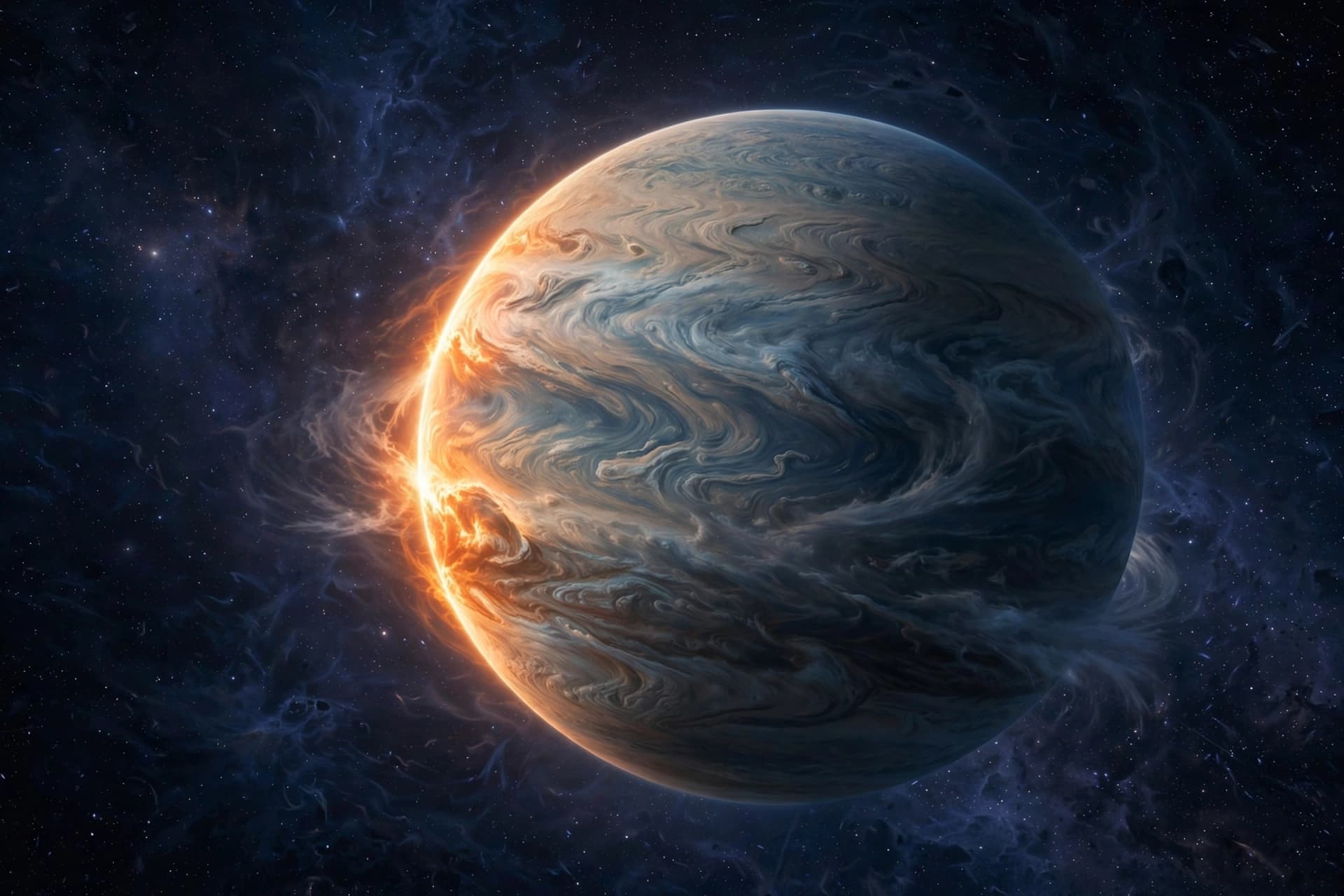
A newly studied distant planetary system is now prompting scientists to reconsider aspects of long-standing planet-formation theory. Observations suggest that the system’s structure does not fully align with conventional models, which typically predict how planets should form and settle within a young star’s surrounding disk of gas and dust.
At the heart of the discussion is a star encircled by planets in configurations that challenge expectations—either by their unexpected mass, their orbital spacing, or their surprising proximity or distance from their host star. Standard core accretion models propose that rocky planets form closer to stars, where heavier materials can condense, while gas giants emerge farther out, where icy materials accumulate and rapidly attract thick atmospheres. Over time, migration can shift these worlds inward or outward, but usually within certain predictable bounds.
In this distant system, however, astronomers report characteristics that strain these boundaries. Some planets appear larger or more massive than anticipated for their location, while others orbit in patterns that suggest either unusually rapid formation or dramatic early migration. Data gathered from advanced telescopes and spectroscopic analysis indicate that the protoplanetary disk may have behaved differently than theory typically assumes.
Researchers emphasize that this does not overturn planet-formation science, but it does introduce complexity. Protoplanetary disks are not uniform environments; they are dynamic systems influenced by turbulence, magnetic fields, radiation pressure, and gravitational interactions. Variations in disk density or temperature gradients can alter how quickly planetary cores accumulate mass. In some scenarios, pebble accretion—a process where small solid particles rapidly build planetary embryos—may accelerate growth beyond traditional timelines.
The distant system also raises questions about disk instability models, an alternative theory in which large clumps of gas collapse directly under gravity to form giant planets. While core accretion has remained the dominant explanation for many observed systems, evidence from this new case hints that multiple formation pathways may operate simultaneously across the galaxy.
Astronomers rely on increasingly sensitive instruments to detect subtle gravitational wobbles, faint light dips, and chemical signatures in starlight. Each new exoplanet discovery refines statistical models, gradually revealing how diverse planetary architectures truly are. The more systems scientists catalog, the clearer it becomes that our own solar system may represent just one variation among countless arrangements.
Importantly, the findings underscore a broader theme in astrophysics: theory evolves alongside observation. Planet-formation models are built upon physics that remains sound, but their parameters must accommodate emerging data. What once seemed a narrow pathway may, in fact, be a spectrum of possibilities shaped by local conditions.
The distant system’s unexpected features encourage further modeling and follow-up observations. Researchers aim to determine whether it represents a rare anomaly or a more common pattern that has simply gone undetected until now. As next-generation telescopes expand detection capabilities, more such curveballs may emerge.
For now, scientists report that while prevailing planet-formation theories remain foundational, this distant system invites refinement. Additional studies are planned to examine disk composition, orbital stability, and planetary mass estimates more closely.
The universe has always been generous with surprises. In its distant systems, we are reminded that formation is not a single script but a collection of unfolding stories—each shaped by gravity, dust, and time.
AI Image Disclaimer: Graphics are AI-generated and intended for representation, not reality.
Sources: BBC Nature Science The Guardian Scientific American
Published by Banx Network. This article is part of the Banx decentralized media programme, powered by the BXE token on the XRP Ledger.