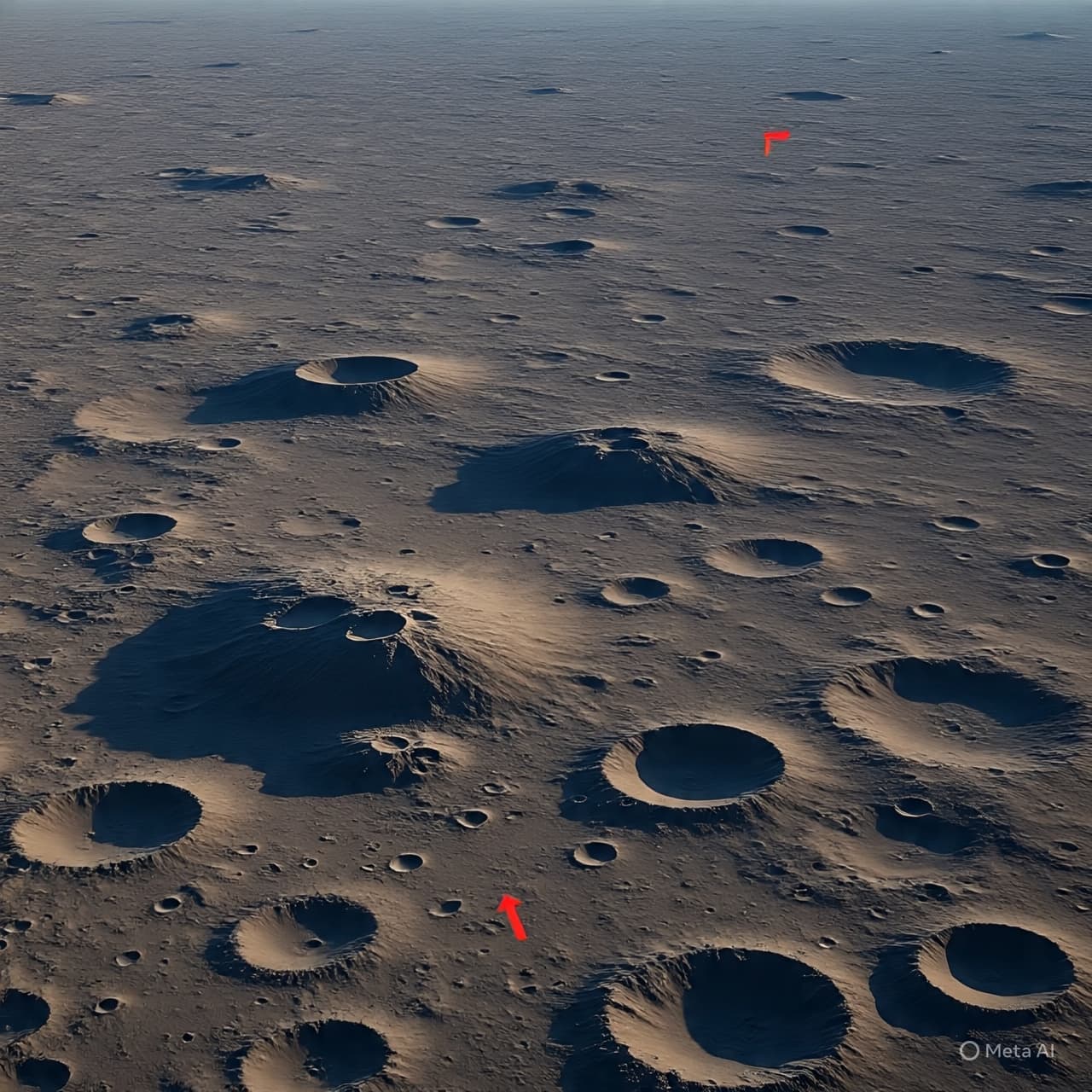
In the quiet sweep of the Moon’s Oceanus Procellarum, where ancient lava plains stretch toward unseen horizons, a whisper from history may have finally been heard again. For six decades, the humble metal sphere of Luna 9 — the first craft ever to land softly on another world — rested somewhere beneath dusty regolith, remembered in texts and photographs but unseen in the orbiting gaze of modern spacecraft. Now, researchers combing high-resolution lunar imagery with the meticulous patience of cartographers and the ingenuity of artificial intelligence think they may have glimpsed its resting place at last.
When Luna 9 touched down on the Moon in February 1966, it marked a quiet triumph in human exploration, sending back the first gentle panoramas of lunar soil and proving that safe landing on another celestial body was possible. Yet the exact location of that historic landing site remained a mystery, its coordinates only roughly known and lost amid the vast tapestry of the lunar surface. For decades, orbiters like NASA’s Lunar Reconnaissance Orbiter (LRO) have captured detailed maps of the Moon, revealing Apollo sites and robotic footprints — all except the tiny Soviet sphere that first opened a new chapter in space history.
In a blend of modern technology and exploratory spirit, scientists from the United Kingdom and Japan trained a machine-learning system known as YOLO-ETA — short for “You Only Look Once — Extraterrestrial Artifact” — to sift through the enormous image library collected by LRO. By teaching the algorithm what human-made landers look like in orbital photos, the team identified a cluster of promising artifacts near the expected landing area, little bright pixels and surface features that may mark spacecraft hardware and the disturbed soil around it.
These findings have stirred cautious excitement. While they do not yet constitute irrefutable proof, they provide credible candidate locations for targeted follow-up imaging by orbiters such as India’s Chandrayaan-2, which carries even higher-resolution cameras. If confirmed, the images will not just pinpoint where Luna 9 came to rest but will add a tangible waypoint to the story of humanity’s early steps on the Moon.
Across the scientific community, the search embodies a bridge between eras — from the dawn of lunar exploration during the Cold War to today’s age of open data and shared curiosity. What was once a footnote in space history may soon be a rediscovered artifact, a reminder that even in places long studied, surprises still wait in silent craters and sun-bleached plains.
AI Image Disclaimer “Visuals are AI-generated illustrations, meant for concept only.”
Source Check This article is based on reporting from IFLScience, ChosunBiz, Forbes, Phys.org, and The Debrief, covering recent developments in identifying the potential lunar landing site of the Luna 9 spacecraft and the use of AI in that search.
Published by Banx Network. This article is part of the Banx decentralized media programme, powered by the BXE token on the XRP Ledger.