Earth's crust moves with extraordinary patience, storing energy over centuries before releasing it in moments that reshape landscapes and deepen scientific understanding. Beneath the forests of the Pacific Northwest and along the rugged coastline of western North America, immense tectonic plates continue their slow and nearly invisible motion. A new study suggests that these distant geological systems may be more closely connected than previously understood, raising fresh questions about how one major earthquake could influence another far away.
Researchers have found evidence indicating that a powerful earthquake originating within the Cascadia Subduction Zone could alter stress conditions along portions of California's San Andreas Fault. Rather than suggesting that one event would immediately cause another, the study proposes that significant changes in underground stress may increase the likelihood of future seismic activity under specific geological circumstances.
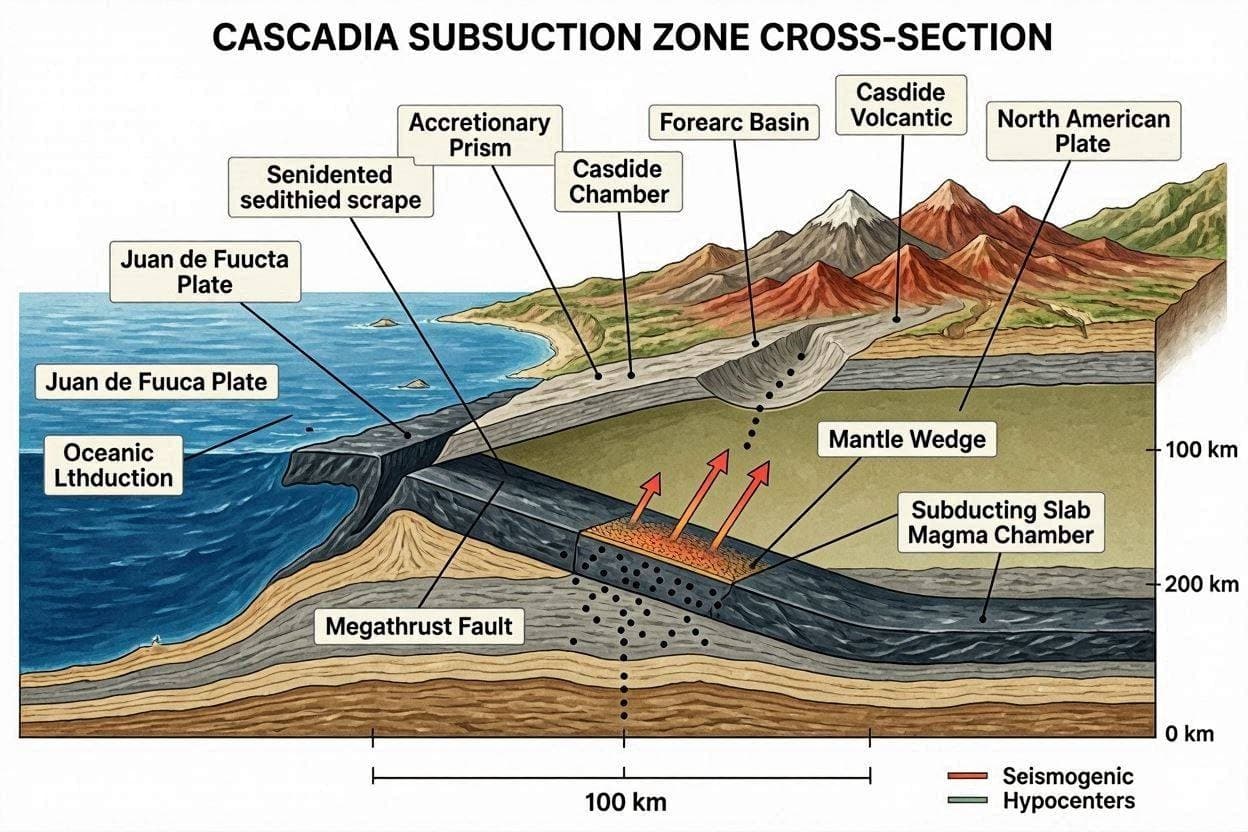
The Cascadia Subduction Zone stretches from northern California through Oregon and Washington into British Columbia. It marks the boundary where the Juan de Fuca Plate slowly descends beneath the North American Plate. Geological records indicate that this region is capable of producing very large megathrust earthquakes, including an event estimated to have occurred in the year 1700.
The San Andreas Fault, meanwhile, is a separate tectonic system extending through much of California. It forms the boundary between the Pacific Plate and the North American Plate and has generated numerous significant earthquakes throughout recorded history. Although the two fault systems differ in structure and behavior, researchers continue investigating whether stress changes from one region can influence another over considerable distances.
Using advanced computer simulations, geological records, and seismic modeling, scientists examined how stress released during a major Cascadia earthquake might redistribute forces throughout western North America. Their models suggest that some segments of the San Andreas Fault could experience measurable stress changes following a very large Cascadia event. Researchers emphasize that this represents a long-term geological interaction rather than a precise prediction of when or where another earthquake would occur.
Seismologists caution that earthquake forecasting remains one of the most challenging areas of Earth science. While researchers can estimate long-term probabilities based on historical records and tectonic behavior, no current scientific method can accurately predict the exact timing, location, or magnitude of future earthquakes. Studies like this instead improve understanding of how complex fault systems interact over time.
The findings may contribute to improved seismic hazard assessments and emergency preparedness planning. Engineers, emergency management agencies, and public officials rely on evolving scientific knowledge when updating building standards, disaster response strategies, and public education programs in earthquake-prone regions. Better understanding of fault interactions helps refine these long-term planning efforts.
Researchers plan to continue studying the relationship between Cascadia and the San Andreas Fault using additional geological evidence, expanded computer modeling, and new seismic observations. While many questions remain, the study provides another valuable perspective on the interconnected nature of Earth's tectonic systems and reinforces the importance of continued scientific investigation into one of the planet's most powerful natural processes.
AI Image Disclaimer: The accompanying illustrations are AI-generated scientific visualizations created to represent tectonic processes and earthquake research. They are intended for educational purposes and are not actual geological observations.
Sources: ScienceDaily; U.S. Geological Survey (USGS); Seismological Society of America (SSA); Nature Geoscience
Published by Banx Network. This article is part of the Banx decentralized media programme, powered by the BXE token on the XRP Ledger.