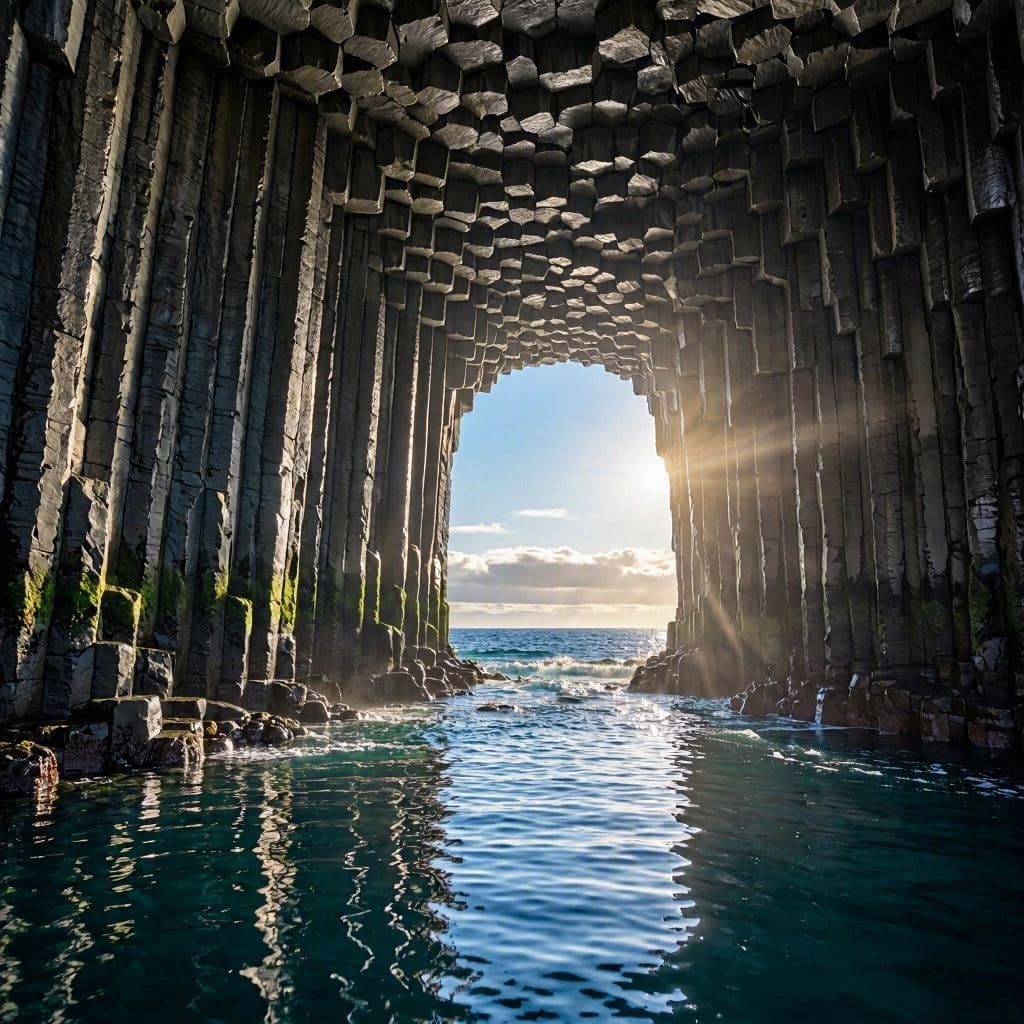
Nature is often described as the greatest artist, sculpting landscapes with patience and power that human hands can only emulate. On the rugged coast of the Isle of Staffa in Scotland, the Atlantic Ocean has spent millions of years carving a masterpiece from basalt columns. Fingal’s Cave, with its hexagonal pillars and cathedral-like arch, stands as a testament to this geological artistry. It is a place where the boundary between the earth and the sea blurs, creating a natural amphitheater that has inspired awe for centuries.
The cave’s formation dates back approximately 60 million years, born from ancient volcanic activity that cooled into distinctive geometric patterns. These basalt columns rise from the water like organ pipes, waiting for a musician to play them. The sea swells in and out of the cavern, creating a rhythmic resonance that echoes off the stone walls. This natural acoustic phenomenon transforms the raw power of the ocean into a haunting melody, audible to anyone who ventures inside.
In 1829, the young composer Felix Mendelssohn visited this remote wonder during his tour of Britain and Ireland. He was not merely a tourist but a seeker of inspiration, drawn to the sublime beauty of the Scottish landscape. Upon entering Fingal’s Cave, he was struck by the interplay of light, sound, and stone. The atmosphere was unlike anything he had experienced in the concert halls of Europe, offering a raw, unfiltered connection to the elements.
The experience left an indelible mark on Mendelssohn’s creative spirit. He reportedly returned from the cave with the opening notes of what would become his famous "Hebrides Overture" already forming in his mind. The music captures the rolling motion of the waves and the grandeur of the cliffs, translating the visual and auditory spectacle into a symphonic narrative. It is a rare instance where a specific location directly birthed a enduring piece of classical music.
The "Hebrides Overture," also known as "Fingal’s Cave," remains one of Mendelssohn’s most celebrated works. It evokes the mood of the place rather than depicting it literally, using sweeping melodies to mirror the vastness of the sea. Listeners today can still hear the echo of those basalt columns in the orchestration, a sonic bridge between the 19th century and the present. The piece serves as a cultural artifact, preserving the memory of the cave’s unique ambiance.
Visiting Fingal’s Cave today requires a boat journey across often choppy waters, adding to the sense of pilgrimage. Tourists brave the elements to witness the site that inspired a musical genius. The journey itself becomes part of the experience, mirroring the effort required to reach such secluded beauties. Once inside, the silence between the waves allows for reflection, inviting visitors to listen as Mendelssohn did.
The preservation of such natural sites is crucial for both ecological and cultural reasons. They serve as reminders of the planet’s dynamic history and its capacity to inspire human creativity. Protecting Fingal’s Cave ensures that future generations can experience the same sense of wonder that captivated a young composer nearly two centuries ago. It is a shared heritage of geology and art.
Fingal’s Cave remains a powerful symbol of the intersection between nature and culture. Through Mendelssohn’s music, the acoustic beauty of this volcanic formation continues to resonate, reminding us that inspiration can be found in the most unexpected and majestic corners of the world.
AI Image Disclaimer: The visual representations accompanying this article are generated by artificial intelligence to illustrate the natural beauty of the location.
Sources: National Trust for Scotland BBC History Classic FM
Published by Banx Network. This article is part of the Banx decentralized media programme, powered by the BXE token on the XRP Ledger.