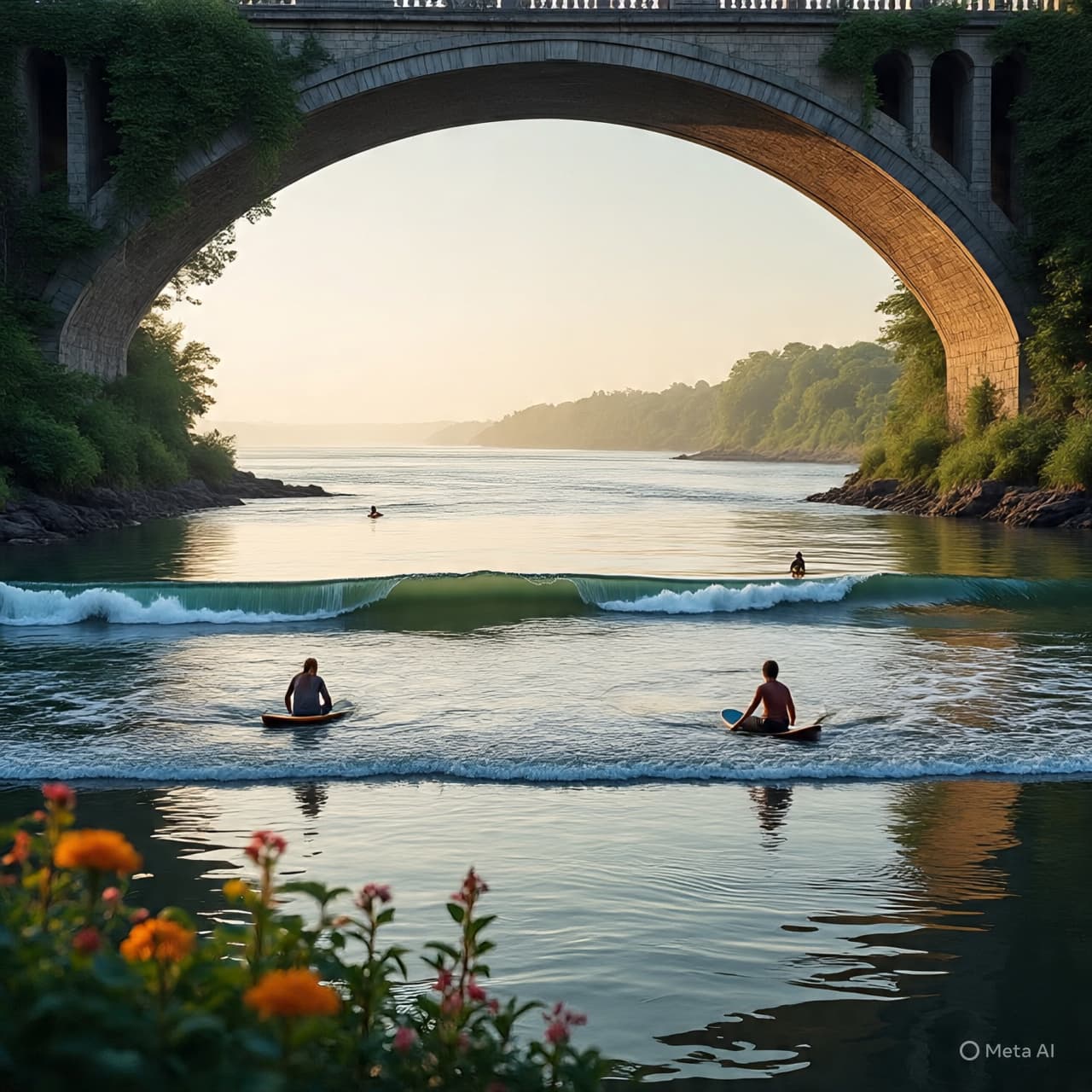
Munich, long celebrated as an unlikely inland surfing hotspot, is reeling after one of its most cherished sensations vanished almost overnight. The Eisbachwelle — that narrow but powerful standing wave flowing through the city’s English Garden — has all but disappeared following a routine river cleanup, leaving local surfers stunned, disoriented, and deeply nostalgic.
This wave wasn’t just water flowing over concrete. It was a rite of passage for those who dared to surf in a landlocked city. With its roughly 1.5-meter height and three distinct sections, the Eisbachwelle was notoriously challenging — a place where only the most experienced could hold their line, yet also a magnet for dreamers who came not just to ride, but to feel something larger than themselves in a fast, cold stream.
Then came the dredging. As city engineers drained and cleaned the bottom of the Eisbach canal, they removed more than just silt. They stripped away key underwater formations — the “bump” of sediment that helped shape the standing wave. What emerged afterward was not the sculpted, powerful swell surfers knew, but a bland ripple — a whitewater bump devoid of surfable character. For Jakob Netzer, a longtime surfer on the site, the change is heartbreaking. He remembers jumping into the E1 section under moonlight, navigating its churning flow with the confidence born of countless sessions. That thrill, he says now, is gone. The once-iconic three-part configuration has flattened; no more smooth transition, no more graceful curves — just a tamed, unrecognizable stream.
Hydrology experts weighing in on the issue say the cause is painfully straightforward: a delicate hydraulic balance was disrupted. The wave depended on a precise combination of fast-moving water and a designed underwater bump. Markus Disse, a hydrology professor, suggested one solution could be experimenting with water flow, perhaps reducing discharge temporarily to rebuild the wave.Another possibility: restoring sediment by dumping gravel into the canal to recreate that lost structure.
Meanwhile, the city has hired an engineering team to map the riverbed, using GPS and sonar to understand exactly how the river’s contour changed. Surfers are watching closely, hopeful but impatient. In a desperate bid to revive the wave, a group once submerged a wooden ramp overnight at the old wave site — for one day, the wave returned. But authorities removed the structure, calling it illegal.
To many, the disappearance of the Eisbachwelle isn’t just a technical loss — it’s a blow to Munich’s spirit. The wave has long been part of the city’s identity, a symbol of subcultural freedom in the heart of urban life. Munich tourism officials say they view it as a “globally unique attraction,” and they’re pressing to restore it quickly.
Published by Banx Network. This article is part of the Banx decentralized media programme, powered by the BXE token on the XRP Ledger.