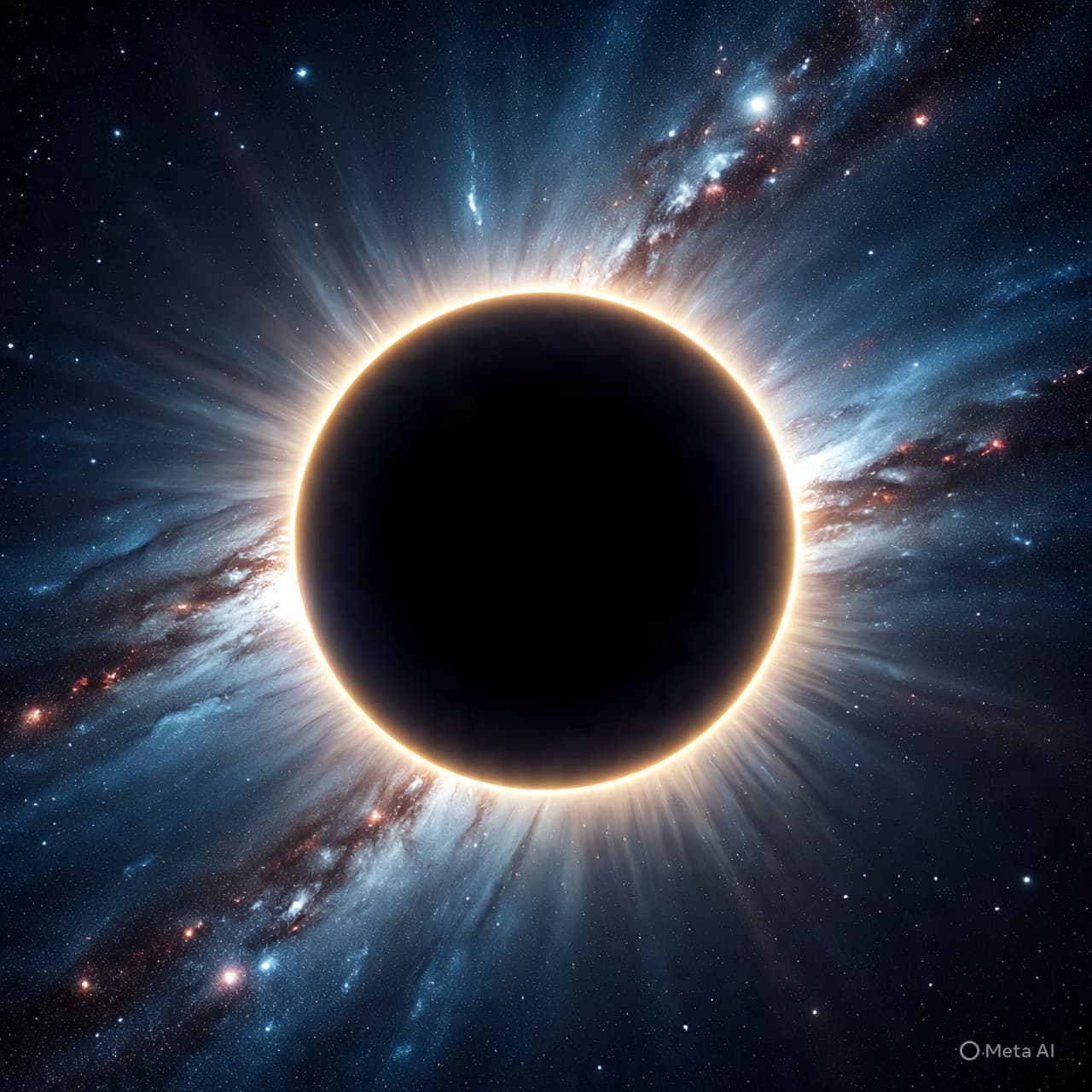
In the silent depths of space, where gravity bends light and time itself softens at the edges, black holes do not simply consume—they converse. Not in words, of course, but in rhythms. Around them, matter circles in luminous spirals, tracing invisible lines of force. And in those spirals, scientists have begun to detect something subtle yet telling: shifts in orbital frequencies that reveal the quirks of these gravitational giants.
Black holes are often described as cosmic endpoints, but they are also dynamic laboratories. As gas and stellar debris fall toward a black hole, they form an accretion disk—a rotating structure heated to extreme temperatures. Within this disk, matter does not orbit in simple, predictable paths. Instead, it vibrates, oscillates, and sometimes flickers in repeating patterns known as quasi-periodic oscillations.
Using data from advanced observatories such as and , astronomers have measured small but significant shifts in these orbital frequencies. These variations are not random. They appear tied to the black hole’s mass, spin, and the geometry of space-time itself.
One of the most intriguing aspects of these findings is how they reflect predictions from Einstein’s theory of general relativity. Near a black hole, gravity is so intense that space and time warp dramatically. This warping affects how matter moves. As material spirals inward, its orbital frequency can change due to frame-dragging—a phenomenon where a spinning black hole pulls space-time along with it.
The observed frequency shifts offer a kind of indirect map. By analyzing them, scientists can estimate how fast a black hole is spinning and how its gravitational field shapes the surrounding environment. It is a method of listening rather than looking—interpreting cosmic vibrations to understand an object that cannot be seen directly.
Recent research has highlighted that some black holes exhibit more complex frequency patterns than previously anticipated. Instead of a single stable oscillation, multiple frequencies can appear and interact. These layered rhythms suggest that the inner accretion disk may tilt, wobble, or undergo subtle instabilities under extreme gravitational stress.
The implications are gentle yet significant. If orbital frequency shifts can be measured with increasing precision, they may serve as tools for testing fundamental physics in the strongest gravitational fields known. They could also refine models of how black holes grow and how they influence the galaxies that host them.
Importantly, scientists emphasize that these observations are part of an evolving picture. Data interpretation requires careful modeling, and alternative explanations—such as magnetic turbulence within the disk—are also being explored. The universe rarely offers simple answers, especially in regions where gravity reigns supreme.
Even so, the rhythm of matter circling a black hole provides a rare opportunity. In those shifting frequencies lies evidence that the cosmos remains both lawful and surprising. The quirks are not contradictions, but signatures—small deviations that illuminate immense forces.
As telescopes and analytical techniques continue to improve, astronomers expect to refine these measurements further. For now, the discovery of orbital frequency shifts adds nuance to our understanding of black holes, suggesting that even in the darkest corners of space, motion carries meaning.
AI Image Disclaimer Visuals are created with AI tools and are not real photographs.
Source Check — Credible Media Coverage Exists:
BBC The Guardian The New York Times Nature News Science Magazine
Published by Banx Network. This article is part of the Banx decentralized media programme, powered by the BXE token on the XRP Ledger.