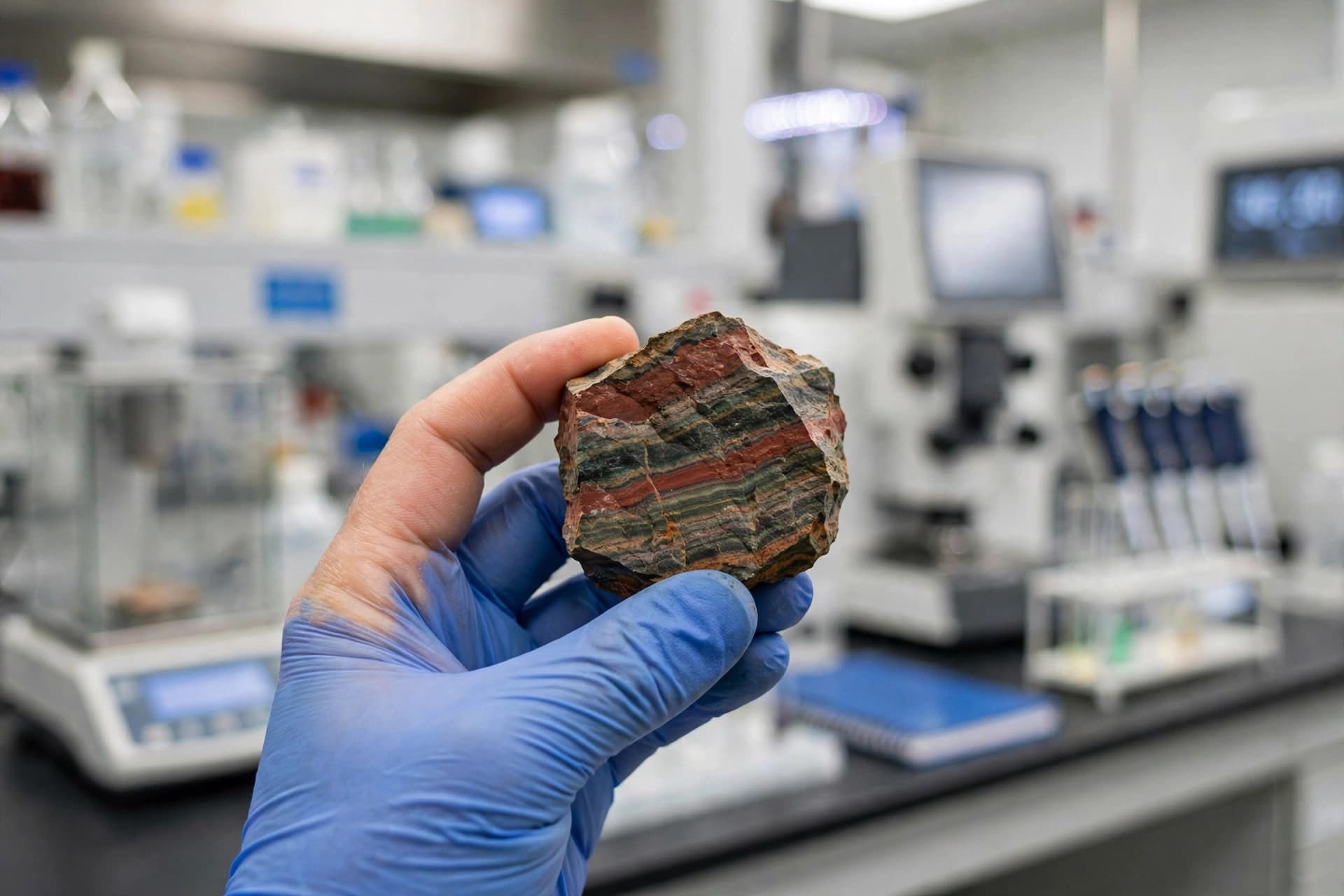
Time is usually something we measure. It ticks in the quiet circuitry of quartz watches, hums in atomic transitions, and pulses in the regular swing of pendulums. Magnetism, by contrast, feels anchored in space—a fixed orientation of spins, north meeting south in patient alignment. Yet in laboratories where materials are thinned to the scale of atoms, these two ideas are beginning to overlap in unexpected ways.
Physicists have now reported evidence of what they describe as “clock magnetism” in an ultra-thin crystal, a phenomenon in which magnetic states rotate through distinct orientations in a repeating, clock-like sequence. Rather than remaining static, as magnets typically do at equilibrium, the magnetic order cycles through multiple stable configurations over time.
The discovery emerges from research into two-dimensional materials—crystals just a few atoms thick. In such constrained geometries, quantum effects become pronounced. Electron spins, which generate magnetism, are more sensitive to subtle interactions. Under certain conditions, the spins do not simply align or oppose; they adopt patterns shaped by the crystal’s symmetry and external influences such as temperature, strain, or applied fields.
In the reported experiments, scientists observed that the thin crystal’s magnetic moments could shift between discrete orientations separated by equal angular steps—much like the positions of numbers on a clock face. Instead of a continuous rotation, the system transitions in defined increments, creating a temporal pattern that repeats predictably. This behavior reflects a delicate interplay between the material’s internal lattice symmetry and competing magnetic forces.
Such clock-like ordering is not entirely without precedent in theoretical physics. Models have long suggested the possibility of “clock phases,” where discrete rotational symmetries govern magnetic alignment. What distinguishes this recent work is the experimental realization within a tangible, atomically thin crystal—bringing abstract models into laboratory reality.
The implications extend beyond conceptual elegance. Two-dimensional magnetic materials are already being explored for next-generation electronics and spintronics, where information is encoded not only in electrical charge but also in electron spin. A material capable of switching between multiple stable magnetic states in a controlled sequence could offer new ways to design memory devices or logic components. The discrete steps of clock magnetism may provide enhanced stability against random fluctuations, a desirable feature at nanoscale dimensions.
There is also a broader theoretical resonance. Magnetism is often described as a ground-state property—a system settling into its lowest energy configuration. Clock magnetism suggests a richer landscape, where multiple nearly equivalent states coexist, and transitions among them can be orchestrated. It hints at time becoming woven more visibly into the behavior of magnetic order itself.
The thin crystal at the center of the study remains a platform for further investigation. Researchers are now examining how external stimuli—light pulses, electric currents, or pressure—might tune or accelerate the transitions between magnetic orientations. If controllable, such dynamics could deepen understanding of quantum materials and open technological pathways.
For now, the finding stands as a careful advance in condensed matter physics. It demonstrates that even in systems only atoms thick, complexity persists. Magnetism, long thought of as steady and directional, can move in measured steps, echoing the rhythm of a clock.
In straightforward terms, physicists have experimentally observed a clock-like magnetic phase in a thin crystalline material, confirming theoretical predictions and highlighting potential applications in future spin-based devices. Further experiments are planned to explore how robust and controllable this phenomenon may be under practical conditions.
AI Image Disclaimer Illustrations were produced with AI and serve as conceptual depictions.
Sources Nature Science Phys.org ScienceDaily MIT Technology Review
Published by Banx Network. This article is part of the Banx decentralized media programme, powered by the BXE token on the XRP Ledger.