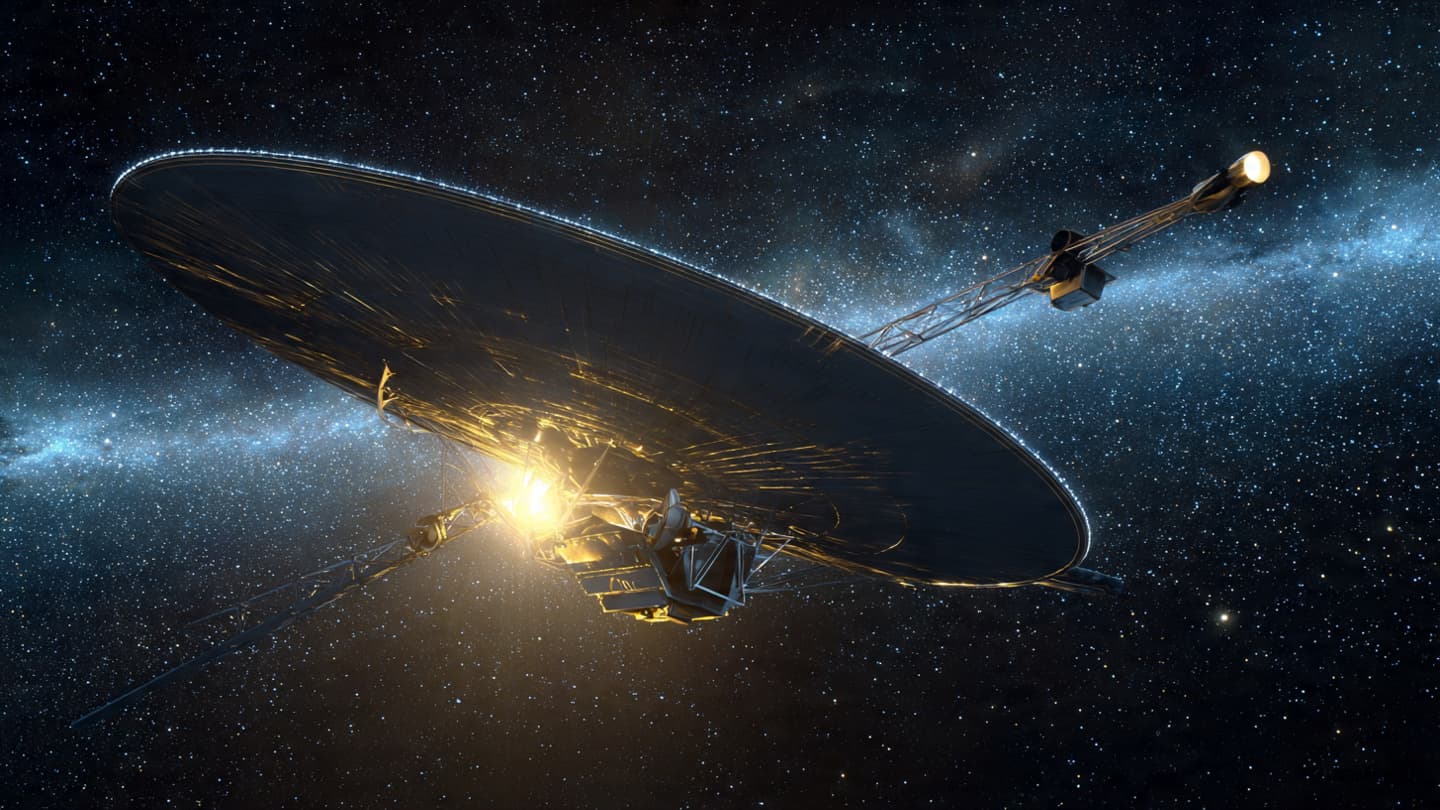
In the vast stillness beyond the planets, two small spacecraft continue their journey outward, carrying with them a message that feels less like instruction and more like memory. The Voyager probes, launched in 1977, hold within them the Golden Record—a carefully curated expression of Earth’s sounds, languages, and imagination.
The Golden Records aboard NASA’s Voyager 1 and Voyager 2 were designed as time capsules intended for any future intelligence that might encounter them. They include greetings spoken in 55 languages, natural sounds from Earth, and curated musical selections representing diverse human cultures.
Among the most discussed elements are recordings such as whale songs, symbolic of Earth’s marine life, and a sequence of human brainwave data recorded during an emotional state of love, intended to convey not just information but human experience in its most abstract form.
These records were developed under the guidance of a team led by figures including Carl Sagan and Ann Druyan, working with NASA’s Jet Propulsion Laboratory. Their goal was not communication in the immediate sense, but rather a long-duration artifact capable of surviving in interstellar space.
Engineers designed the record to withstand extreme time scales, with estimates suggesting it could remain readable for hundreds of millions to potentially a billion years, depending on environmental exposure and cosmic conditions.
The Voyager spacecraft themselves are now in interstellar space, continuing to transmit limited data back to Earth while gradually moving farther from the Sun’s influence. The Golden Records travel with them as silent companions, carrying a curated portrait of life on Earth.
This effort reflects a rare intersection of science, culture, and philosophy, where engineering decisions were shaped not only by technical feasibility but also by the desire to represent humanity in a lasting form.
As the Voyager probes drift deeper into space, their Golden Records remain one of humanity’s most enduring symbolic messages to the cosmos.
AI Image Disclaimer: Some visuals used in connection with this article may be AI-generated for interpretive representation.
Published by Banx Network. This article is part of the Banx decentralized media programme, powered by the BXE token on the XRP Ledger.