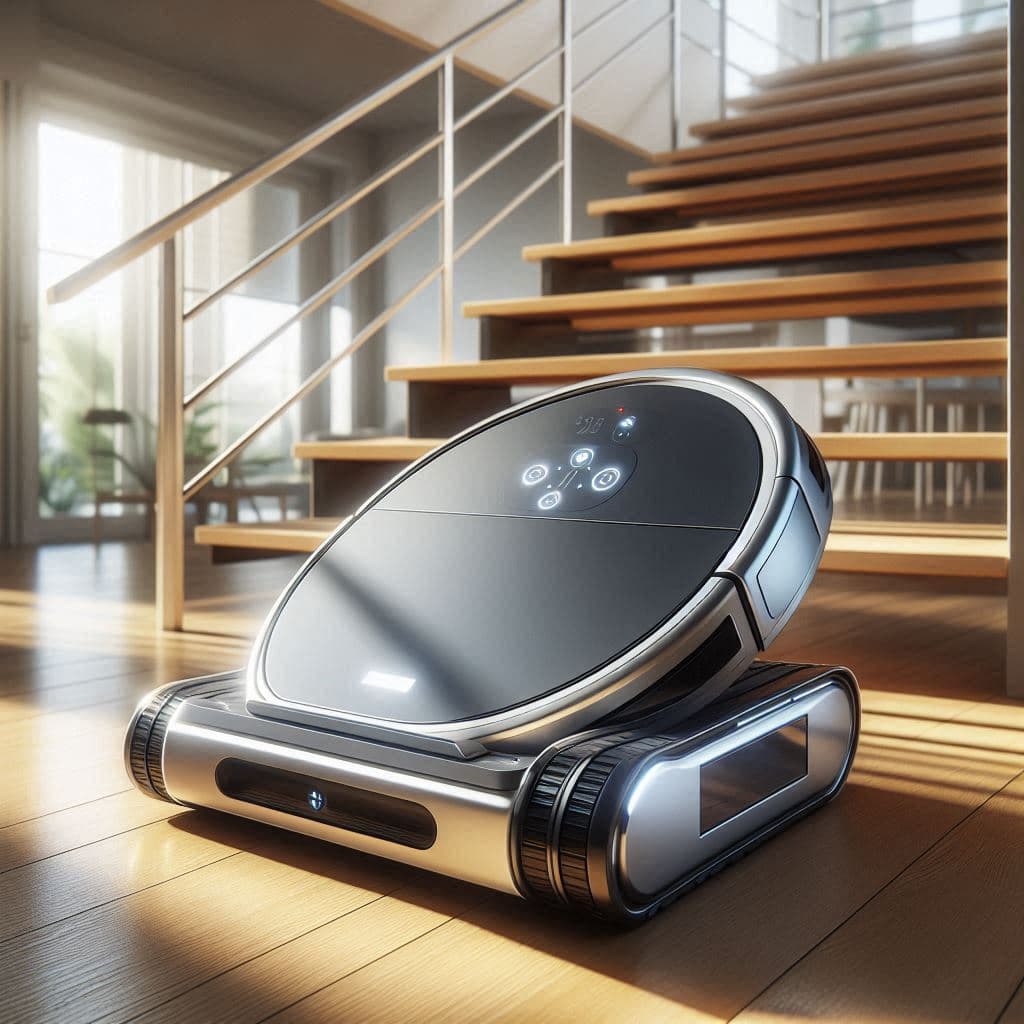
In the gentle half-light of early innovation, where ideas unfurl like morning mist over still water, the familiar hum of robotic vacuums took on an unexpected new shape at CES 2026. For years, these helpers have threaded their way across our floors — faithful, steady, and respectful of the boundaries we set for them. But like a river that discovers a new channel, some designs are learning to rise above the flat plains and touch the stairs that once marked their limits.
The story of this shift begins not with loud fanfare but with a curious resolve to rethink what a household robot can be. Chinese home robotics maker Roborock, already a well-known name in smart cleaning appliances, unveiled the Saros Rover — a prototype that has captured attention with an almost poetic blend of wheels and extendable limbs that lift it toward the contours of multi-story homes. As sunlight catches dew upon grass, so too does this machine catch imaginations, inviting us to consider a future where a device can travel up a flight of stairs as naturally as it glides across a hardwood floor.
This stair-climbing ambition is not merely aesthetic; it’s an answer to a longstanding and humble challenge. Many robot vacuums, no matter how cleverly engineered, have treated staircases as forbidden valleys — spaces to be feared, avoided, or left untouched. In contrast, the Saros Rover’s articulated structure — drawn from a blend of wheels and adaptive leg-like extensions — seeks to integrate steps into the very map of its domain. Through this novel design, the vacuum lifts itself, shifts with balance, and steps forward — not unlike a careful traveler ascending a worn staircase, each foot placed with intention.
And yet, even as we reflect on the elegance of such innovation, it is worth noting that this is still a glimpse of what might be. The Saros Rover, as shown in demonstrations, is a work in progress — a prototype whose promise has not yet fully translated into a scheduled consumer release. Alongside this pioneering model, Roborock continues to refine its broader lineup of vacuums, evolving systems that climb thresholds and navigate complex floor plans with greater adaptability.
In the broader stage of the home robotics market, Chinese manufacturers are increasingly seen as a driving force of change, pushing product features like embodied navigation and artificial intelligence that respond to dynamic household environments. In this subtle rise of mechanical capability, one can almost see the trace of a broader human endeavor — to smooth the edges of daily life and, in doing so, to expand the quiet landscapes we inhabit.
In reported updates from ongoing demonstrations this year, Roborock’s stair-climbing vacuum, shown as the Saros Rover, uses extendable wheel-leg architecture to navigate steps and slopes during trials at Consumer Electronics Show 2026. The device is currently in prototype form with no confirmed consumer launch date. Alongside this advancement, Roborock introduced additional new models including Saros 20 and Saros 20 Sonic with improved threshold handling and cleaning capabilities
AI Image Disclaimer Graphics are AI-generated and intended for representation, not reality.
Sources (Media Names Only) Digitimes Asia WebProNews WTOP Tech NotebookCheck.net Tom’s Guide
Published by Banx Network. This article is part of the Banx decentralized media programme, powered by the BXE token on the XRP Ledger.