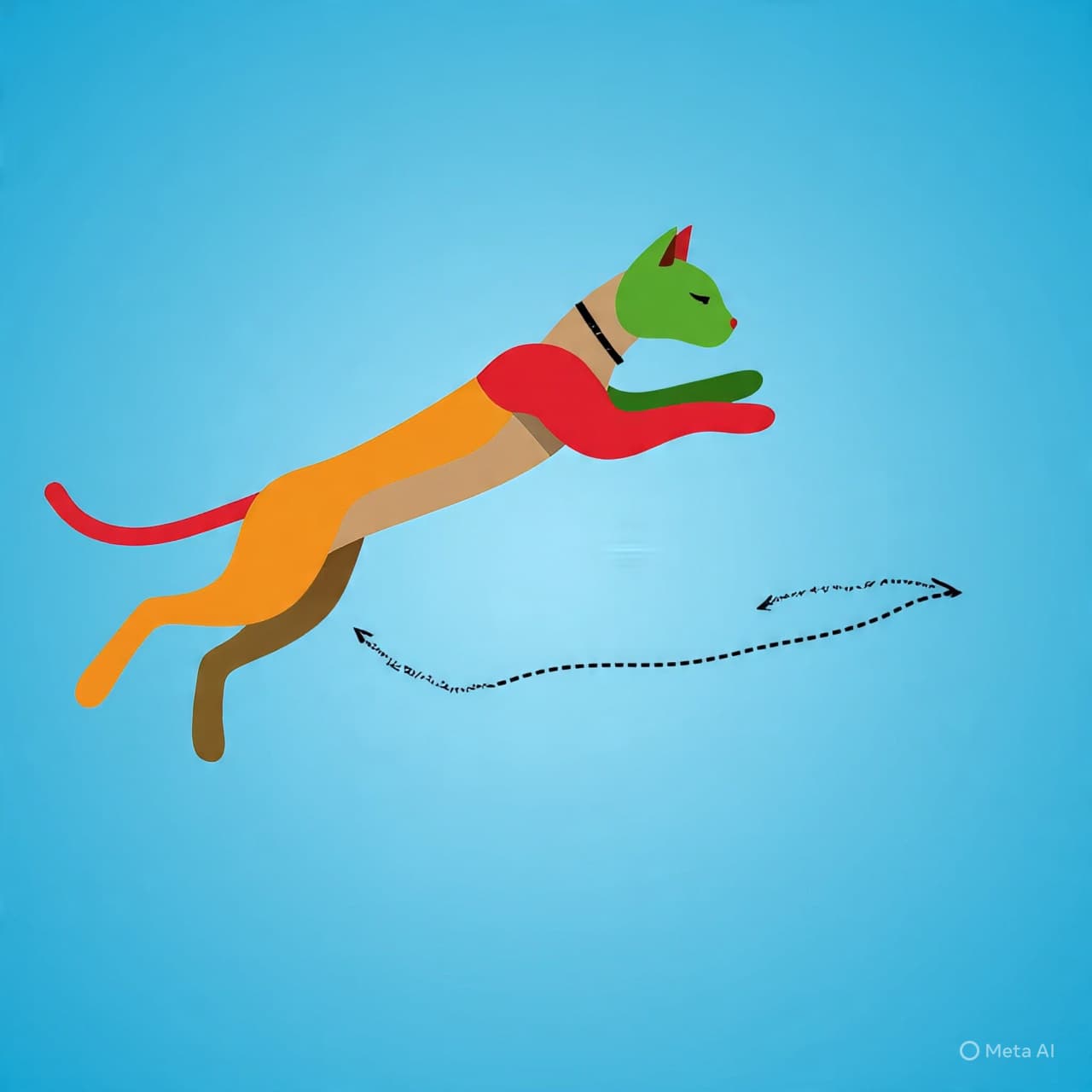
There is a quiet wonder in watching a cat let its body unfurl midair, as if time slows and instinct guides every twist and turn. In those fleeting moments before the paws touch ground, something profound unfolds — a graceful choreography that seems to defy the casual observer’s intuition about gravity and motion. This seemingly effortless righting of the body has long been one of nature’s small marvels, whispered about in households and sketched in childhood notebooks, but until recently its full explanation lingered on the edges of curiosity and scientific challenge.
For centuries, people have observed that cats almost always land on their feet when they fall, a skill that seems at once miraculous and commonplace. Yet when scientists began to look closely at this capacity, they realized they were tracing contours of a deeper mechanical ballet, one that blends physics with anatomy in ways both subtle and elegant. In a new study led by researchers at Yamaguchi University in Japan, scientists peeled back the mystery to reveal how the very structure of a cat’s spine plays a starring role in this aerial twist.
Cats are equipped with a remarkable range of motion in their spines. The new study found that the thoracic region — the upper and middle part of the back — is far more flexible than the lumbar region toward the rear. This mismatch in flexibility, almost like having a pliant hinge followed by a sturdy anchor, allows the front of the cat’s body to begin rotating in midair first, while the stiffer lower back holds the rear steady. Gradually, the twist initiated up front propagates through the body, bringing all four paws into position to greet the ground.
This twisting, known in the scientific world as the “air‑righting reflex,” unfolds not in one fluid sweep but in a sequential dance: the head and front limbs turn first, guided by that supple thoracic region; then the rest of the body follows. What looks like magic to a casual observer is actually the harmonious interplay of skeletal design and instinctive reflex, finely honed by evolution to safeguard a cat against injury.
Though it may seem to brush up against the laws of physics — how can an object reorient itself in free fall without pushing against anything? — the answer lies in the cat’s own internal mechanics and how it redistributes its body during each fall. Long before modern tools in biomechanics were available, scientists puzzled over this behavior, but the latest research deepens our understanding by focusing on the precise role of different spinal segments and how they cooperate.
This knowledge may also ripple beyond the feline world, inspiring better treatments for spinal injuries or informing the design of more agile robots that could mimic nature’s effortless turns.
AI Image Disclaimer (Rotated Wording) “Graphics are AI‑generated and intended for representation, not reality.”
Sources (Credible Media) Wired Smithsonian Magazine Phys.org Jerusalem Post (science section) Nashaniva.com
Published by Banx Network. This article is part of the Banx decentralized media programme, powered by the BXE token on the XRP Ledger.