The night sky often appears unchanged, as though every familiar star has already shared its story. Yet the universe has a remarkable way of reminding humanity that even its most carefully studied corners can still conceal quiet surprises. Like a well-read book revealing an overlooked page, the Beta Pictoris star system has offered astronomers another chapter, one that remained hidden until the James Webb Space Telescope looked with extraordinary precision.
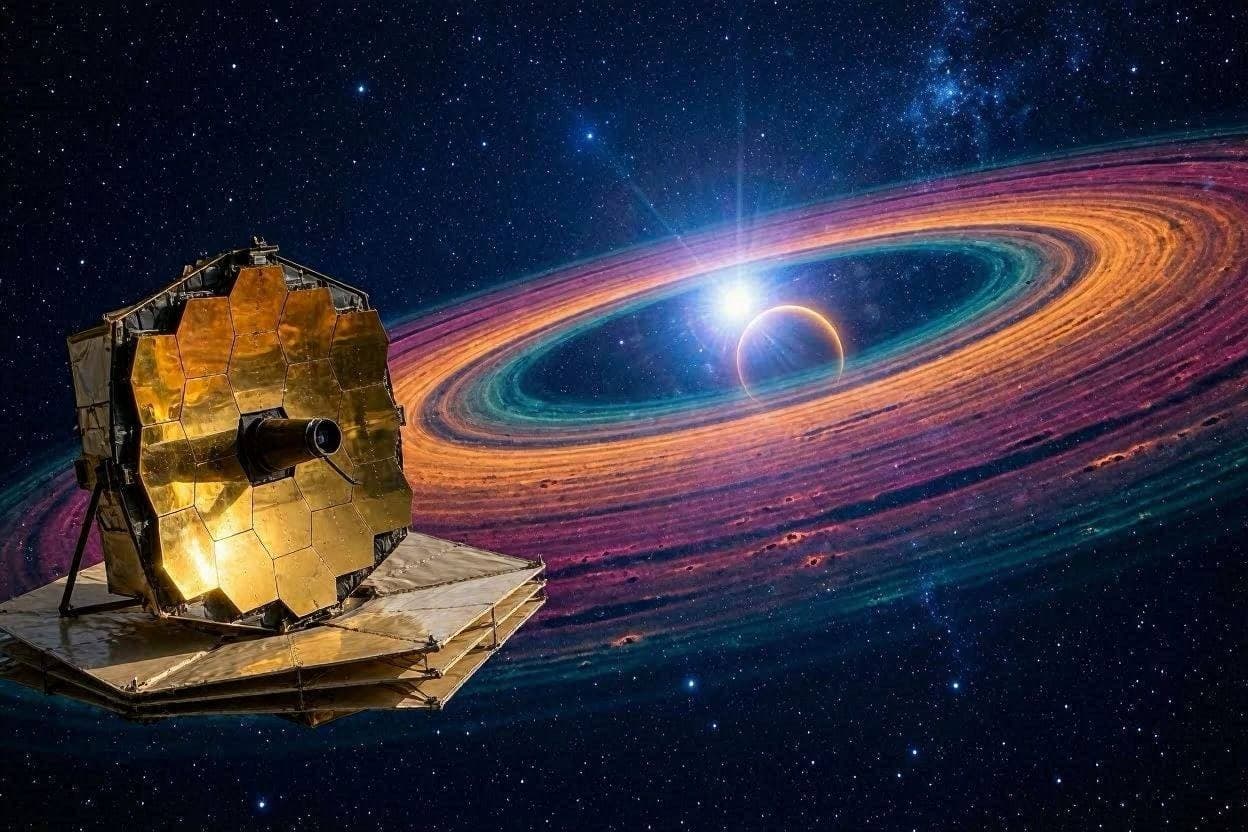
NASA announced that Webb has identified a previously unknown exoplanet within the Beta Pictoris system, located about 63 light-years from Earth. The discovery adds another member to one of the best-known planetary systems beyond our own, a destination that has fascinated astronomers for decades because of its young age, bright debris disk, and already confirmed giant planets.
The newly identified planet, named Beta Pictoris d, was not found through traditional imaging alone. Instead, Webb detected the chemical signature of the planet's atmosphere using its advanced infrared instruments. By separating the planet's light from the overwhelming brightness of its parent star, researchers were able to reveal a world that had remained hidden despite years of observation.
Scientists describe the finding as an important demonstration of Webb's unique capabilities. Rather than relying solely on visible light, the telescope can observe infrared wavelengths that expose details invisible to earlier generations of observatories. This approach allows astronomers to detect planets that may otherwise blend into the intense glow of their host stars.
The Beta Pictoris system has long served as a natural laboratory for studying how planetary systems develop. Estimated to be only around 20 million years old, it offers researchers an opportunity to observe giant planets during relatively early stages of their evolution. Every new discovery within the system helps refine models of how planets form, migrate, and interact with surrounding disks of gas and dust.
Researchers also noted that the planet's atmospheric characteristics provide valuable information about its composition and temperature. Such measurements help scientists compare planetary environments across different star systems, gradually improving understanding of how diverse planets can become under varying conditions throughout the galaxy.
Beyond the discovery itself, the achievement highlights the growing role of advanced space telescopes in expanding humanity's view of the cosmos. As Webb continues its mission, astronomers expect similar techniques to uncover additional planets that have remained hidden around nearby stars, broadening the catalog of known worlds and opening new paths for future exploration.
The discovery of Beta Pictoris d demonstrates that even well-studied regions of space can still reveal unexpected treasures. With each observation, the James Webb Space Telescope continues to deepen scientific understanding while reminding researchers that the universe remains richer and more intricate than previously imagined.
AI Image Disclaimer: The accompanying illustrations are AI-generated artistic interpretations inspired by verified scientific reporting and are not actual images captured during the discovery.
Sources:
NASA Associated Press (AP) Phys.org The Astrophysical Journal Letters
Published by Banx Network. This article is part of the Banx decentralized media programme, powered by the BXE token on the XRP Ledger.