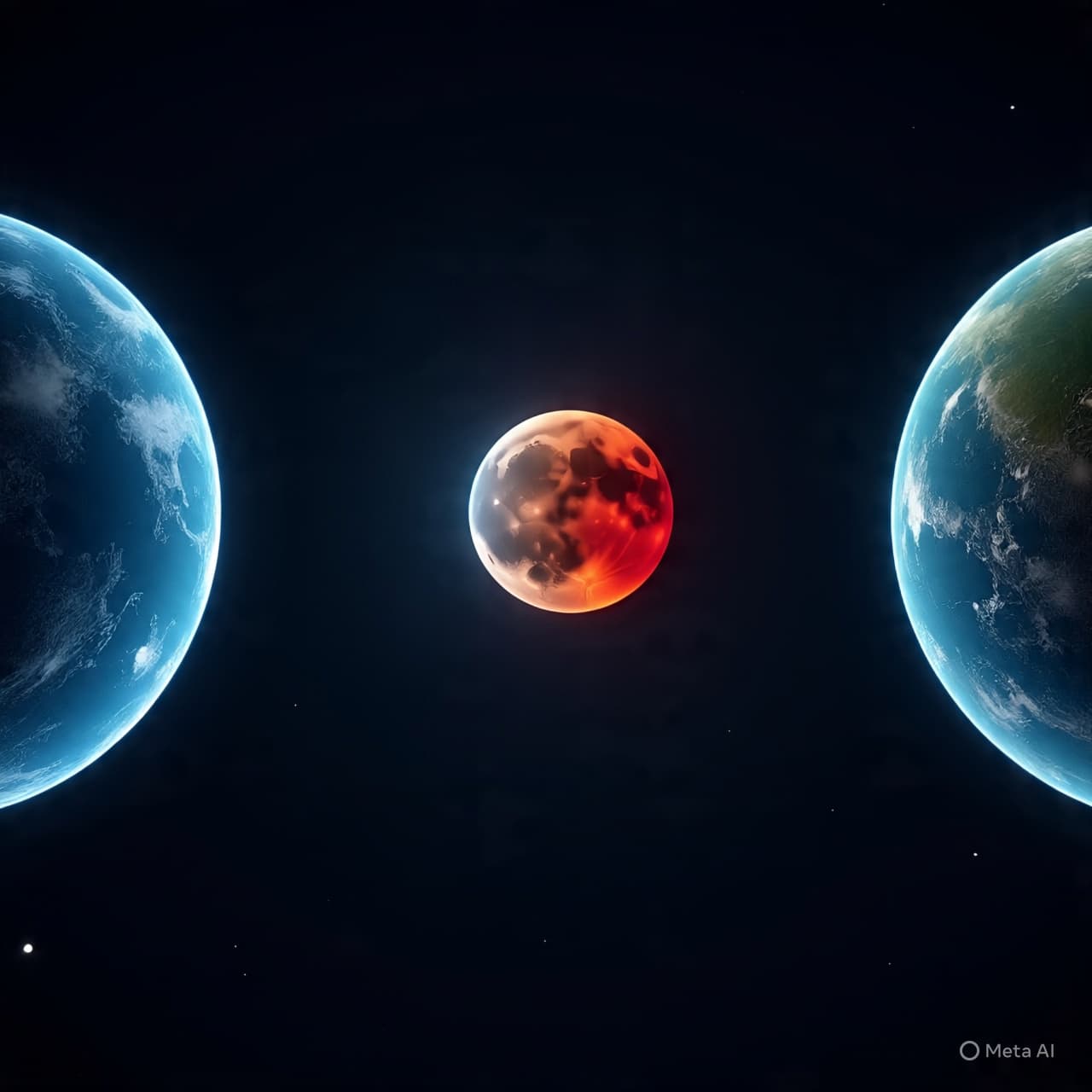
steady in its quiet glow, as though nothing above us could ever shift. And yet, from time to time, the familiar face of the Moon reminds us that even the most constant companions are part of a grand choreography. In the early hours of March 2–3, 2026, that choreography will briefly transform the night over into a stage for one of nature’s most subtle spectacles: a total lunar eclipse, often called a “Blood Moon.” The Moon will not disappear. Instead, it will deepen in color, trading its silver sheen for hues of copper and crimson. This change comes as Earth glides precisely between the Sun and the Moon, casting its shadow outward into space. When the alignment is exact, the Moon passes fully into the darkest part of that shadow — totality — and sunlight filtered through Earth’s atmosphere bends gently toward the lunar surface. What remains is a glow shaped by every sunrise and sunset happening around our planet at that very moment.
According to coverage from and astronomy outlets including , totality during this eclipse will last close to an hour, offering skywatchers ample time to observe the transformation. The most favorable views will be across much of the United States, Canada, and parts of Mexico, particularly in western regions where the Moon will still be higher in the sky before dawn begins to brighten the horizon.
The eclipse will unfold gradually. First, a subtle darkening will appear along the Moon’s edge as it enters Earth’s outer shadow. Then, as it moves into the deeper umbra, the shadow will curve visibly across its surface. During totality, the Moon may appear rusty red, brick orange, or even a muted brown, depending on atmospheric conditions. Dust, clouds, and particles in Earth’s air can slightly alter the shade, making each eclipse unique.
One of the quiet gifts of a lunar eclipse is its accessibility. Unlike a solar eclipse, no special glasses are required. The event is entirely safe to view with the naked eye. Binoculars can enhance the texture of the lunar surface, and a small telescope may reveal craters glowing faintly beneath the red tint, but even without equipment, the sight remains striking.
Timing will vary by time zone, but in many areas across North America, the most dramatic phase will occur in the pre-dawn hours of March 3. Observers are encouraged to find a location with a clear western horizon, minimal light pollution, and open skies. A backyard, a quiet park, or a rural overlook can provide an excellent vantage point. Weather, of course, will determine visibility, so checking local forecasts in advance is wise.
Total lunar eclipses are not exceedingly rare in a cosmic sense, yet any single event feels singular when experienced firsthand. There is something gently humbling about watching Earth’s shadow move across the Moon — a reminder that we are part of the same celestial system, bound by motion and light.
As the shadow recedes and the Moon gradually regains its familiar brightness, the moment will pass quietly. By sunrise, the spectacle will have ended, leaving only memory and perhaps a few photographs captured in the stillness before dawn. For those who rise early or stay awake late, this March eclipse offers a calm invitation: step outside, look up, and witness the slow turning of the heavens.
AI Image Disclaimer Illustrations were produced with AI and serve as conceptual depictions.
Sources NASA Space.com Live Science Timeanddate.com The Associated Press
Published by Banx Network. This article is part of the Banx decentralized media programme, powered by the BXE token on the XRP Ledger.