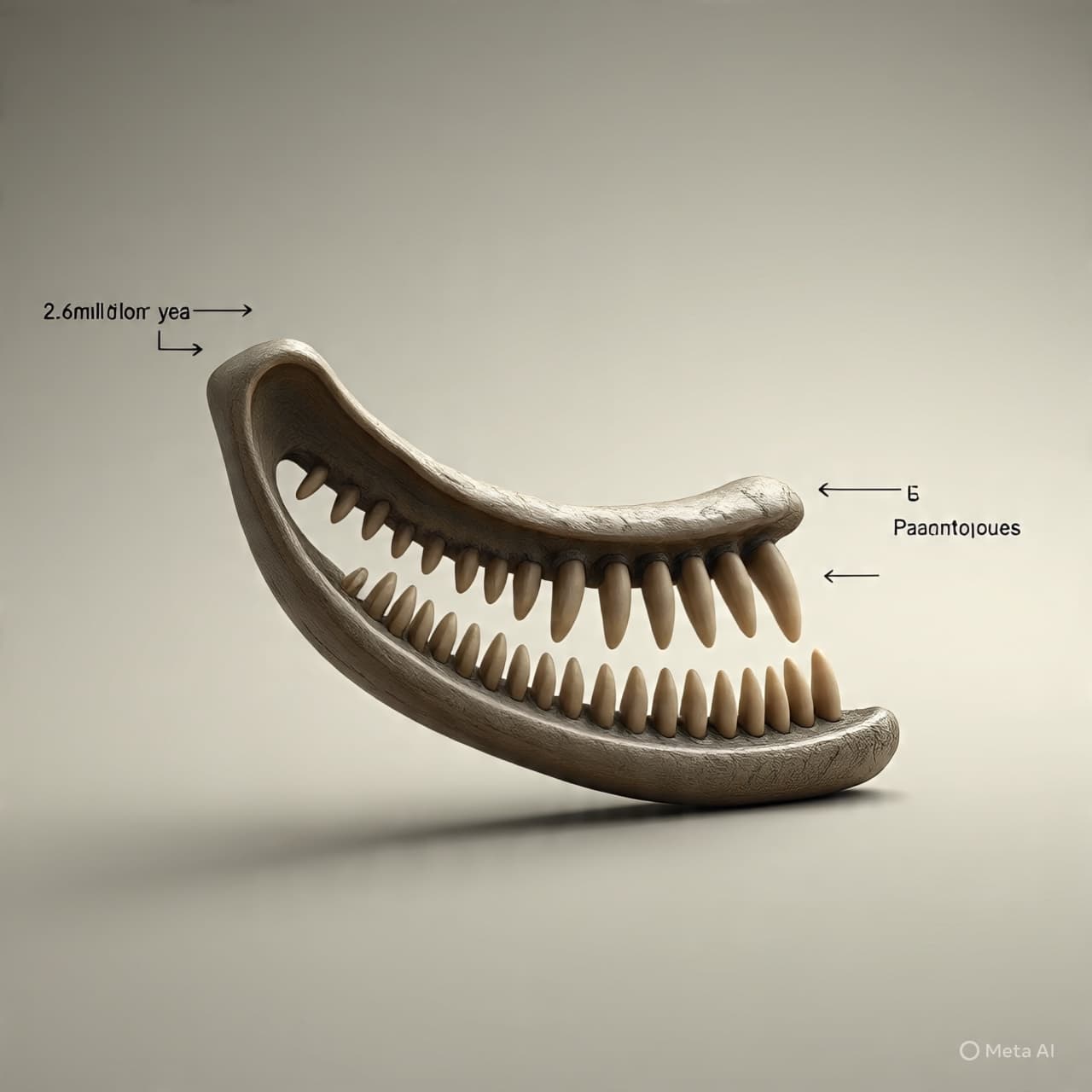
It was as if the earth had kept a quiet secret in its sedimentary pages, waiting for a curious hand and a patient gaze to unfold a chapter that had long eluded human imagination. In the sweeping plains of Ethiopia’s Afar region, where the light curves itself around ancient bones as gently as a storyteller leaning in close, scientists unearthed a fragment of jawbone—a humble piece of rock that now pulses with an echo of deep-time life. This 2.6-million-year-old Paranthropus fossil has become a new stanza in a poem about our earliest relatives, urging us to re-read lines we thought we knew.
Beneath the calm of discovery lies a compelling revelation: this jawbone extends the known reach of Paranthropus far into northern Ethiopia, hundreds of miles beyond where such fossils had been found before. The genus, often affectionately nicknamed the “nutcracker” for its robust teeth and powerful jaws, was once thought to be a quieter player on the evolutionary stage—specialized, perhaps, in niche diets and limited in its geographic wanderings. Yet here, in the Mille-Logya research area, this ancient jaw invites us to imagine a hominin both adaptable and widespread, comfortable in landscapes once thought beyond its domain.
It is the nature of science to imagine, then revise—like a river tracing new channels as terrain shifts. The presence of Paranthropus alongside contemporaries in the same fertile fossil beds that cradle remains of Australopithecus and early Homo suggests not a solitary path, but a shared stage where multiple hominins thrived, adapted, and perhaps crossed into one another’s stories. The genus’ robust anatomy—once interpreted narrowly through the lens of diet—now tells a tale of resilience and versatility.
In this unfolding narrative, the jawbone is both artifact and mirror. It reflects not only the life of an ancient being but also the ever-evolving story of how humans seek to understand themselves. It whispers of ecological flexibility, of journeys into unfamiliar lands, and of diets that may have been as varied as the landscapes these hominins traversed. As researchers carefully piece together fragments of fossil and context, we are reminded that our comprehension of prehistory is less a fixed chronicle than an artful mosaic, ever enriched by new strokes of evidence.
So we hold this find with both reverence and curiosity—not as the final word, but as a gentle guide through a terrain of questions. Where once Paranthropus was imagined as timid in its scope, it now emerges as a hominin with a broader range and a richer story. In the cadence of discovery, each fossil unearthed invites us to reshape our collective imagination of the ancient world.
And as the plains of Afar continue to yield their treasures, nestled between rock strata and time’s patient march, we pause to let these ancient whispers inform our modern wonder. For in every fossil lies not just a biological remnant, but an invitation to reflect upon the vast tapestry of life that shaped the dawn of humankind
AI Image Disclaimer (Rotated Wording) “Visuals are created with AI tools and are not real photographs.”
Sources University of Chicago News (University press) EurekAlert! (AAAS-affiliated press release) ScienceDaily (research summary) Sci.News (science news site) Discover Magazine (science media)
Published by Banx Network. This article is part of the Banx decentralized media programme, powered by the BXE token on the XRP Ledger.