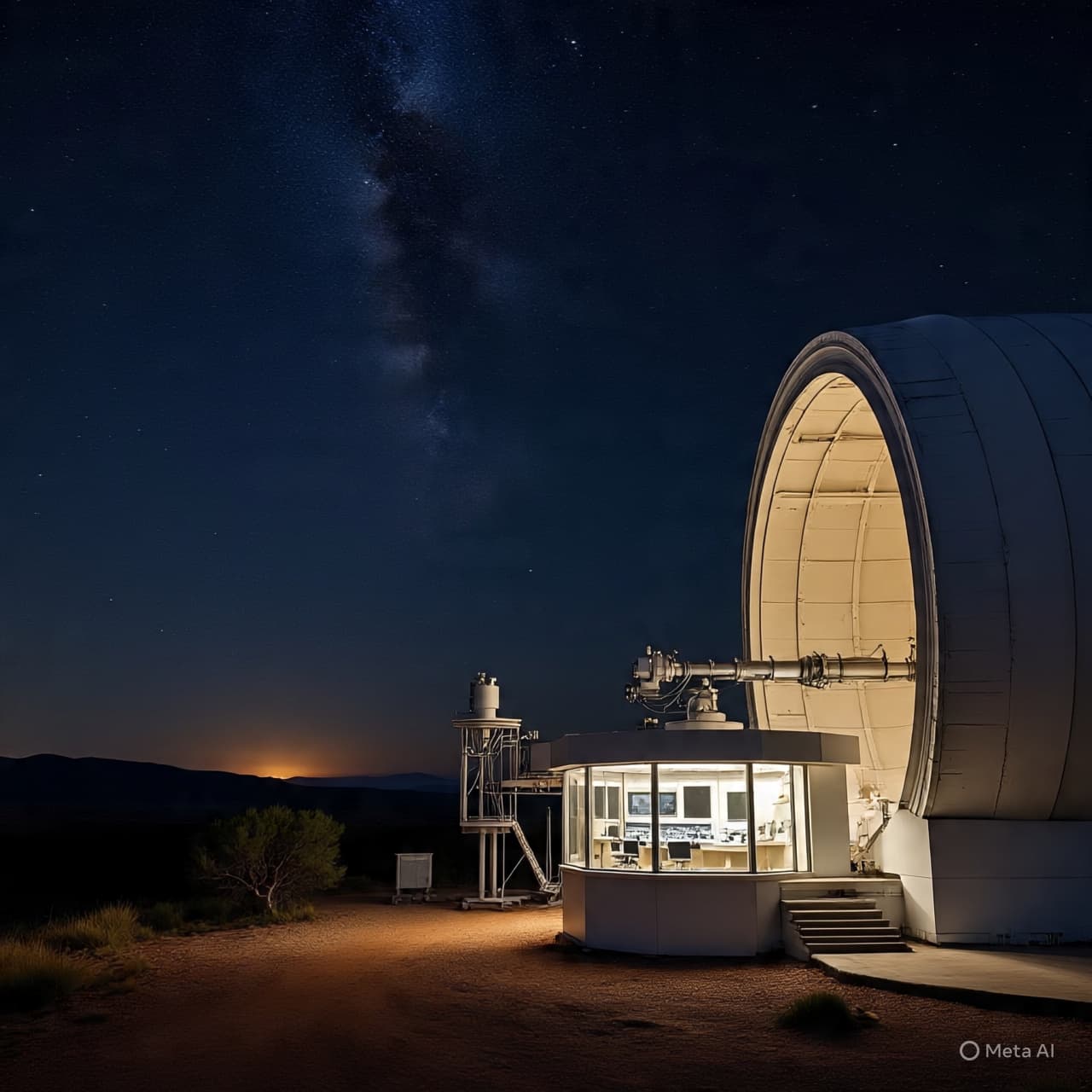
In the quiet domes of astronomical observatories, discovery often begins with patience. A telescope waits beneath the night sky like a careful listener, gathering whispers of light that have traveled millions or even billions of years to reach Earth. Yet the universe rarely moves at a predictable pace. A star might suddenly explode, a distant galaxy might flare, or clouds might drift across the sky at just the wrong moment.
For generations, astronomers have stood beside these instruments, watching, adjusting, and interpreting the signals that arrive from the cosmos. But now, a new kind of assistant is beginning to share that responsibility—one built not of glass and metal, but of algorithms.
A partnership between the United Kingdom and South Africa is exploring how artificial intelligence can help telescopes become more responsive, efficient, and insightful. The collaboration brings together specialists from the Science and Technology Facilities Council’s Hartree Centre in the UK and the South African Astronomical Observatory, aiming to create what researchers describe as an “Intelligent Observatory.”
At its heart, the idea is simple: allow telescopes to think a little for themselves.
Running an observatory has always been a delicate balance between human expertise and mechanical precision. Instruments must track distant objects with extraordinary accuracy, while scientists monitor weather conditions, equipment health, and incoming data streams. Even small disruptions—from a passing cloud to a minor technical fault—can interrupt observations that may never occur again.
Artificial intelligence offers a way to ease that complexity.
Through the Intelligent Observatory program, researchers are developing AI systems that allow telescopes to monitor their own performance, detect problems early, and process astronomical data almost instantly. Instead of waiting for technicians to review every signal, the system can analyze observations in real time and alert researchers when something unusual appears.
In practical terms, this means telescopes could capture fleeting cosmic events more effectively. Phenomena such as supernova explosions or sudden bursts of radiation from distant galaxies can occur without warning and fade quickly. With AI analyzing incoming data continuously, the observatory can respond faster, ensuring these rare events are recorded before they vanish into the background of space.
The technology also aims to improve the quality of the data itself. AI tools can correct for atmospheric distortions, identify potential instrument errors, and automatically transform raw observations into refined scientific datasets. What once required hours of manual analysis can now happen almost immediately.
Researchers involved in the project say this approach may allow astronomers to spend less time managing technical systems and more time interpreting discoveries. In other words, the telescope becomes not just a tool for observation, but an intelligent partner in exploration.
Another part of the initiative focuses on helping scientists navigate the vast amount of documentation that surrounds modern observatories. AI-powered search systems can scan manuals, research papers, and maintenance records, allowing astronomers to find answers quickly during busy nights of observing.
Beyond the telescope dome, the collaboration also reflects a broader shift in how scientific facilities operate. Observatories produce enormous volumes of data, often measured in terabytes each night. Artificial intelligence and high-performance computing are increasingly essential for turning those raw signals into meaningful scientific insights.
The partnership also carries educational benefits. By combining expertise in astronomy, computing, and artificial intelligence, the project provides opportunities for students and researchers across Africa and the United Kingdom to work with advanced technologies at the intersection of science and data.
South Africa already plays an important role in global astronomy, hosting major facilities and contributing to international projects that explore the deep universe. Integrating AI into observatory operations may further strengthen that position, opening new pathways for discovery and collaboration.
In many ways, the initiative represents a quiet evolution in how humanity studies the stars. Telescopes will still look upward, collecting faint light from distant galaxies as they always have. But beside them now, invisible systems of code and computation are learning to watch the sky as well.
For scientists, this partnership suggests that the future of astronomy may involve not only sharper lenses and larger mirrors, but also smarter instruments—ones capable of helping humanity listen more carefully to the stories written across the night sky.
In the coming years, researchers will continue refining these AI systems and expanding their capabilities. If successful, the Intelligent Observatory approach could influence how observatories around the world operate, helping telescopes work more efficiently and capture discoveries that might otherwise slip past unnoticed.
AI Image Disclaimer Visuals are created with AI tools and are not real photographs.
Sources UK Research and Innovation (UKRI) Space.com Phys.org SpaceNews ScienceDaily
Published by Banx Network. This article is part of the Banx decentralized media programme, powered by the BXE token on the XRP Ledger.