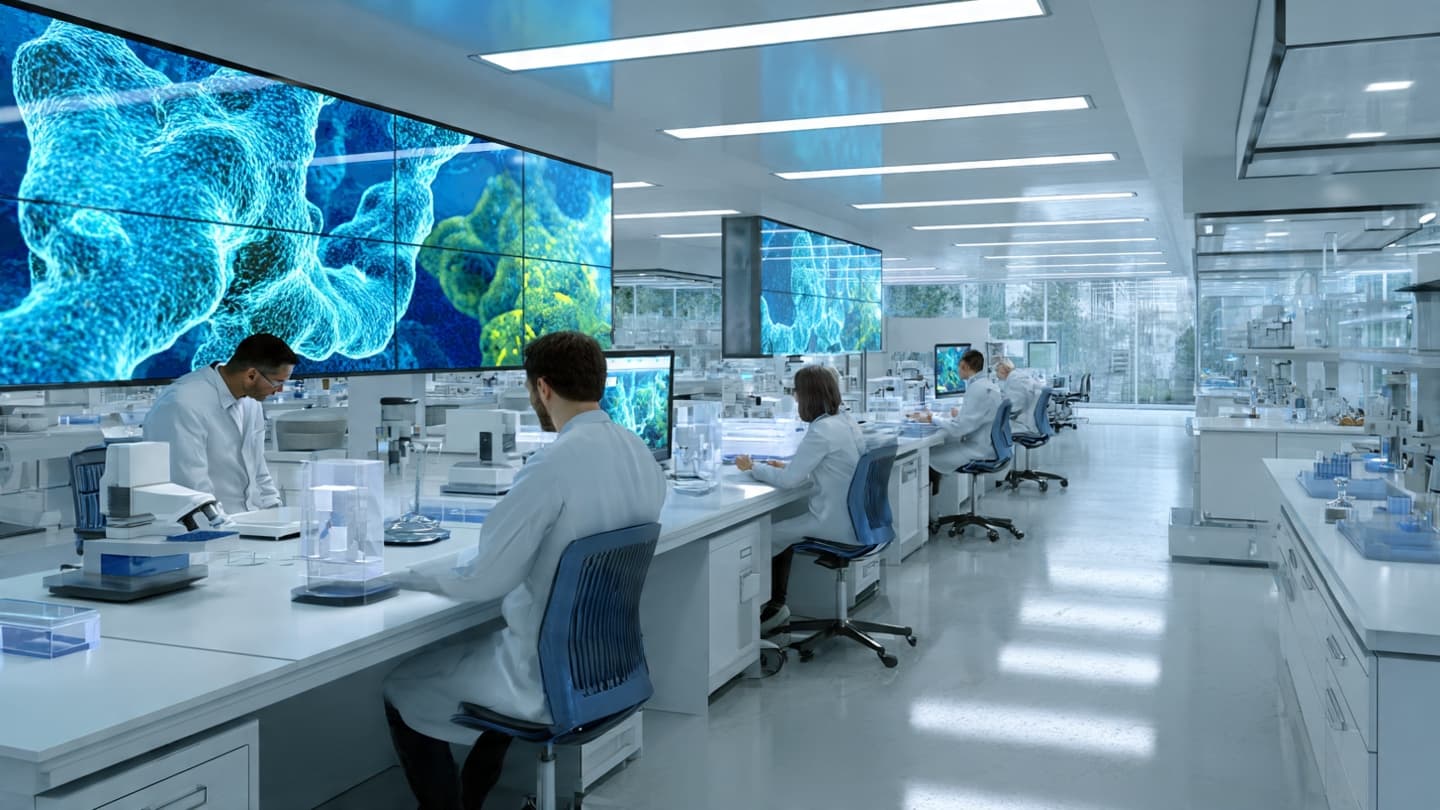
In a laboratory, discovery has traditionally moved at the pace of experiments: a sample prepared, a result recorded, another test arranged. Artificial intelligence is beginning to change that rhythm. Across Britain's research institutions, algorithms are increasingly being used to examine biological information and search for patterns that might otherwise take much longer to identify.
Drug discovery is particularly suited to computational tools because researchers must examine enormous numbers of possible compounds and biological interactions. AI systems can help narrow those possibilities, allowing scientists to focus laboratory experiments on candidates considered more promising.
The technology does not remove the need for laboratory science. Instead, it changes the relationship between computation and experimentation. A computer may suggest a molecule, predict its behavior or identify a biological target, but researchers still need to test whether those predictions hold true in the physical world.
Britain has a long-established pharmaceutical and biomedical research sector, supported by universities, hospitals and private companies. That ecosystem provides an environment where AI research can be combined with existing expertise in genetics, chemistry, pharmacology and clinical science.
Artificial intelligence can also help researchers analyze complex biological datasets. Genomic information, medical imaging and protein structures contain enormous amounts of information, much of which is difficult to examine manually. Machine-learning systems can process those datasets rapidly and identify relationships that may warrant further investigation.
The growing interest comes at a time when pharmaceutical research is facing pressure to become more efficient. Developing a new medicine can take many years and involve substantial investment. If computational tools can help eliminate less promising candidates earlier, they could potentially reduce some of the time and resources spent during discovery.
But biological systems remain unpredictable. A molecule that performs well in a computational model may behave differently in a laboratory or human body. The gap between prediction and medical reality is therefore one of the central challenges for AI-assisted drug development.
Regulation and trust are also important. Medical researchers need to understand how AI-generated predictions were produced, while pharmaceutical companies must demonstrate that new medicines meet strict standards for safety and effectiveness.
The technology is consequently becoming part of a broader research workflow rather than a standalone replacement for scientists. Algorithms can search, compare and predict, while researchers provide experimental design, interpretation and clinical expertise.
Britain's growing use of AI in biomedical research reflects a larger transformation in the scientific process. As computing power and biological data continue to expand, artificial intelligence is becoming another instrument in the laboratory—one that may help researchers move more efficiently through the long path from biological discovery to potential treatment.
AI Image Disclaimer The images were generated using AI as conceptual scientific illustrations and are not photographs of actual British laboratories or research projects.
Sources Reuters UK Research and Innovation National Institute for Health and Care Research The Wellcome Sanger Institute The Francis Crick Institute
Published by Banx Network. This article is part of the Banx decentralized media programme, powered by the BXE token on the XRP Ledger.