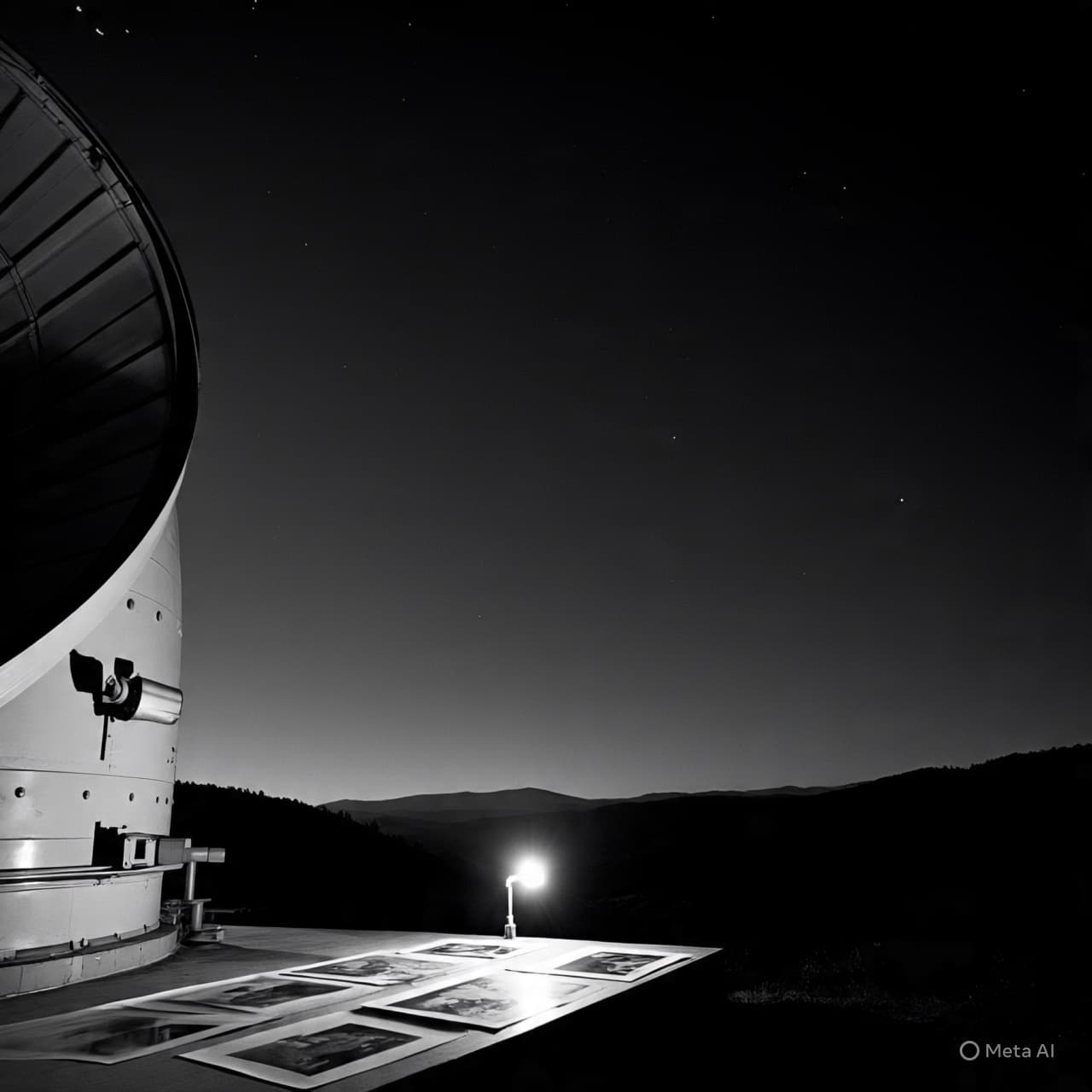
In the hush of the night sky over the 1950s, long before the world had orbiting satellites, glass photographic plates quietly captured the heavens. For decades, thousands of brief, star-like flashes — what astronomers call “transients” — appeared in one exposure and vanished by the next, their origin unexplained. A new study, however, has opened the door to a compelling possibility: these fleeting lights may be tied to the dawn of the nuclear age.
Researchers examined archival data from the VANISHING AND APPEARING SOURCES DURING A CENTURY OF OBSERVATIONS (VASCO) PROJECT, which combed digitised plates from the Palomar Observatory Sky Survey (POSS-I) taken between 1949 and 1957. Among more than 100,000 images, they identified instances where a bright spot appeared in one exposure yet failed to show up in any earlier or later survey image. These were not easily dismissed as plate defects, artifacts of the emulsion, or normal celestial phenomena.
The twist came when the team cross-referenced the dates of these transients with known above-ground nuclear detonations — carried out by the United States, the Soviet Union and the United Kingdom during that era. The result: nights within one day of a nuclear test were about 45 % more likely to show a transient than nights with no test window. The strongest correlation was found the day after a test.
Moreover, the researchers compared the transient occurrences with historical reports of what are now called Unidentified Anomalous Phenomena (UAPs) — the modern term for what was once popularly dubbed UFOs. They found that when there were more UAP reports on a given night, the number of transients increased by roughly 8.5 % for each additional report.
AI image disclaimer: AI-generated illustrations for editorial concept only.
Sources: ScienceAlert Phys org
Published by Banx Network. This article is part of the Banx decentralized media programme, powered by the BXE token on the XRP Ledger.