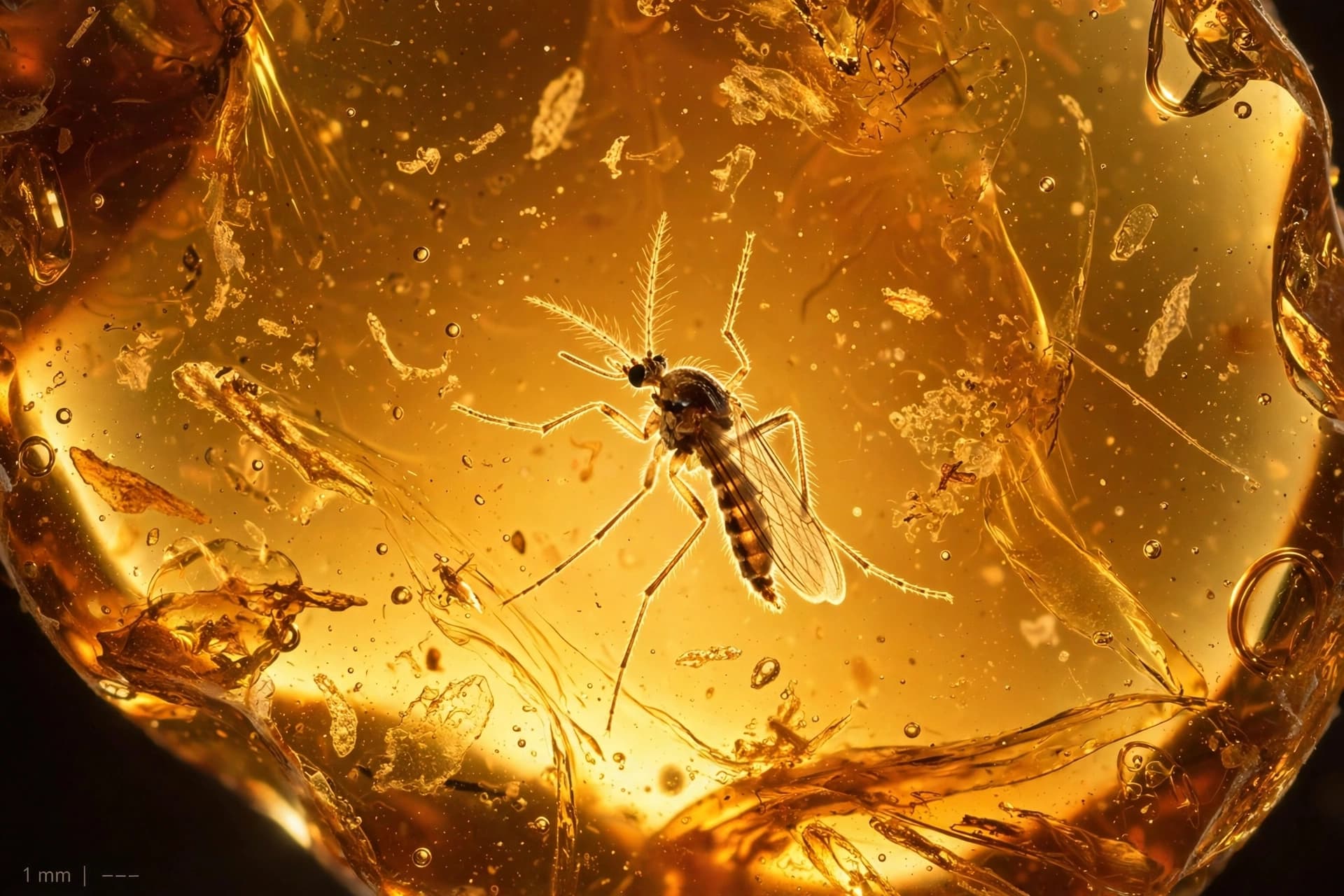
There is a particular joy in discovering that the natural world once produced something so strange it seems almost imagined—a creature whose anatomy defies easy comparison, whose way of life has no modern equivalent. In a piece of amber from Myanmar, scientists have found just such a creature: a tiny insect that lived 99 million years ago, with a mouthpart twice the length of its body and a flexibility that has no parallel among its living relatives.
The insect, described in the journal Insects, has been named Cretodorus noonoo—"Noo-Noo"—after the vacuum cleaner character from the children's television series Teletubbies. The name was chosen because the insect's long, flexible, corrugated mouthpart resembles the character's bendy hose .
Researchers from the Steinhardt Museum of Natural History in Israel and the Nanjing Institute of Geology and Paleontology in China studied 13 specimens preserved in Kachin amber, dating to the Cretaceous period when dinosaurs still roamed the Earth. Using high-resolution 3D X-ray imaging, they found that the mouthpart's surface was densely covered with fine, accordion-like folds .
Those folds were not decorative. They were a mechanical adaptation, allowing the mouthpart to bend without kinking or collapsing—much like a corrugated drinking straw or a flexible hose. This flexibility, researchers believe, enabled the insect to probe deep into cracks in tree bark, reaching sap-rich tissues that were inaccessible to insects with more rigid, needle-like mouthparts .
The tip of the mouthpart had another unusual feature: two grooved lobes that could expand, anchoring the insect to the walls of a bark crack like a wall plug expanding inside a drilled hole. No living relative of Noo-Noo possesses such a structure, suggesting it represents an evolutionary solution that disappeared over time .
"The discovery of 'Noo-Noo' gives us an extraordinary glimpse into the insect world of the age of the dinosaurs," said Leonidas-Romanos Davranoglou of the Steinhardt Museum. "This is not merely an insect previously unknown to science, but an animal that developed an evolutionary solution with almost no modern equivalent" .
The insect belonged to an ancient family of planthoppers called Neazoniidae. Its modern relatives have simple needle-like mouthparts for piercing plants and sucking fluids. Noo-Noo's corrugated, flexible feeding organ suggests that Cretaceous forests—perhaps rich in thick-barked trees shaped by frequent fires—created ecological conditions very different from those we know today .
The discovery adds another piece to the puzzle of how ancient ecosystems functioned, and how evolution can produce solutions that seem almost stranger than fiction.
AI Image Disclaimer: Visuals in this article are AI-generated and do not depict actual specimens or events.
Sources: Yahoo News Malaysia, China.org.cn, NEWSru.co.il, УНІАН, MDPI Insects
Published by Banx Network. This article is part of the Banx decentralized media programme, powered by the BXE token on the XRP Ledger.