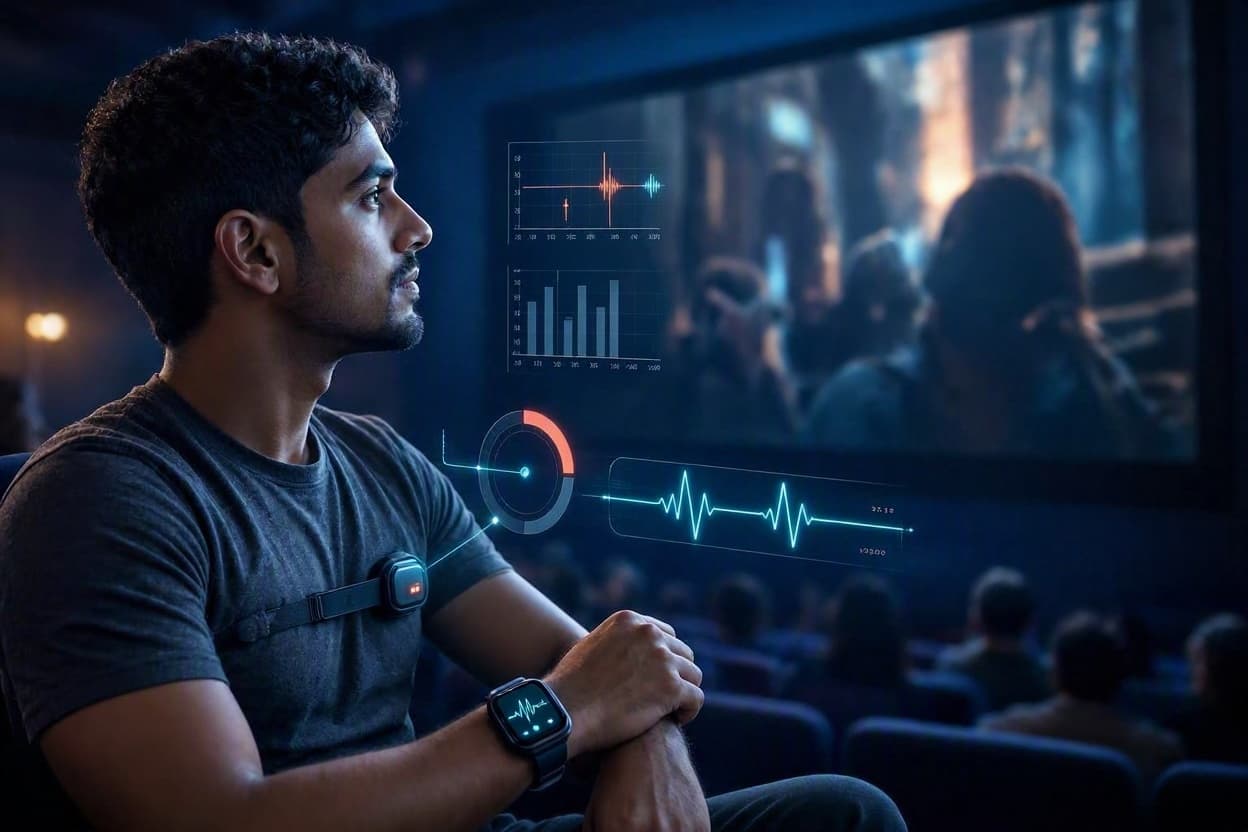
Cinema has long relied on the subjective experience of the viewer to measure its impact. Did the scene move you? Did the climax raise your pulse? Now, technology offers a more objective answer. A recent study utilizes the "internet of bodies"—a network of wearable sensors—to track physiological responses to film, providing a quantitative map of emotional engagement. This fusion of art and data reveals how stories physically resonate with us.
The study equipped participants with devices that monitored heart rate, skin conductance, and other biometric markers while they watched various films. These sensors created a real-time feedback loop, capturing the body’s involuntary reactions to narrative twists, musical swells, and visual shocks. The result was a detailed timeline of emotional arousal, showing exactly when and how strongly viewers responded.
This approach moves beyond self-reported surveys, which can be influenced by memory bias or social desirability. Instead, it captures the raw, immediate physical response to storytelling. The data revealed that certain cinematic techniques, such as rapid editing or sudden silence, consistently triggered heightened physiological states across diverse groups of viewers.
The term "internet of bodies" refers to the interconnectedness of these biological data points. By aggregating responses from multiple individuals, researchers can identify universal patterns in human emotion. This collective data helps filmmakers understand which elements are most effective in creating suspense, joy, or sadness, allowing for more precise crafting of emotional arcs.
However, the study also highlights individual differences. Not every viewer responded in the same way, reflecting personal histories, cultural backgrounds, and psychological traits. The data does not replace the subjective experience but enriches it, offering a layered understanding of how art interacts with the human organism. It validates the idea that emotion is both personal and shared.
For the film industry, this technology offers new tools for testing and refinement. Directors and editors can use biometric feedback to fine-tune pacing and intensity, ensuring that key moments land with maximum impact. It bridges the gap between creative intuition and empirical evidence, fostering a deeper connection between creator and audience.
Ethical considerations remain important. The collection of biometric data raises questions about privacy and consent. Researchers emphasize the need for transparent practices and secure data handling to protect participants. The goal is to enhance artistic expression, not to manipulate viewers without their knowledge or agreement.
As the technology evolves, its applications may extend beyond entertainment to education and therapy. Understanding how narratives affect the body can help design more effective learning materials or therapeutic interventions. The internet of bodies thus becomes a bridge between science and humanity, measuring the immeasurable.
The use of wearable technology to gauge film’s emotional power marks a new frontier in media studies. It offers a deeper appreciation for the physicality of emotion, reminding us that stories are not just heard or seen, but felt in the very fabric of our being.
AI Image Disclaimer: Any images used in conjunction with this article are AI-generated conceptualizations meant to illustrate the themes of media and justice.
Sources: Nature Human Behaviour, MIT Technology Review, The Verge, Academic Journal of Media Psychology
Published by Banx Network. This article is part of the Banx decentralized media programme, powered by the BXE token on the XRP Ledger.