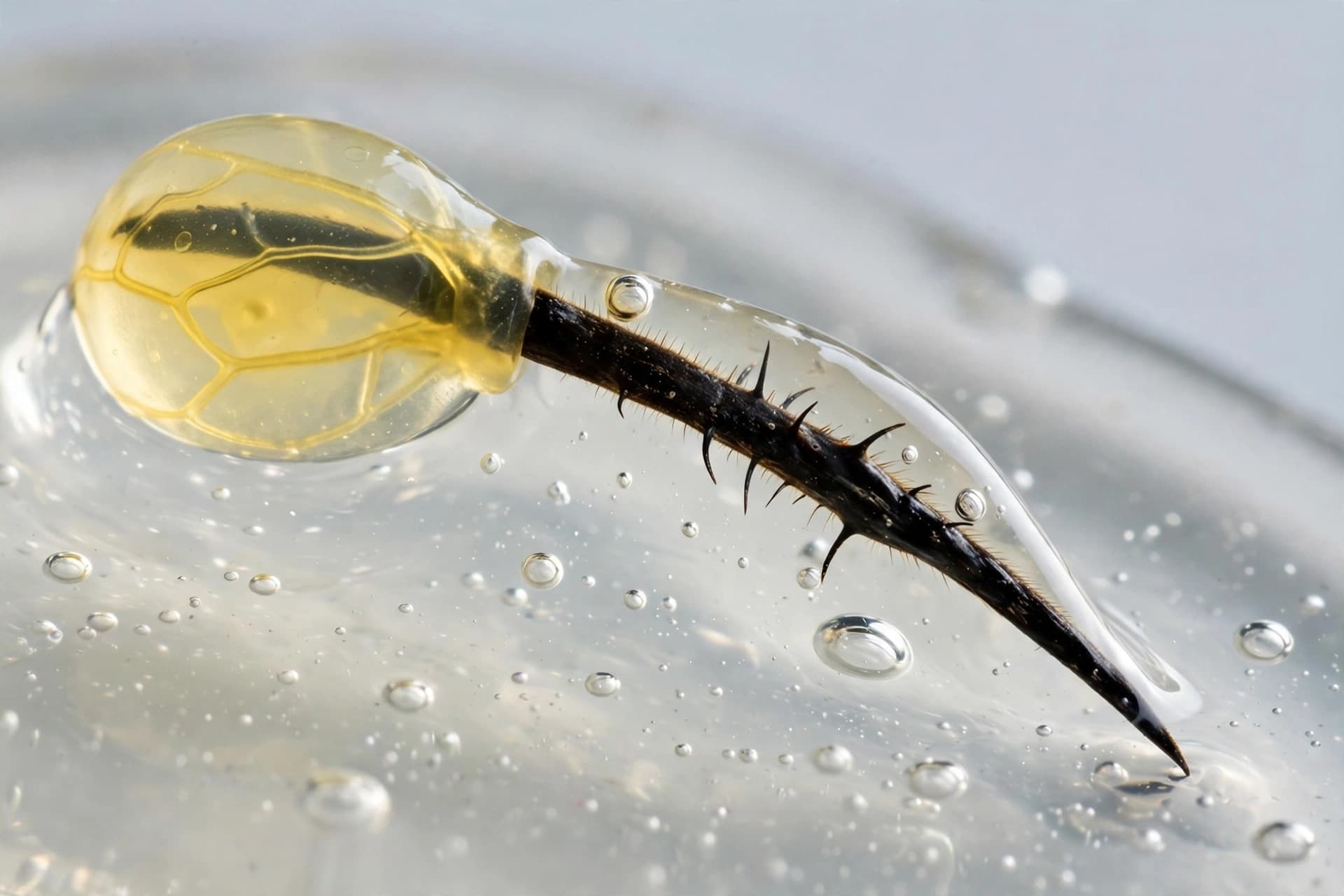
In the soft amber glow of an artifact room in Weimar, a silent story waited like a distant echo — a story that reached across millions of years before it was heard. Just as sunlight can reveal hidden hues when it passes through stained glass, so too has modern science allowed us to peer into objects that have long captured our imagination. An unpolished piece of amber, once part of the personal collection of Johann Wolfgang von Goethe — a figure more familiar to us for poetry and philosophy than for paleontology — has become a luminous window into the Eocene world nearly 40 million years in the past.
What looks at first like a warm, golden stone holds an astonishing secret: a minuscule ant, extraordinarily well preserved inside its resinous prison. For centuries, the fossil lay unseen because to the naked eye, it seemed unremarkable. Goethe himself, whose curiosity often wandered into the realm of natural objects, seems never to have noticed the biological time capsule within the amber he treasured. Yet time, temperature, and resin conspired to seal that ant in remarkable detail, preserving features both outward and internal — a rarity among fossil insects.
When scientists from the University of Jena and partner institutions approached the amber with today’s imaging technologies — specifically synchrotron micro-computed tomography — they did more than find an insect. They reconstructed in three dimensions the anatomy of a creature that once roamed ancient forests that blanketed prehistoric Europe. This extinct species, †Ctenobethylus goepperti, had been identified in amber before, yet never with such clarity of structure. With these digital slices of light, researchers could peer inside the ant’s thorax and head, witnessing skeletal architecture long lost in most fossil records.
Beyond the scientific fascination, there is a poetic symmetry in the discovery. Goethe — whose work bridged aesthetics and the early natural sciences — might have found delight in knowing that something he once held could help illuminate evolutionary history centuries after his time. Modern researchers suggest that this ant might have lived in treetop colonies, building nests and navigating warm, humid Eocene forests, its life forever captured in droplets of resin that hardened into amber.
This rediscovery does more than add another name to the catalogue of extinct species. It underscores the value of historical collections, reminding us that curiosity captured by earlier generations can germinate new insight today. In that quiet amber stone, time became not a barrier but a bridge — linking poetic past and scientific present in a small ant’s long-forgotten world.
AI IMAGE DISCLAIMER (Rotated Wording) Visuals are created with AI tools and are not real photographs.
SOURCE CHECK (Top 5 Mainstream / Credible) ScitechDaily Phys.org DiscoverWildlife ArkeoNews Research-in-Germany
Published by Banx Network. This article is part of the Banx decentralized media programme, powered by the BXE token on the XRP Ledger.