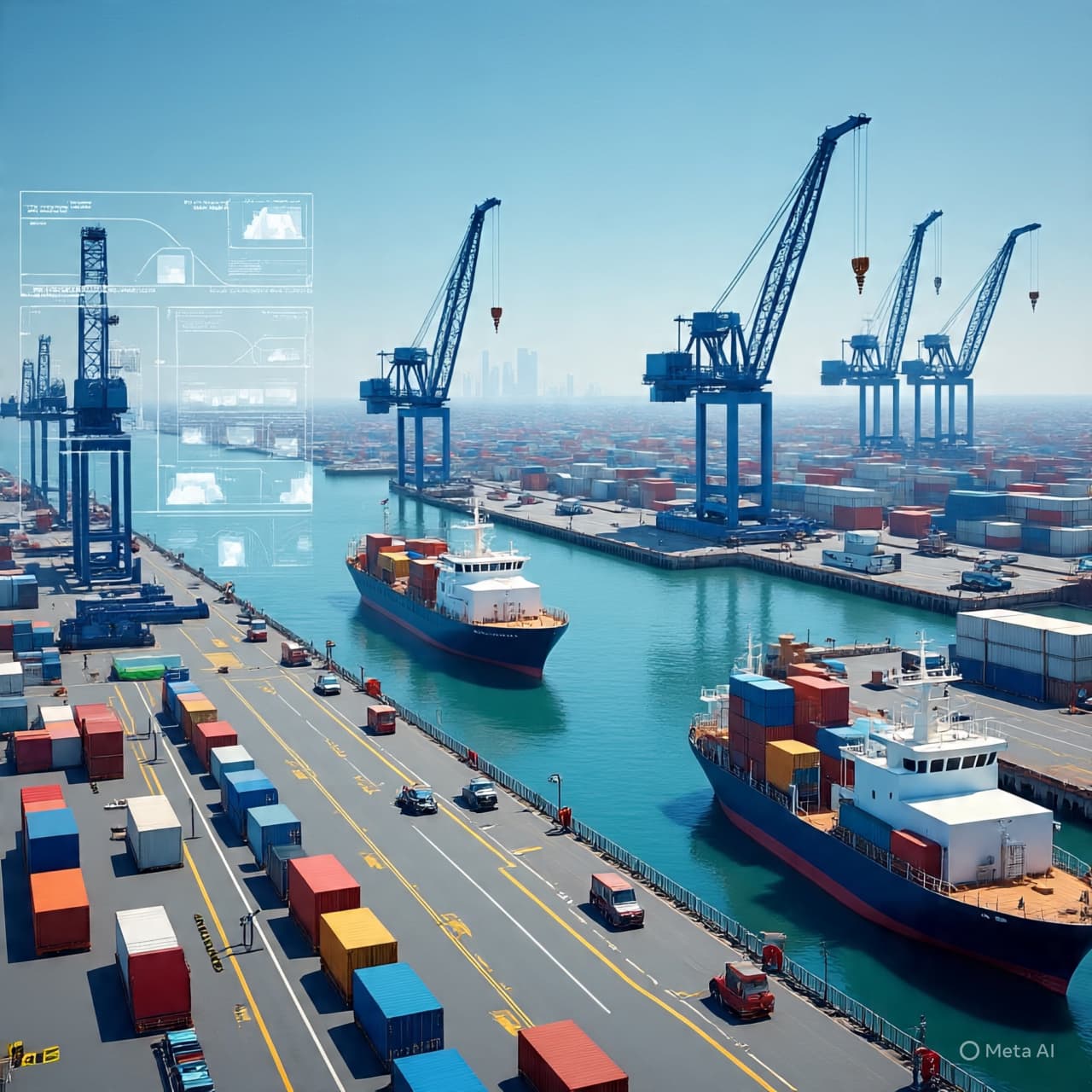
Opening Article In the dance of ships and tides, where steel giants weave across oceans and intricate chains of movement determine whether goods arrive on time, there lies a puzzle deeply woven with constraints and cascading decisions. Like a grand symphony with countless instruments yet no single conductor, maritime logistics has long been governed by complexity — weather patterns, berth assignments, crane availability, truck flows, labor shifts, and unpredictable disruptions. Amid this intricate choreography, a new kind of partner is emerging: quantum computing. Not as a replacement for the tried and true, but as a complementary voice that offers a fresh cadence to the rhythms of scheduling, strategy, and optimization.
Article Body At its heart, the challenge of managing port operations and maritime logistics is not simply about moving data — it’s about taming the exponential complexity that arises when thousands of potential decisions intersect under real‑world constraints. Classical computing systems, for all their power, often fall back on simplifications and heuristic shortcuts because evaluating every possible scenario in dense scheduling problems takes impractically long. Quantum computing, and particularly hybrid quantum‑classical approaches, offer a way to explore tangled optimization landscapes differently, bringing new computational dimensions to some of the hardest problems in logistics.
Ports are vast and dynamic ecosystems. Berths must be assigned and reassigned in real time as ships deviate from schedules, cranes must be sequenced to serve multiple vessels efficiently, tugs must be dispatched optimally, and container stacking strategies must consider constraints ranging from weight distribution to intermodal connections. Many of these problems — from berth allocation to fleet routing — become computationally intractable when they include all real variables like weather shifts, labor rules, emissions goals, and equipment break‑downs. In such tangled domains, solutions often settle for “good enough” rather than truly optimal.
Quantum computing brings a different perspective because quantum algorithms can navigate multiple solution candidates simultaneously through the principles of superposition and entanglement. In a hybrid workflow, classical computing still handles data management, logistical constraints, and business rules. Quantum routines are called upon to weigh the most computationally dense decision spaces — generating high‑quality candidate solutions that might be difficult or slow for traditional methods to uncover. This synergy helps planners navigate disruption more rapidly and identify schedules that improve throughput, reduce delays, and make better use of limited resources.
Real experimentation is already underway in some of the world’s busiest ports. Initiatives in hubs such as the Port of Los Angeles and at terminals engaged in digital twin modelling are beginning to test hybrid quantum algorithms in live terminal environments. Europe’s Port of Hamburg, for example, is exploring quantum computing to improve tugboat scheduling — a task influenced by varying vessel arrival times, weather, and shifting operational demands — aiming to reduce fuel use, minimize delays, and improve reliability as boats arrive and depart.
Although quantum hardware remains in early stages compared to mature classical systems, pilot programs and industry white papers underscore the momentum behind logistics and maritime innovation. Organizations are investing in quantum modelling capabilities, training, and ecosystem partnerships to ensure they are ready for broader adoption as technologies mature and software accessibility barriers ease.
In sum, quantum computing is not a futuristic promise alone; it is beginning to be woven into pragmatic digital workflows where scheduling complexity defies simple solutions. As global supply chains grow more interconnected and the rhythm of maritime trade accelerates, the industry is seeking out every computational advantage it can find — with quantum methods offering an emerging lens to see beyond the limitations of traditional computing.
Closing Article The transformation of maritime logistics through quantum computing is gentle, incremental, and laden with promise. It does not rewrite old rules overnight, but rather augments them; offering new pathways through complexity and uncertainty. For ports and supply chains shaped by thousands of daily decisions, even modest gains in throughput and scheduling quality cascade into broader impacts — on economic resilience, fuel efficiency, emissions reductions, and the fluidity of commerce itself. In this evolving narrative, quantum computing is not a distant star above the horizon, but one just beginning to brighten the seascape of global logistics.
AI Image Disclaimer (Rotated Wording) Visuals are created with AI tools and are not actual photographs, used here to illustrate conceptual ideas.
Sources Digital Watch Observatory The Maritime Executive Riviera Maritime Media World Economic Forum reporting World Economic Forum white paper summary
Published by Banx Network. This article is part of the Banx decentralized media programme, powered by the BXE token on the XRP Ledger.