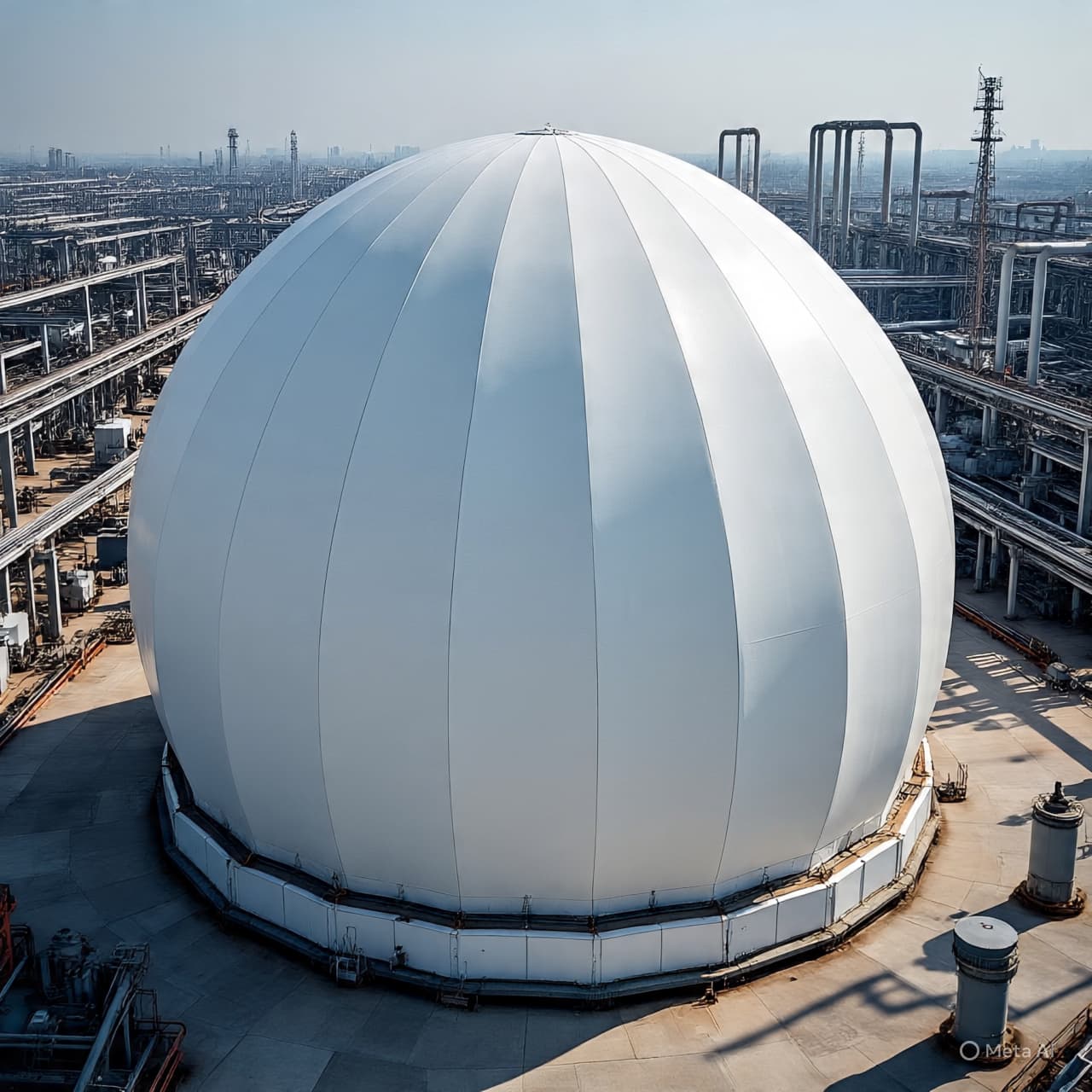
At first glance, it looks almost playful — a vast inflatable dome rising gently against an industrial skyline, more festival structure than power plant. Yet beneath its soft contours lies a serious ambition: to solve one of renewable energy’s most persistent problems, how to store power when the sun sets and the wind stills.
This structure is not a novelty, but a carbon dioxide battery. Designed to store excess renewable energy for up to a full day, the system relies on pressure, phase change, and familiar physics rather than rare minerals or massive chemical cells. Its simplicity is part of its appeal, offering a different path in the crowded search for long-duration energy storage.
The concept works by using surplus electricity to compress carbon dioxide gas, which is then stored inside the sealed dome. As the gas is compressed, it releases heat, which is captured and stored separately. When electricity is needed again, the process is reversed: the CO2 is allowed to expand, driving turbines to generate power, while the stored heat is reintroduced to improve efficiency.
Unlike traditional batteries, the system does not degrade significantly over time. Carbon dioxide can be reused indefinitely, and the mechanical components are designed for long operational life. This durability makes the technology particularly attractive for grid-scale storage, where longevity and predictable performance matter more than compact size.
Supporters argue that such systems could complement lithium-ion batteries rather than replace them. While chemical batteries excel at short bursts of energy, CO2-based storage is better suited for sustained output, filling gaps that stretch across hours rather than minutes. The dome itself, though visually striking, is simply the most visible part of a larger industrial process.
There are, however, limits. The technology requires space, careful engineering, and upfront investment. Its efficiency, while competitive, depends on precise thermal management. Still, as grids incorporate more solar and wind power, the value of reliable, long-duration storage continues to rise.
In that context, the inflatable dome becomes more than an oddity. It represents a shift toward storage solutions shaped by physics and patience rather than speed alone. Quietly, and under pressure, it suggests that the future of clean energy may sometimes arrive looking softer than expected.
Published by Banx Network. This article is part of the Banx decentralized media programme, powered by the BXE token on the XRP Ledger.