Scientific progress is often measured not only by remarkable discoveries but also by the quiet persistence of those who dedicate their lives to understanding nature. Some breakthroughs arrive in dramatic moments, while others emerge through decades of careful thought, gradually reshaping how the world understands its most fundamental processes.
Rudolph A. Marcus, the Nobel Prize-winning chemist whose pioneering work transformed the understanding of electron transfer reactions, has died at the age of 102. Marcus passed away peacefully at his home on July 16, 2026, just days before his 103rd birthday. According to the California Institute of Technology (Caltech), he remained actively engaged in research until the end of his life and was working on three scientific papers at the time of his death.
Marcus received the 1992 Nobel Prize in Chemistry for developing what became known as Marcus Theory, a mathematical framework explaining how electrons move between molecules during chemical reactions. His work provided scientists with a powerful tool for understanding reaction rates in countless natural and technological processes, ranging from corrosion and photosynthesis to battery chemistry and catalysis.
Born in Montreal, Canada, on July 21, 1923, Marcus earned both his bachelor's and doctoral degrees in chemistry from McGill University before pursuing research in Canada and the United States. After academic appointments at the Polytechnic Institute of Brooklyn and the University of Illinois, he joined Caltech in 1978, where he spent nearly five decades advancing theoretical chemistry and mentoring generations of researchers.
One of Marcus' most influential contributions involved explaining why some electron-transfer reactions occur rapidly while others proceed much more slowly, despite appearing similar. His theory also predicted the counterintuitive Marcus inverted region, in which increasing the energy driving a reaction can actually reduce its rate. Initially regarded with skepticism, the prediction was later confirmed experimentally and became a cornerstone of modern chemical physics.
The impact of Marcus' research extends far beyond academic chemistry. His theoretical framework has influenced studies of solar energy conversion, biological respiration, semiconductor technology, electrochemistry, and renewable energy systems. Scientists continue applying his ideas to improve batteries, catalysts, and artificial photosynthesis, demonstrating how fundamental research can shape practical innovation decades after its original publication.
Colleagues remembered Marcus not only for his scientific achievements but also for his enduring curiosity and humility. Caltech noted that he authored more than 500 scientific publications across nearly eight decades while remaining an active mentor and collaborator well past his 100th birthday. His commitment to research reflected a lifelong belief that scientific discovery begins with thoughtful questions rather than immediate answers.
Rudolph Marcus leaves behind a legacy that reaches across chemistry, physics, biology, and engineering. While his passing marks the end of an extraordinary scientific career, the principles he uncovered continue to guide researchers exploring the movement of electrons—the invisible pathways that power life, technology, and countless natural processes.
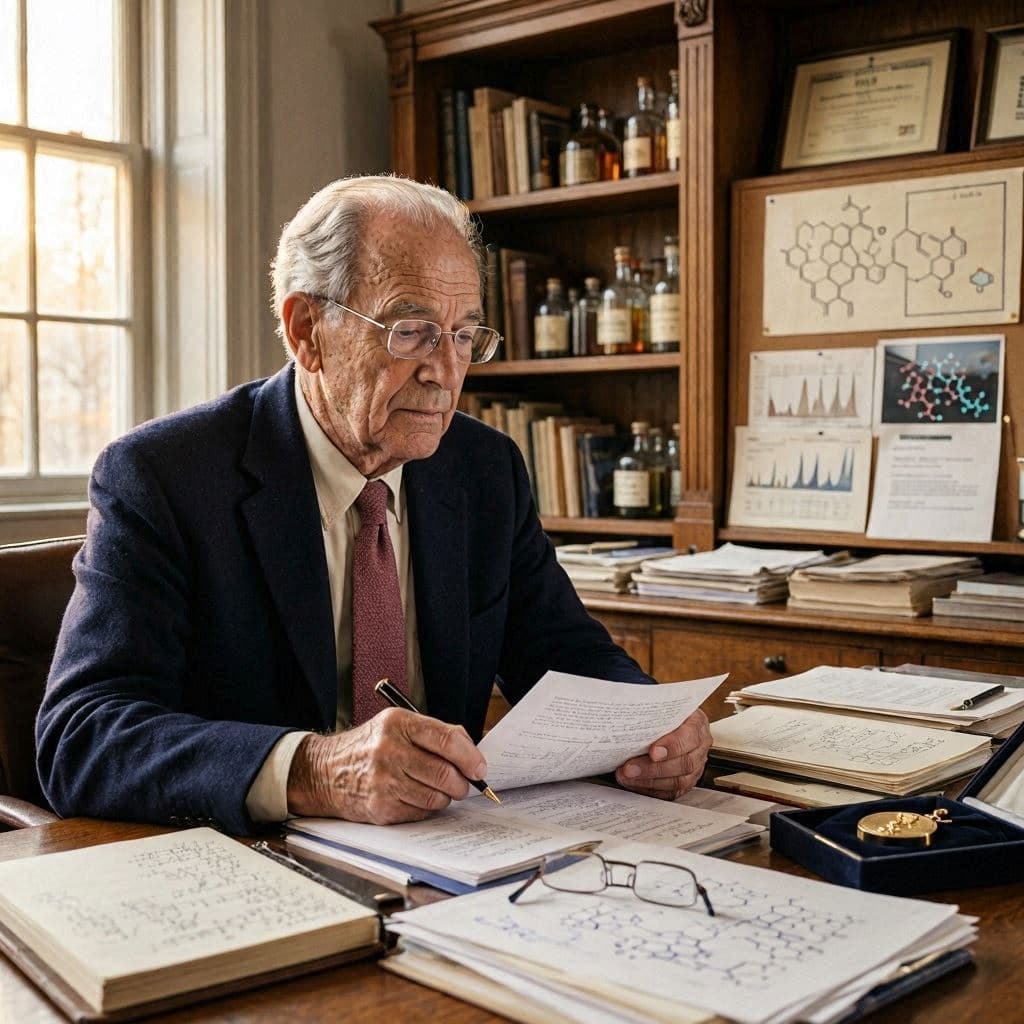
AI Image Disclaimer: The accompanying images are AI-generated artistic representations created to illustrate this news report and are not authentic historical photographs.
Source Verification Check: Verified
Sources: Caltech, Los Angeles Times, Nobel Prize, Pasadena Now
Published by Banx Network. This article is part of the Banx decentralized media programme, powered by the BXE token on the XRP Ledger.