There are moments in astronomy when the universe appears less like an expanse of cold vacuum and more like a gallery of living forms. Spiral arms unfurl like petals. Nebulae glow like drifting embers. And sometimes, across the canvas of deep space, a galaxy stretches outward in a shape that feels almost biological — delicate, flowing, strangely familiar. It is in one of these moments that a “cosmic jellyfish” has emerged from the dark.
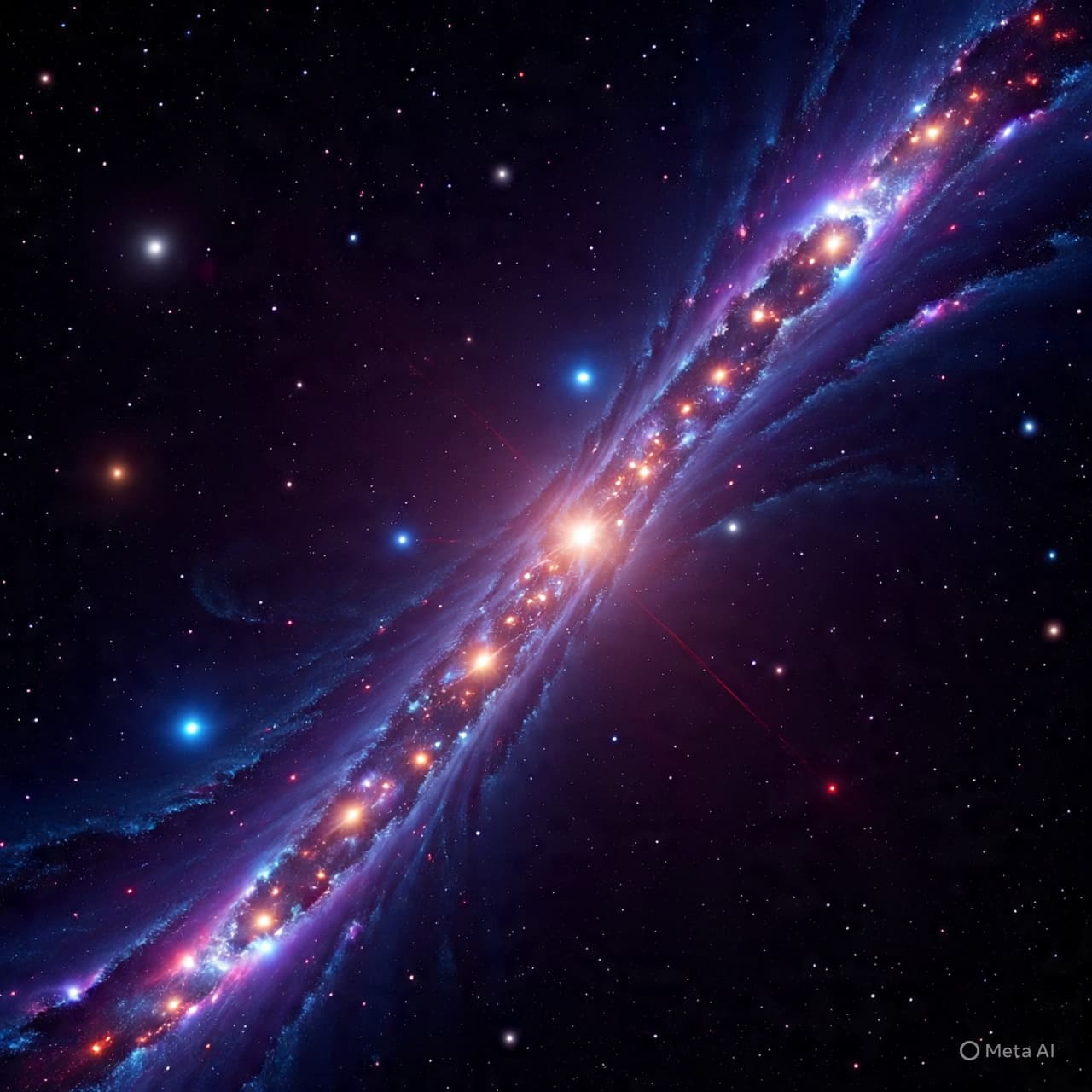
Using the powerful eye of the , astronomers have captured a striking image of a galaxy shaped by a dramatic process known as ram-pressure stripping. The image, released in collaboration with and its international partners, reveals long, trailing streams of gas and newly forming stars that extend behind the galaxy like luminous tentacles.
Jellyfish galaxies earn their name from these extended tails. As a galaxy moves at high speed through the dense environment of a galaxy cluster, the hot intergalactic medium acts like a headwind. Gas — the essential fuel for star formation — is pushed out of the galaxy’s disk, streaming behind it in glowing arcs. Over time, this process can dramatically alter the galaxy’s structure and star-making capacity.
Webb’s infrared sensitivity allows scientists to peer through dust and capture details previously obscured. Within the trailing filaments, researchers have identified pockets of active star formation, suggesting that even as gas is stripped away, it can collapse into new stars in the wake. In this way, the galaxy’s loss becomes a site of creation — a reminder that cosmic evolution often unfolds through tension and transformation.
Understanding jellyfish galaxies helps astronomers piece together larger questions about galactic evolution. Why do some galaxies continue forming stars while others fall quiet? How do interactions within clusters shape their long-term development? The stripping of gas may gradually starve a galaxy of the material needed to birth new stars, nudging it toward a more passive state.
The environment of galaxy clusters plays a decisive role in this story. These clusters, bound together by gravity and permeated by extremely hot gas, create conditions that can dramatically reshape their members. Webb’s detailed observations provide clues about the timing, scale, and consequences of these interactions, refining theoretical models that describe how galaxies grow and change.
There is a quiet paradox in the image. The galaxy appears fragile, its luminous strands stretched thin across the void. Yet it is precisely this vulnerability — this interaction with its environment — that reveals deeper truths about cosmic structure. Evolution, in space as on Earth, is rarely isolated. It unfolds through encounter.
In straightforward terms, astronomers using the James Webb Space Telescope have imaged a jellyfish galaxy whose extended gas tails offer new insight into how galaxies evolve within dense clusters. The findings contribute to ongoing research into star formation, gas dynamics, and long-term galactic transformation.
AI Image Disclaimer Images in this article are AI-generated illustrations, meant for concept only.
Sources (Media Names Only)
NASA Space.com Live Science The Guardian Reuters
Published by Banx Network. This article is part of the Banx decentralized media programme, powered by the BXE token on the XRP Ledger.