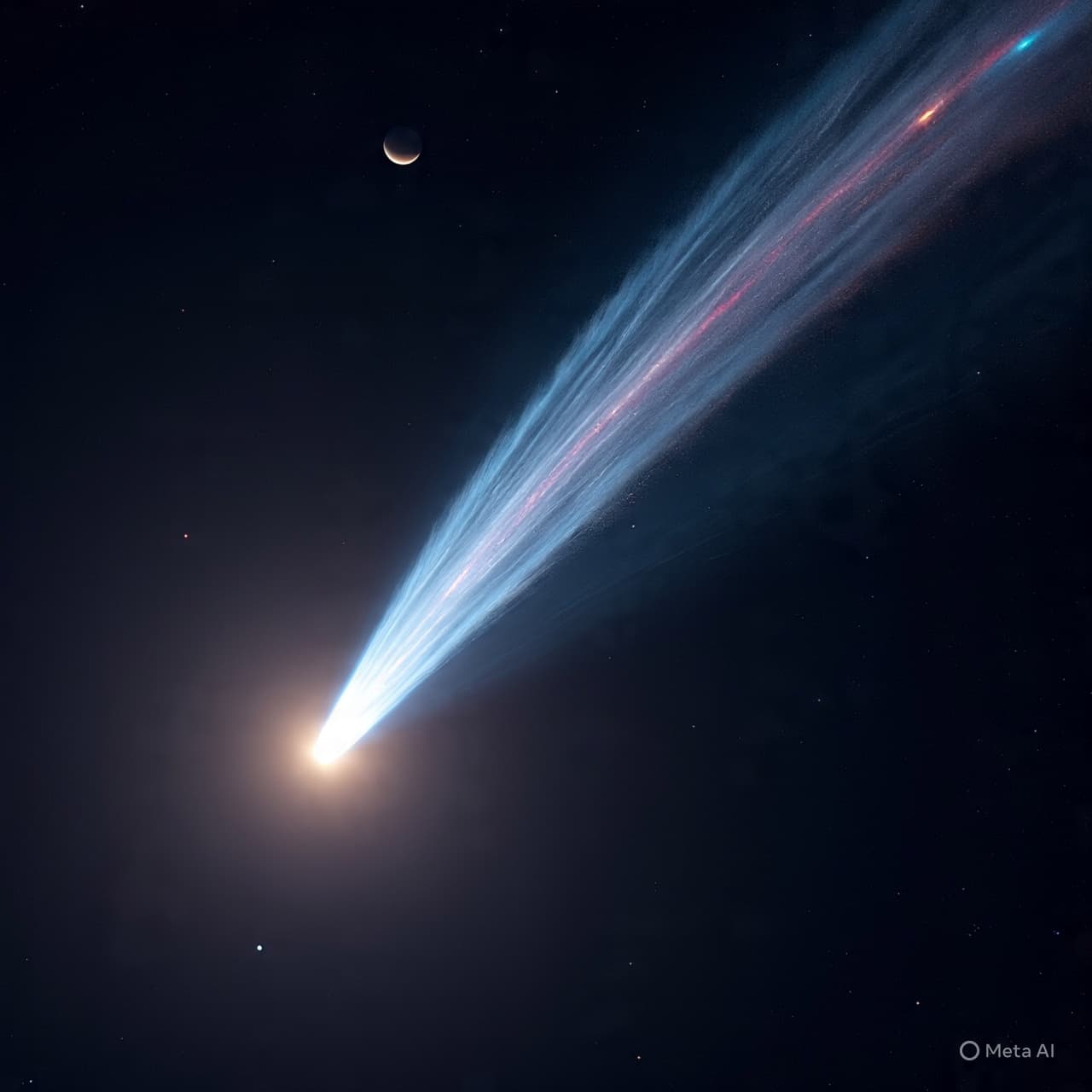
Some motions in the universe feel eternal. Planets circle, stars drift, and comets—those wandering archives of ice and dust—trace long, patient arcs around the Sun. Their journeys seem steady, almost rehearsed, as though guided by a rhythm older than memory. Yet, every so often, a small traveler hesitates. It slows, shifts, and quietly rewrites the direction of its own spin, as if pausing mid-sentence in a story written across the sky.
This is what the Hubble Space Telescope has recently witnessed: a comet not merely moving through space, but altering the way it turns within it. Observations reveal a subtle but profound change—its rotation, once steady, has begun to slow, and then, remarkably, reverse. The image is almost poetic: a celestial body applying its own brakes, as though reconsidering the path it has taken for millennia.
The cause of this reversal is not an external collision or sudden disruption, but something quieter and more intimate. As comets approach the Sun, their icy surfaces warm, releasing jets of gas and dust. These outgassing events act like tiny thrusters, pushing unevenly across the comet’s surface. Over time, these gentle but persistent forces can alter its rotation. In this case, they have done more than nudge—they have gradually brought the comet’s spin to a halt and then set it turning in the opposite direction.
Scientists supported by agencies like NASA and the European Space Agency have long understood that comets are dynamic, evolving objects. But witnessing such a clear reversal offers something rarer: a direct glimpse into how delicate forces accumulate across time. Each jet of vapor is small, almost insignificant on its own, yet together they reshape motion itself. It is a reminder that in space, as in nature, persistence often outweighs force.
There is also a quiet tension in this transformation. A comet that changes its spin so dramatically may be approaching instability. As its rotation shifts, stresses can build within its structure. Cracks may widen, fragments may loosen, and eventually, the comet could begin to break apart. This is why such objects are often described as “doomed”—not in a dramatic sense, but in the gentle inevitability of physical processes playing out over time.
Coverage from outlets such as Space.com and discussions in publications like Scientific American have highlighted how rare and informative these observations are. They allow scientists to refine models of comet behavior, to better understand how rotation, structure, and solar heating interact. Even within the vastness of space, small changes carry meaning.
And so, the comet continues its journey—not quite as it began, but not entirely undone. It turns now in the opposite direction, carrying with it the quiet evidence of forces that cannot be seen but can be measured in time. The Hubble Space Telescope has simply watched, patient as ever, recording a moment when motion itself chose to pause and begin again.
In closing, astronomers note that such rotational reversals provide valuable insight into comet evolution and structural stability. While the long-term fate of this particular comet remains uncertain, ongoing observations will continue to inform how these small bodies respond to solar heating and internal stress over time.
AI Image Disclaimer Illustrations were produced with AI and serve as conceptual depictions.
Source Check (Credible Coverage Exists):
NASA European Space Agency Space.com Scientific American Nature
Published by Banx Network. This article is part of the Banx decentralized media programme, powered by the BXE token on the XRP Ledger.