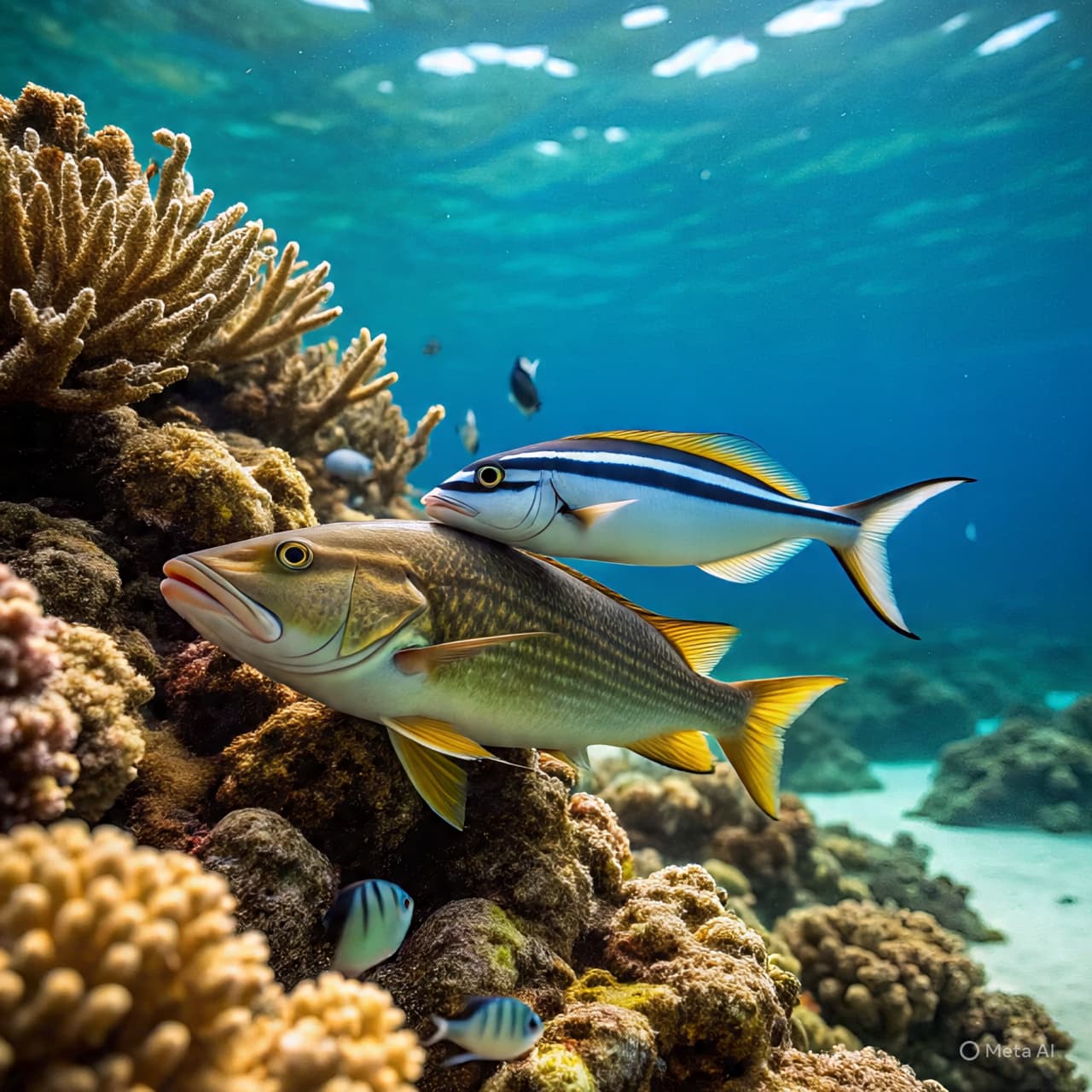
There is something quietly humbling about watching a small fish at work along a coral reef. It darts, pauses, inspects, and returns again — as if guided by more than instinct alone. In the bright, restless world beneath the waves, cleaner fish have long been seen as diligent attendants, removing parasites from larger fish in a relationship that seems almost transactional. Yet recent research invites us to look again, and perhaps more carefully. Beneath their quick movements and modest size may lie signs of intelligence and even self-awareness once thought to belong chiefly to mammals.
Cleaner fish, particularly the bluestreak cleaner wrasse, have become unlikely protagonists in the study of animal cognition. For years, scientists have explored how these fish navigate complex social environments on coral reefs. They remember frequent “clients,” adjust their behavior depending on who is watching, and even appear to negotiate during interactions. Such behaviors have gradually shifted perceptions, suggesting that intelligence in the animal kingdom may be more widely distributed than previously assumed.
The most striking findings emerged from variations of the mirror self-recognition test — an experiment historically used to assess self-awareness in animals such as primates, dolphins, and elephants. In these studies, a mark is placed on an animal’s body in a spot visible only with a mirror. If the animal uses the mirror to investigate or attempt to remove the mark, researchers interpret this as a sign of self-recognition.
When cleaner fish were exposed to mirrors under controlled conditions, their responses unfolded in stages. Initially, they reacted as though encountering another fish — displaying social or territorial behaviors. Over time, however, their reactions shifted. When marked with a colored spot, some cleaner fish attempted to scrape the mark off their bodies after seeing their reflection, a behavior they did not show when the mark was transparent. The pattern raised an intriguing question: were these fish recognizing themselves?
The implications ripple outward gently but persistently. For decades, the mirror test has been treated as a kind of cognitive threshold — a dividing line between animals that possess a sense of self and those that do not. Yet cleaner fish challenge that boundary. If a small reef fish can demonstrate behaviors consistent with self-recognition, then perhaps the test measures something more nuanced than previously believed. It may reflect ecological intelligence — the ability to interpret reflections as useful information — rather than self-awareness in the human sense.
Scientists remain careful in their interpretations. Some researchers argue that passing the mirror test does not necessarily confirm self-awareness as humans experience it. Others suggest that intelligence should not be measured by a single experimental standard. What is clear, however, is that cleaner fish exhibit sophisticated problem-solving abilities, social awareness, and behavioral flexibility that complicate older assumptions about fish cognition.
In coral reef ecosystems, cleaner fish manage delicate relationships daily. They must balance cooperation with self-interest, as they sometimes prefer to eat protective mucus rather than parasites — a choice that can upset their larger clients. Observations show they adjust their behavior depending on circumstances, a subtle dance of trust and strategy that hints at advanced social processing.
Perhaps the broader lesson is less about ranking species and more about widening perspective. Intelligence may not belong exclusively to warm-blooded mammals or large-brained animals. It may appear in varied forms, shaped by ecological need rather than evolutionary prestige. The reef, vibrant and intricate, becomes not only a habitat but a classroom.
In straightforward terms, multiple peer-reviewed studies have reported that cleaner fish display complex cognitive behaviors, including responses in mirror recognition experiments. Researchers continue to debate how these findings should be interpreted, but the evidence supports the view that certain fish species possess higher levels of intelligence than once assumed.
And so, in the shifting light of shallow tropical waters, a small fish continues its work — unaware, perhaps, of the philosophical waves it has stirred above the surface.
AI Image Disclaimer Graphics are AI-generated and intended for representation, not reality.Source Check (Credible Media Coverage Identified):
BBC News The Guardian National Geographic Nature Science
Published by Banx Network. This article is part of the Banx decentralized media programme, powered by the BXE token on the XRP Ledger.