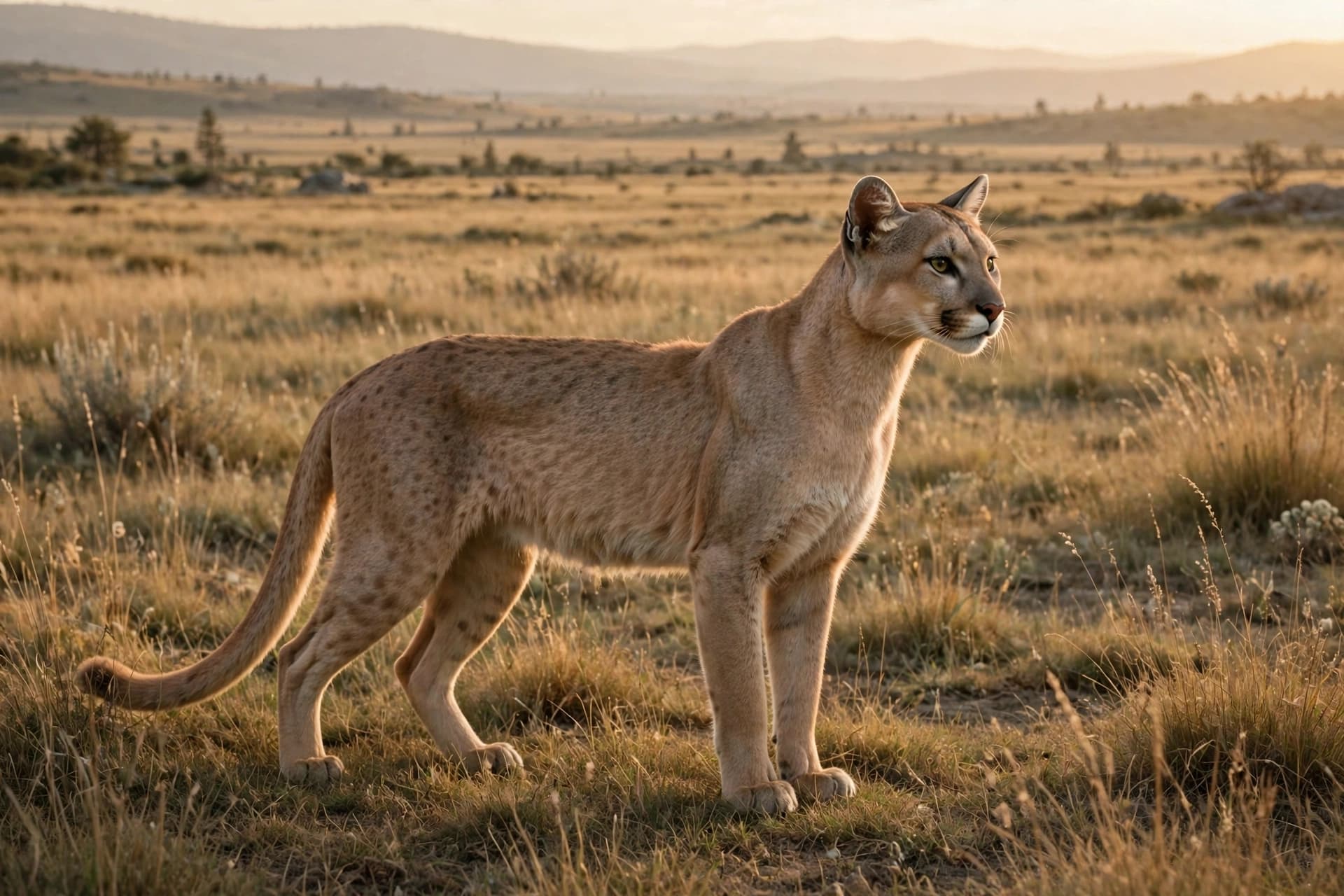
There is a particular kind of error that settles into scientific names, a shorthand that becomes a story and then becomes a fact. The extinct cat known as the "American cheetah" earned its nickname from its slender body, long legs, and large nasal cavities—features that reminded paleontologists of the African cheetah. But ancient DNA has now revealed that the resemblance was a coincidence, a case of convergent evolution rather than close kinship. Miracinonyx trumani was not a cheetah at all. It was a puma's cousin, and its story is stranger and more adaptable than its nickname ever suggested.
The research, published in Current Biology, was led by Molly Cassatt-Johnstone of the University of California, Santa Cruz. Her team sequenced the most complete ancient DNA set to date from four M. trumani specimens: one from a cave in Wyoming and three from Canada's Yukon territory . The Yukon samples were previously thought to belong to a different species, but the DNA confirmed they were M. trumani, extending the known range of the animal more than twenty degrees of latitude farther north than previously known.
The genomic analysis placed M. trumani as most closely related to the modern puma, having diverged from a common ancestor around 2.6 million years ago. Its last shared ancestor with the African cheetah lived roughly 4.7 million years ago, which means the two cats evolved their similar builds independently . The American cheetah's speed-adapted morphology was not inherited from a cheetah ancestor. It evolved on its own, shaped by the open grasslands of Pleistocene North America.
The diet was another surprise. The long-standing assumption was that M. trumani hunted pronghorn on the plains, a fast predator chasing a fast prey. But pronghorn did not live as far north as the Yukon, and the team wanted to know what the northern cats ate. Stable isotope analysis of the Yukon fossils revealed nitrogen levels about six parts per thousand higher than contemporary carnivores and their terrestrial prey—a signal consistent with a diet of fish. The Wyoming cat, by contrast, showed the chemical signature of a terrestrial predator that ate herbivores, similar to a lion . The same species, in different places, had adopted radically different diets.
The researchers also found that two of M. trumani's genes involved in circadian rhythm regulation were nonfunctional. These genes help control an animal's internal clock, using cues like sunlight to determine when to sleep. The loss may suggest that populations at high latitudes adapted to extreme periods of daylight and darkness, or that the animals were nocturnal . It is another piece of evidence that this was not a single, inflexible predator but a species capable of adjusting to radically different environments.
Cassatt-Johnstone offered a reflection that extends beyond this one cat. It is very hard to imagine a prehistoric species we have never seen without comparing it to something we know, she said. But that approach can limit our understanding of ancient animals' complexity, unique evolutionary histories, and behaviors . The American cheetah was not a cheetah. It was a puma relative that looked like one, ate fish in the Arctic, and may have been nocturnal. The nickname was a starting point, not a conclusion.
The species went extinct as the last ice age transitioned to the warmer Holocene, along with the woolly mammoth and other large mammals of Beringia . Its fossils are rare, and its story is still being assembled from fragments of bone and DNA. But the picture that has emerged is of an animal far more adaptable than its nickname implied—a cat that could chase prey across the plains or fish in northern waters, that could live under the midnight sun or the long Arctic night. It was not a cheetah. It was something else entirely, and now we know a little more of what that something was.
Image note: The visual content in this article was generated using artificial intelligence and does not depict the actual fossils or the living animal.
Sources: Cell Press, Current Biology, EurekAlert, ScienceDirect, Yahoo News
Published by Banx Network. This article is part of the Banx decentralized media programme, powered by the BXE token on the XRP Ledger.