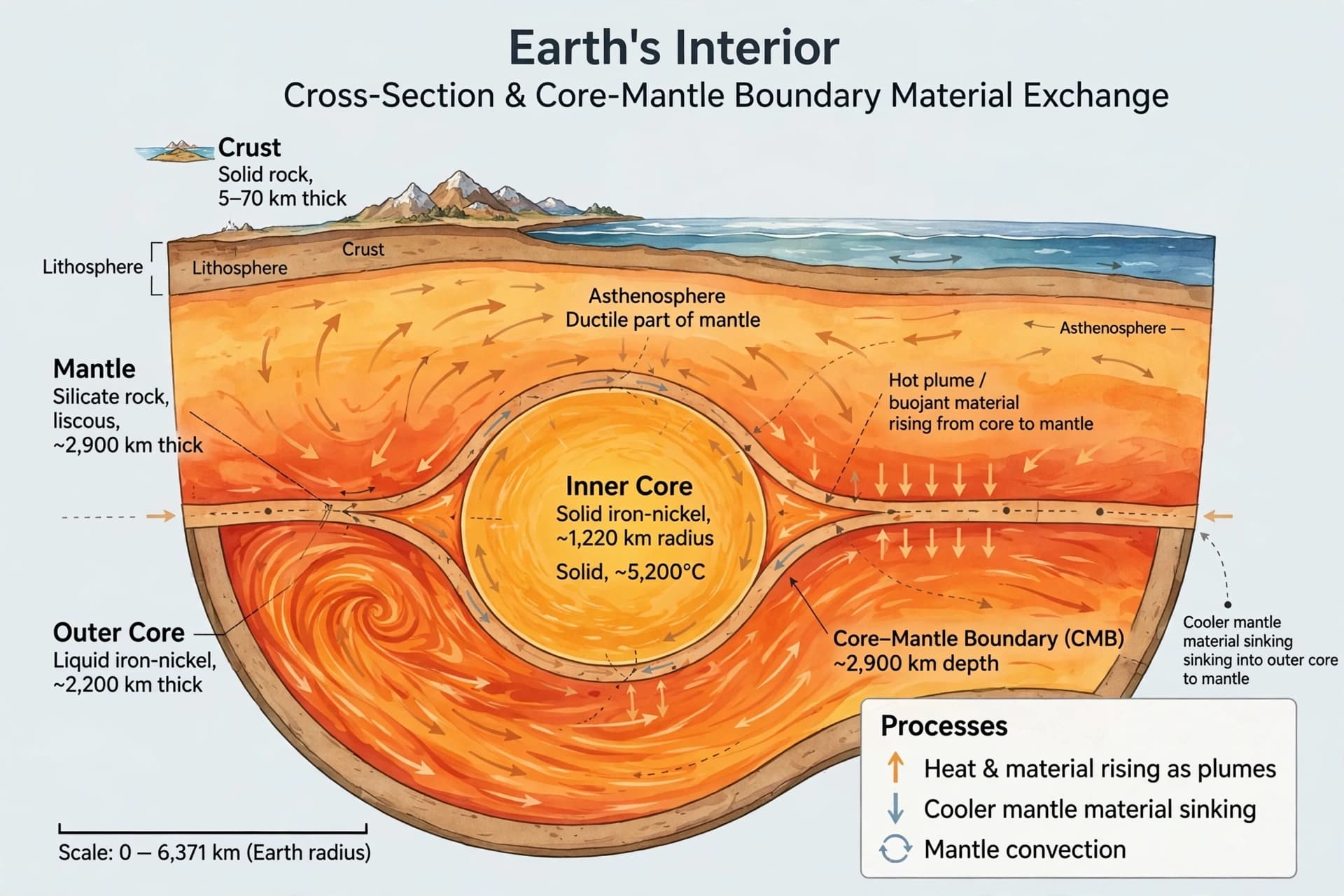
There is a certain comfort in the old diagram of Earth's interior—the neat concentric circles, the iron core locked away from the rocky mantle, the whole system sealed like a vault. It is a model that has served textbooks well for generations. But science has a habit of unsettling comfortable diagrams, and new research suggests that the boundary between core and mantle may be less a wall than a slow, ancient exchange.
A study published in Science Advances has found evidence that hydrogen—a key component of water—has been leaking from Earth's metallic core into the lower mantle over billions of years, eventually influencing the chemistry of volcanic rocks that reach the surface . The researchers examined unusual hydrogen isotope signatures in lavas from Baffin Island in the Canadian Arctic, rocks that erupted some 62 million years ago above a mantle plume now located beneath Iceland .
The clue lies in the ratio of deuterium to normal hydrogen. The Baffin Island lavas contain exceptionally low deuterium levels, a signature that is difficult to explain through surface processes or ordinary mantle mixing. Computer simulations replicating deep-Earth conditions showed that as Earth's ancient magma ocean cooled and crystallized, hydrogen isotopes distributed relatively evenly throughout the mantle . The extreme depletion observed in these rocks required another source—one that had been isolated for eons and carried a distinct isotopic fingerprint.
That source, the researchers argue, is the core. As iron sank to form the core during Earth's early differentiation, it absorbed lighter hydrogen preferentially, leaving the core depleted in deuterium . Over geological time, some of that hydrogen-rich material appears to have escaped across the core-mantle boundary and been carried upward by mantle plumes. The same volcanic rocks also show elevated ratios of helium-3 to helium-4, a rare isotope that may have been preserved in the core since the planet's formation, along with unusual tungsten and ruthenium signatures that point toward a core contribution .
What makes this finding significant is not only the leak itself but what it implies about the planet's interior dynamics. Rather than two entirely separate chemical reservoirs, the core and mantle may have exchanged volatile elements over billions of years, allowing material from the deepest interior to influence the composition of rocks at the surface. The researchers estimate that if the present-day convecting upper mantle has an average deuterium composition between that of seawater and the core, roughly 8 to 37 percent of the hydrogen in the upper mantle may derive from the core .
The work does not close the question. The exact mechanism by which material crosses the core-mantle boundary remains unclear, and future studies will be needed to trace that pathway. But the evidence adds to a growing picture of a planet that is not a set of sealed layers but a system in slow, persistent conversation with itself. The vault, it seems, has a door.
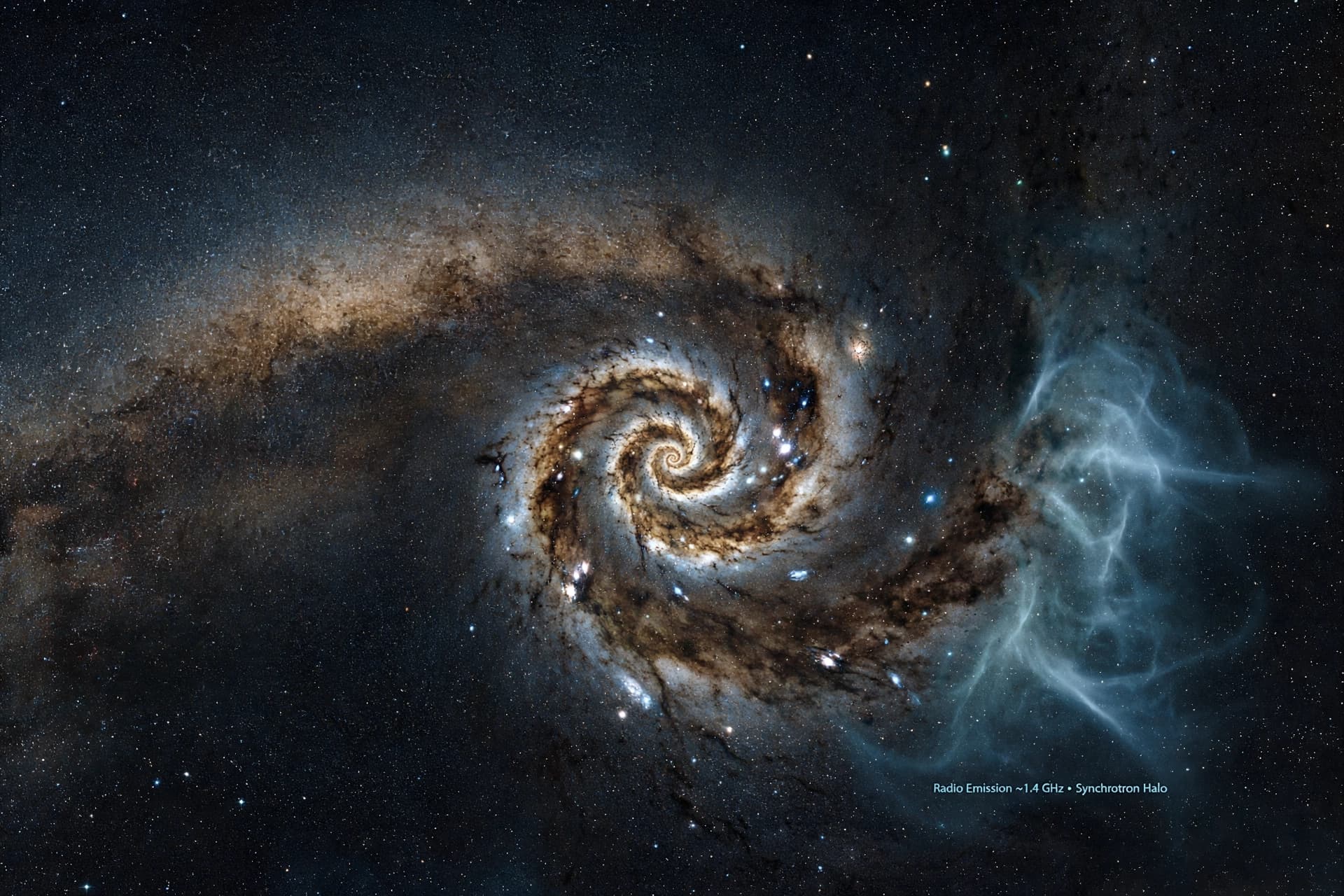
The images in this article are AI-generated for illustrative purposes only.
Sources: Science Advances, Gizmodo, Nature (via cited reports), National Science Foundation
Published by Banx Network. This article is part of the Banx decentralized media programme, powered by the BXE token on the XRP Ledger.