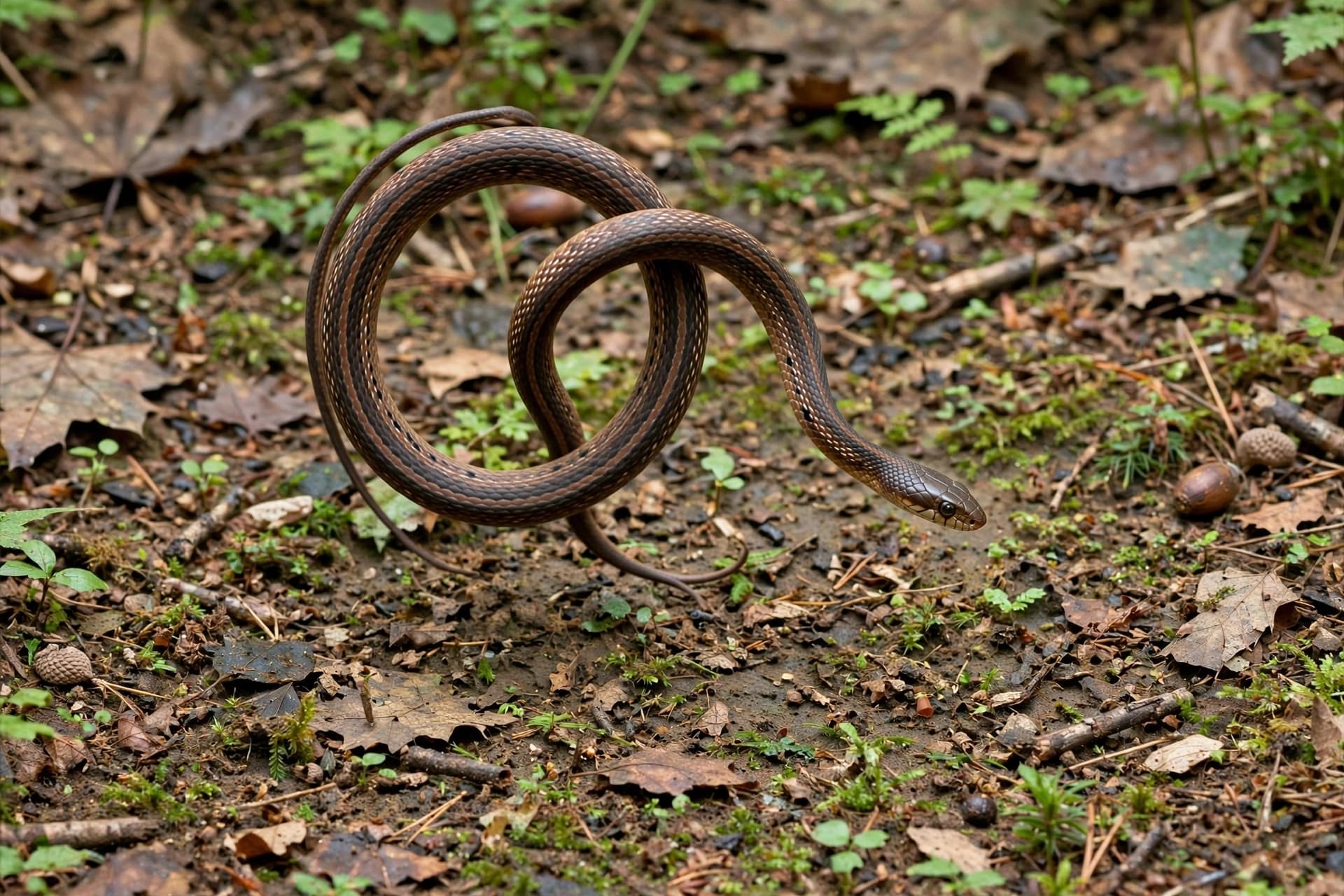
There is something almost comical about a snake doing a cartwheel—a creature defined by its sinuous, ground-hugging motion suddenly throwing itself into a roll, tumbling end over end like a wheel that has lost its axle. But comedy is not the point. When a dwarf reed snake cartwheels, it is running for its life, and it is doing so at a speed that puts most human joggers to shame.
Researchers in Japan have now captured the maneuver on video from multiple angles, revealing how three species of dwarf reed snakes (genus Pseudorabdion) achieve their remarkable escape. The findings, published in Current Biology, show that the snakes can travel at speeds of up to 1.7 to 3.7 meters per second—roughly 6 to 13 kilometers per hour, or about 12 feet per second at their fastest . That is approximately four times faster than they can move by slithering .
The mechanics are precise and surprisingly elegant. The snake begins by curling its body into a C-shape, lifting its head and pointing it in the direction it wants to go. It then straightens forcefully, whipping its tail backward and briefly launching itself off the ground. The tail swings forward and over the head, landing ahead, and the cycle repeats—a continuous, rolling motion that propels the snake forward in a series of loops . Throughout the maneuver, the head remains relatively stable and facing the direction of travel, a crucial detail that allows the snake to maintain control and see where it is going while the rest of its body rotates .
The behavior was first scientifically documented in 2023, but the new footage provides a detailed look at how the movement is executed. The researchers filmed thirteen snakes from three Pseudorabdion species, along with six related reed snakes from the Calamaria group for comparison. All thirteen Pseudorabdion snakes performed the cartwheel; none of the Calamaria snakes did . The snakes kept to a track just twenty centimeters wide while rolling, suggesting a high degree of coordination .
What remains unknown is how this ability evolved and why only some closely related snakes possess it. The researchers have not yet determined whether the cartwheeling species have special physical features or simply coordinate their muscles differently . The behavior is also not sustainable for long periods. The snakes appear to use it only when extremely threatened, and they tend to dive underneath nearby objects for cover after rolling .
There is a lesson in the dwarf reed snake's escape that extends beyond herpetology. Evolution does not always favor the most obvious solution. For a small snake in a forest full of predators, the ability to turn oneself into a wheel—briefly, desperately, and at surprising speed—is a solution that works. It is strange, and it is effective, and it has been hiding in the leaf litter of Southeast Asian forests for longer than anyone thought to look.
This article includes AI-generated images for illustrative purposes.
Sources: Live Science, BBC, Nautilus, India Today, Current Biology
Published by Banx Network. This article is part of the Banx decentralized media programme, powered by the BXE token on the XRP Ledger.