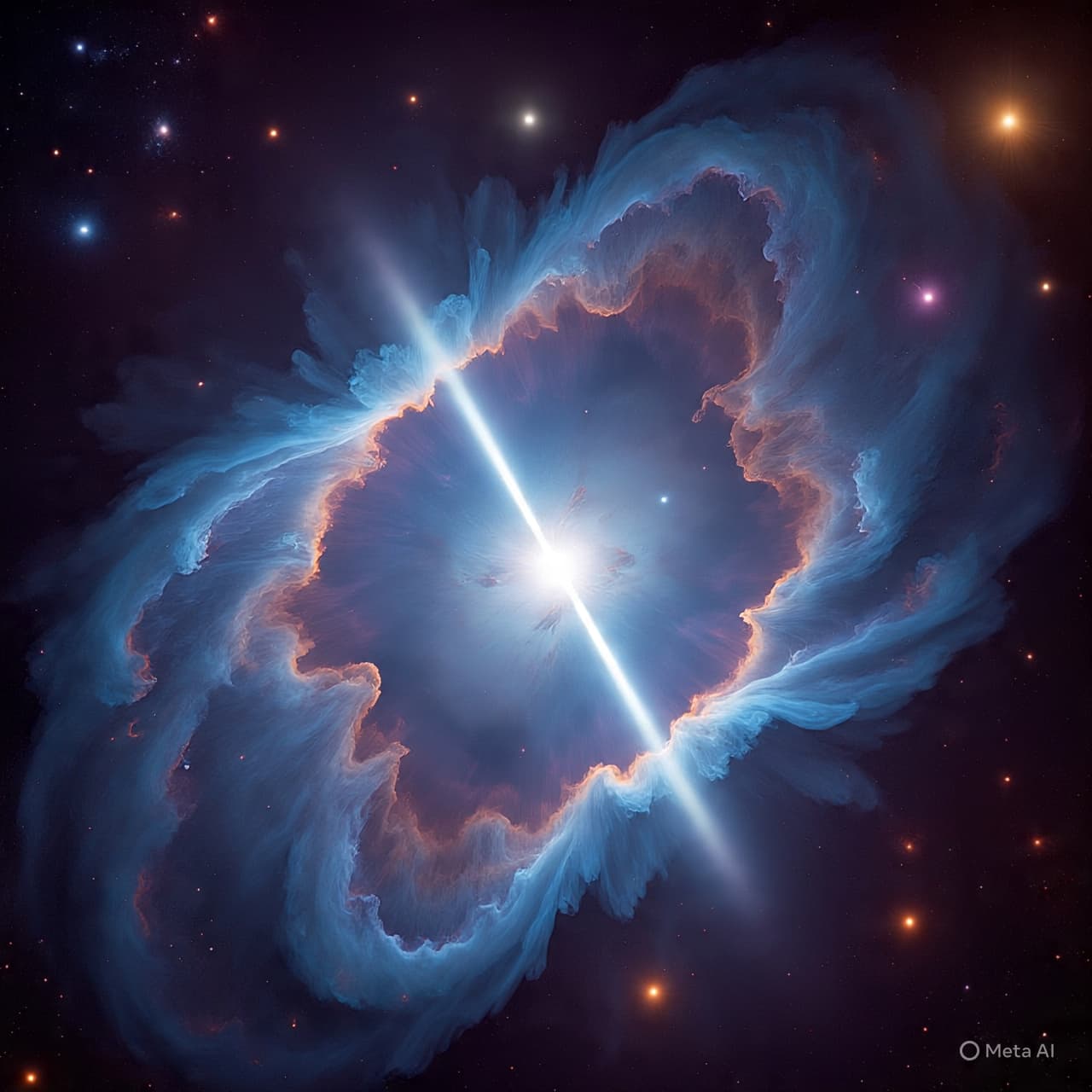
In the vast amphitheater of the night sky, some scenes feel so familiar that we mistake them for quiet certainty. The Ring Nebula has long been one of those. Like a painted circle suspended in velvet darkness, it has inspired awe and admiration for centuries — a testament to the life cycle of stars and the beauty of cosmic change. But recently, beneath that serene shell of glowing gas, astronomers have detected something unexpectedly tangible: a long, narrow structure rich in iron atoms that cuts across the heart of the nebula, as if a cosmic artisan has threaded a metal rod through an old tapestry.
What makes this discovery so captivating is not just its material — elemental iron, stripped of electrons and glowing in forbidden light — but its very shape. This “bar” of ionized iron does not follow the nebula’s gentle ringlike curves; it stretches across the interior like a silent arrow pointing to unanswered questions. Its presence was revealed by an innovative instrument called WEAVE on the William Herschel Telescope, which allowed scientists to capture detailed spectra across the nebula’s face and, in doing so, see where specific chemical signatures lurked in places they had never been noticed before.
Astronomers say the iron bar spans a tremendous distance — roughly 500 times the distance from Earth to Pluto — and may contain as much iron as a rocky world such as Mars. Even though the nebula itself has been studied by telescopes like Hubble and James Webb for decades, this bar remained hidden until now because earlier observations couldn’t map the complete chemical landscape in the way WEAVE can.
The star that birthed the nebula was once much like our Sun — a bright, searing sphere of gas burning its nuclear fuel. As it reached the end of its life, it shed its outer layers into space, creating the intricate ring of glowing gas we see today. At the center now lies the dim remnant, a white dwarf quietly cooling while its former light bathes the expelled material. Somewhere in this transition from life to quiet embers, the iron bar was forged or left behind, and astronomers are still piecing together how that happened.
Two broad possibilities have been proposed. One is that the bar is a record of uneven or directional flows as the star expelled material in its final breaths — a sort of fossil imprint of how the dying star breathed its last. The other, more poetic idea, is that the iron bar could be the vaporized remains of a rocky planet that once orbited the star and was swallowed when the star expanded into a red giant. In that scenario, the planet’s metal heart could have been scattered into space, leaving behind this whisper of its existence, like embers from a fire long since faded.
Yet neither explanation is confirmed, and the subtle movements and composition of the iron structure will take further observation to unravel. What is clear is that even well-known cosmic neighbors can hold surprises — threads of mystery waiting for new tools and fresh eyes. In this sense, the Ring Nebula’s iron bar is a gentle reminder that nature often keeps secrets longer than we expect, and that our pursuit of understanding is an ongoing conversation between curiosity and discovery.
In the coming years, astronomers hope to use WEAVE and other instruments to observe similar nebulae, hoping to find more examples of these hidden structures. Each new insight, like a stanza in a long poem, adds depth to our understanding of stellar life cycles and the transformation of matter across space and time.
AI Image Disclaimer
“Visuals are created with AI tools and are not real photographs.”
Sources
1. Reuters 2. Space.com 3. University College London / UCL News 4. Royal Astronomical Society 5. Discover Magazine
Published by Banx Network. This article is part of the Banx decentralized media programme, powered by the BXE token on the XRP Ledger.