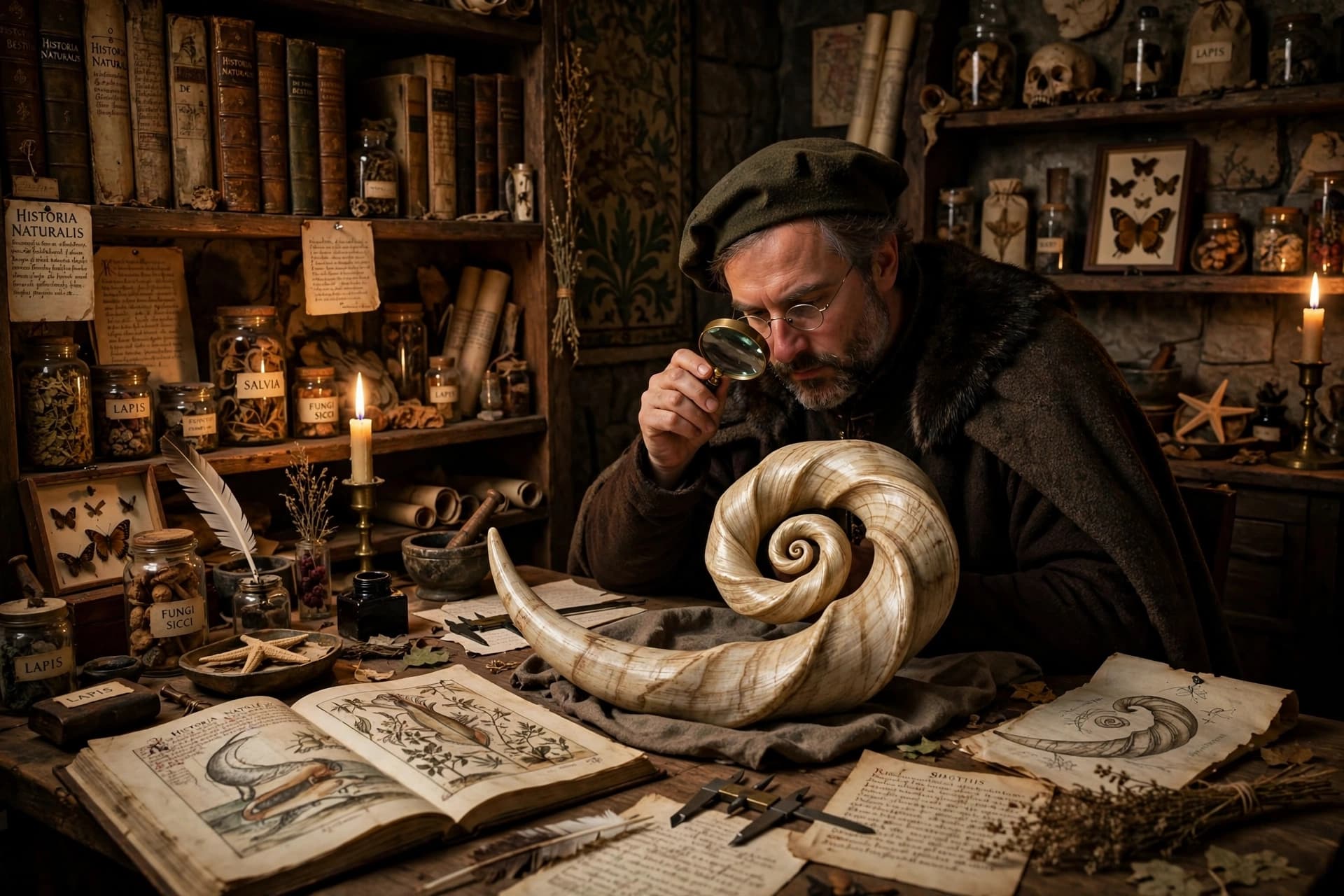
There is a particular poignancy in the way our ancestors encountered the deep past—not as a record to be read, but as a mystery to be fitted into the world they already knew. Before there was a science of vertebrate paleontology, before the concept of extinction was even thinkable, the bones and tusks that occasionally emerged from the earth were not evidence of vanished worlds. They were relics of giants, dragons, and unicorns. They were proof of the legends. And the people who found them were not being foolish; they were being human, reaching for the stories that made sense of what they could not explain.
In an excerpt from his new book, The Story of the Mammals in 25 Discoveries, author Donald R. Prothero explores this pre-scientific world, a time when the idea of extinction was considered blasphemous . If God had created all creatures, and if His creation was perfect, how could any of them simply cease to exist? The answer, for medieval and early modern thinkers, was that they had not. The creatures whose remains were unearthed were still out there somewhere, or they were the giants and monsters of scripture and myth. A giant tusk from Siberia might be the horn of a unicorn, or the tusk of a dragon . A skull with a single bony protrusion could only belong to a beast with a horn in the center of its forehead.
The unicorn legend, in particular, was sustained by a global trade in objects that were taken as proof of its existence. The spiraled tusks of narwhals, harvested from the Arctic, were sold across Europe as unicorn horns, their value so great that they were worth more than their weight in gold . The tusks of mammoths, unearthed from the permafrost of Siberia, were similarly reinterpreted—not as the remains of an extinct elephant, but as the horns of the mythical beast . And the fossilized remains of Elasmotherium sibiricum, a massive rhinoceros-like creature that once roamed Central Asia, may have provided another source for the legend. Known as the "Siberian unicorn," it weighed up to four tons and measured more than five meters long, and its skull bore a dome that paleontologists believe supported a keratinous horn . No horn has ever been found—it would have been made of keratin, the same material as hair and fingernails, and would not survive the millennia. But the myths of the Tatar people who once inhabited Siberia spoke of an animal with a horn so immense it could only be removed with a sledgehammer .
What makes this history worth remembering is not that medieval people were credulous, but that they were working with the tools they had. As Prothero notes, the path to understanding our own branch of the animal kingdom has not been straightforward . The fragments of the past—a tusk, a skull, a bone—were tokens of something larger, something that could only be described through the stories that were available . The unicorn was not a mistake. It was an interpretation, a way of fitting the strange into the familiar. And when the science finally arrived, it did not erase the wonder. It simply replaced one story with another, equally strange and equally true.
AI Image Disclaimer: All images in this article are AI-generated and are intended for illustrative purposes only.
Sources: Live Science, The Story of the Mammals in 25 Discoveries, Smithsonian Institution, Superinteressante
Published by Banx Network. This article is part of the Banx decentralized media programme, powered by the BXE token on the XRP Ledger.