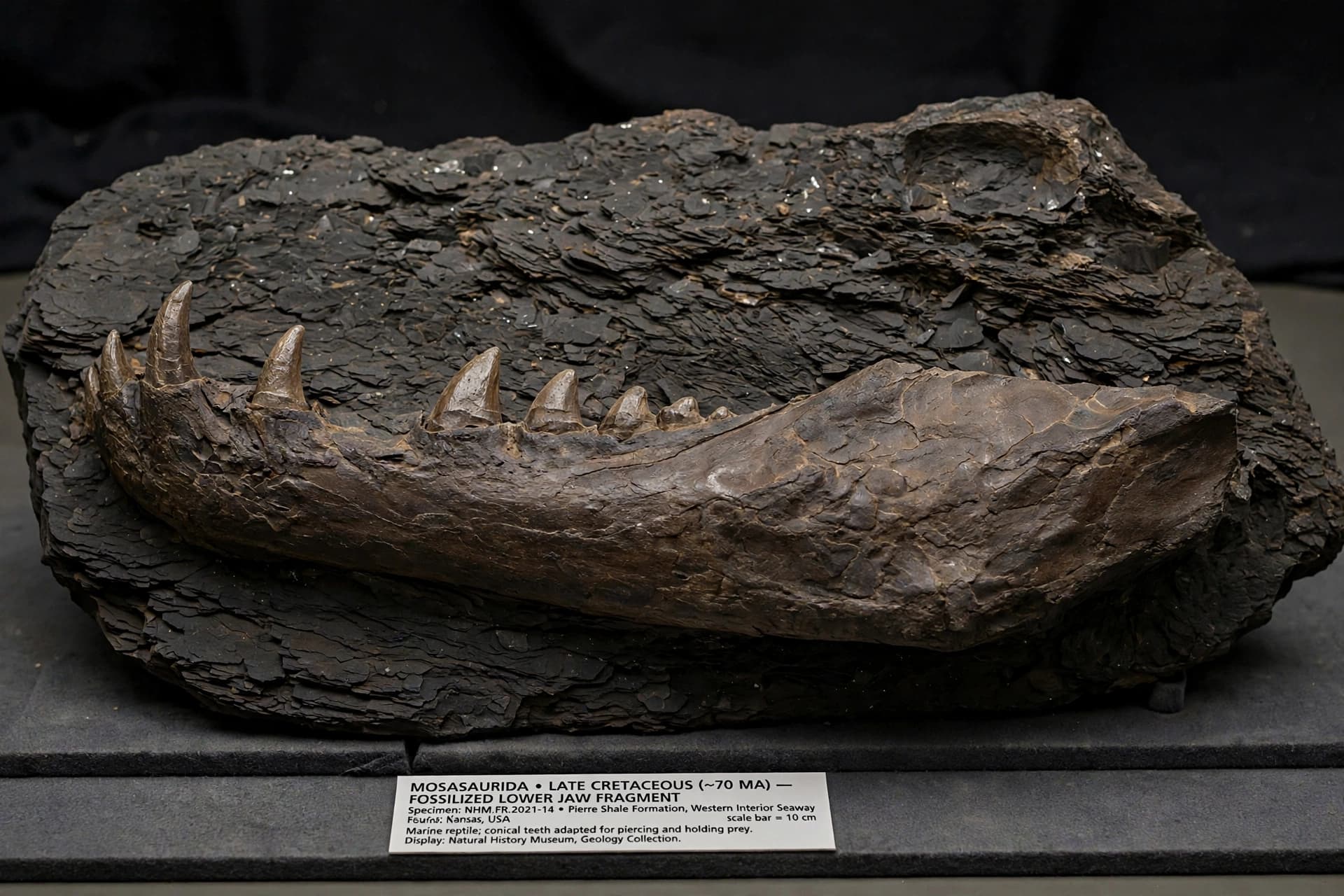
There is a particular kind of awe that comes from contemplating creatures that lived long before us, whose existence we know only through the fossils they left behind—bones turned to stone, teeth preserved in sediment, the silent architecture of a world we will never see. Among the most fearsome of these ancient inhabitants were the marine reptiles known as pliosaurs, apex predators of the Jurassic and Cretaceous seas, whose jaws were lined with teeth that could grow to lengths measured not in inches but in feet.
The Kronosaurus queenslandicus, a pliosaur from the Early Cretaceous of Australia, possessed teeth that reached approximately twelve inches from base to tip . These were not the serrated blades of a shark or the curved fangs of a crocodile; they were conical, robust, and designed for gripping and tearing. With a jaw capable of opening wide enough to swallow an adult human whole, the Kronosaurus was a predator that feared little and ate almost anything it could catch .
Paleontologists describe the Kronosaurus as one of the largest marine predators of its time, with an estimated body length of up to twelve meters . Its four large flippers propelled it through the waters of what is now Queensland, Australia, where its fossils were first discovered. The animal’s bite force has been compared to that of a modern saltwater crocodile—sufficient to crush bone and puncture the thick hides of other marine reptiles .
The teeth themselves tell a story of function. They were not serrated like the teeth of a great white shark, which slice through flesh. Instead, they were smooth-sided and interlocking, designed to seize prey and prevent escape . Some reconstructions suggest the Kronosaurus used its teeth to slash at the necks of prey or tear open their bellies, delivering wounds that would quickly incapacitate or kill. This was not a predator that relied on a single lethal bite; it was one that wore its prey down, inflicting trauma until the struggle ceased.
The taxonomy of the Kronosaurus remains a subject of debate among researchers. Only one species, K. queenslandicus, is universally accepted, and even its original fossil material—a fragment of lower jaw—is insufficient to define the genus with certainty . Other specimens once classified as Kronosaurus have since been reassigned to different branches of the pliosaur family, leaving the full picture of this predator’s diversity and range still incomplete .
What is clear is that the Kronosaurus occupied a niche at the very top of its ecosystem, a position it held through a combination of size, speed, and weaponry. Its fossils, though fragmentary, offer a window into a time when the oceans were ruled not by mammals but by reptiles—creatures whose dimensions and capabilities stretch the limits of our imagination.
The twelve-inch teeth of the Kronosaurus are more than a curiosity of natural history. They are a reminder that the world we inhabit is a recent development, a thin layer of time atop a vast and alien past. The creatures that came before us were not lesser versions of what we know; they were different, and in some cases, far more terrifying.
AI Image Disclaimer: The visuals in this article were generated by artificial intelligence and are intended for illustrative purposes only, not as scientific reconstructions.
Sources: Discover Magazine, Prezi, Dinopedia, Encyclopedia of Life
Published by Banx Network. This article is part of the Banx decentralized media programme, powered by the BXE token on the XRP Ledger.