There is an irony at the heart of aviation safety: the machines are monitored with relentless precision, every component tracked, every cycle counted, every limit observed. The people who maintain them are not. A helicopter's diagnostics report before, during, and after maintenance. The technician performing the work has no equivalent system, no dashboard, no warning light. And fatigue, unlike a cracked rotor, does not announce itself.
At the Vertical MRO Conference in Kelowna, B.C., last month, Meredith Hedwell and Doug Downey of Pulsar Informatics addressed this gap directly. Downey offered a comparison that landed with the room: "Fatigue should be monitored and managed with the same discipline we apply to our aircraft systems" . Hedwell defined fatigue not as tiredness but as a physiological state of reduced mental or physical performance—one that can exist without the person feeling tired at all. "You can be fatigued and not feel tired," she said .
The effects, she explained, mirror those of alcohol. Fatigue slows response times, lapses attention, impairs risk perception, and reduces situational awareness. It can cause microsleeps—lapses of half a second that the person experiencing them may never notice, yet which can be catastrophic during a borescope inspection or engine work. Fatigued technicians make more errors and have poorer memory. Their mood changes, often noticed by coworkers before they notice it themselves .
Three root causes are directly addressable. Sleep debt accumulates and can only be repaid with sleep. Long duty periods leave too little time for the obligations of daily life, compressing the hours available for rest. And time of day matters: the window of circadian low, roughly 2 a.m. to 6 a.m., is when the body most needs sleep and when night-shift work is most punishing. When these causes combine, Hedwell said, the effect is not additive but multiplicative. "It's not like one plus one is two. It's like one plus one is five" .
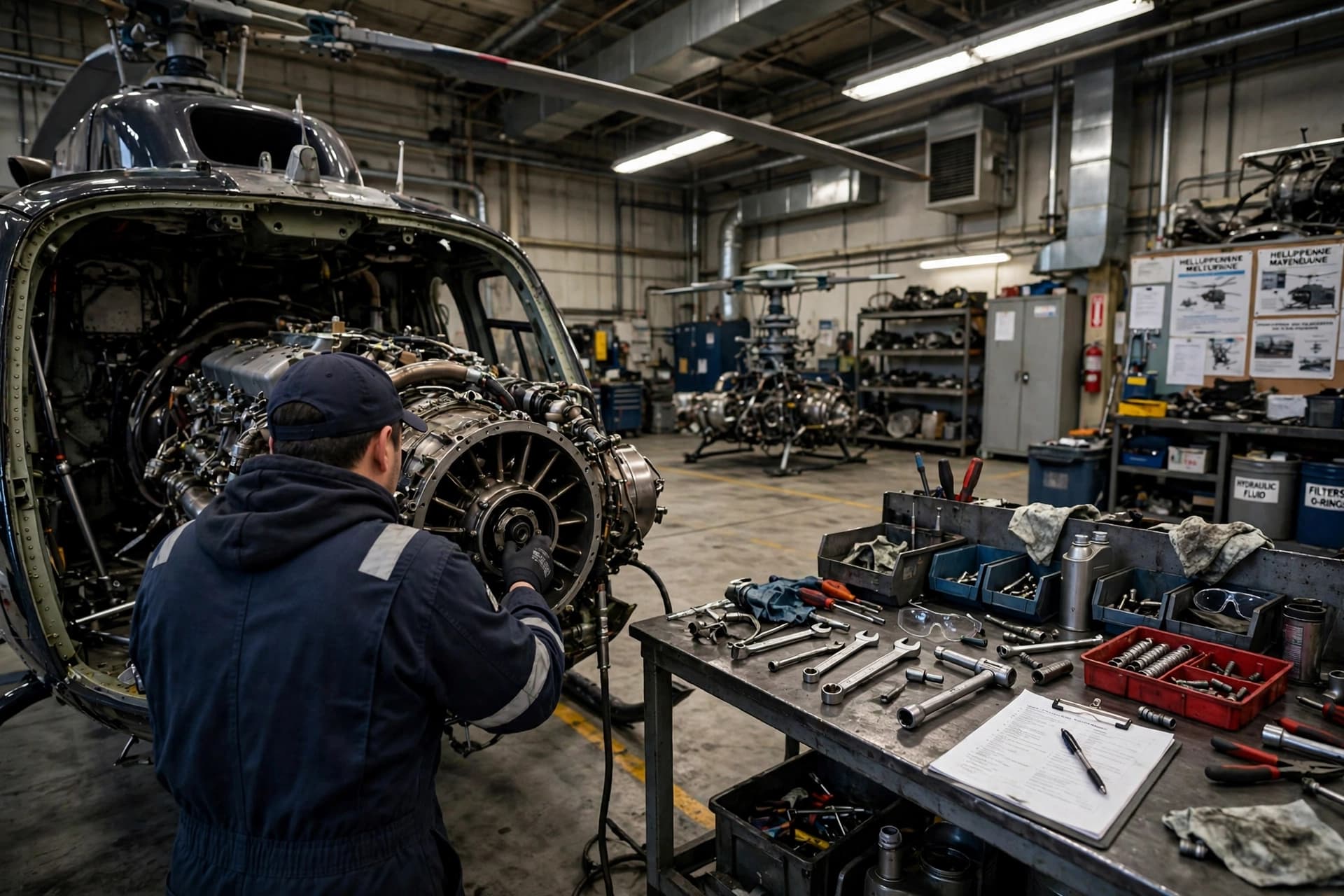
The industry context gives this urgency. Helicopter maintenance is safety-sensitive work performed under schedules that often extend into nights and early mornings. The Dirty Dozen—the classic list of human factors in aviation maintenance—includes fatigue as a thread running through every other risk. Downey emphasized that reducing fatigue requires examining root causes rather than assigning blame, a culture shift as much as a scheduling one .
The solutions are not exotic. Wearable devices can help individuals understand their sleep needs. Shifts can be planned to allow sleep during at least part of the circadian low window. Time can be built in to overcome sleep inertia, the grogginess after waking. None of these are technological breakthroughs. They are adjustments to how work is organized and how rest is valued.
What the conference conversation revealed is a quiet truth about safety culture: the machines are protected by procedure, and the people who keep them flying are protected, when they are protected at all, by attention. The question is whether that attention becomes as systematic as the diagnostics that govern the aircraft themselves.
Images in this article are AI-generated and are not photographs of the conference or individuals described.
Sources: Vertical Magazine
Published by Banx Network. This article is part of the Banx decentralized media programme, powered by the BXE token on the XRP Ledger.