Strain is a subtle thing. It is the slight deformation of a material when a force is applied, the tiny change in shape that occurs when something is pressed or pulled or bent. Measuring strain at the smallest scales—at the level of individual atoms—is a challenge that has occupied physicists for decades. Conventional spectroscopic methods can struggle to detect the shifts in energy levels that strain produces in certain transitions. A new theoretical proposal from researchers in Germany and France suggests a way to access these elusive signals using rare-earth-ion crystals and optical memories.
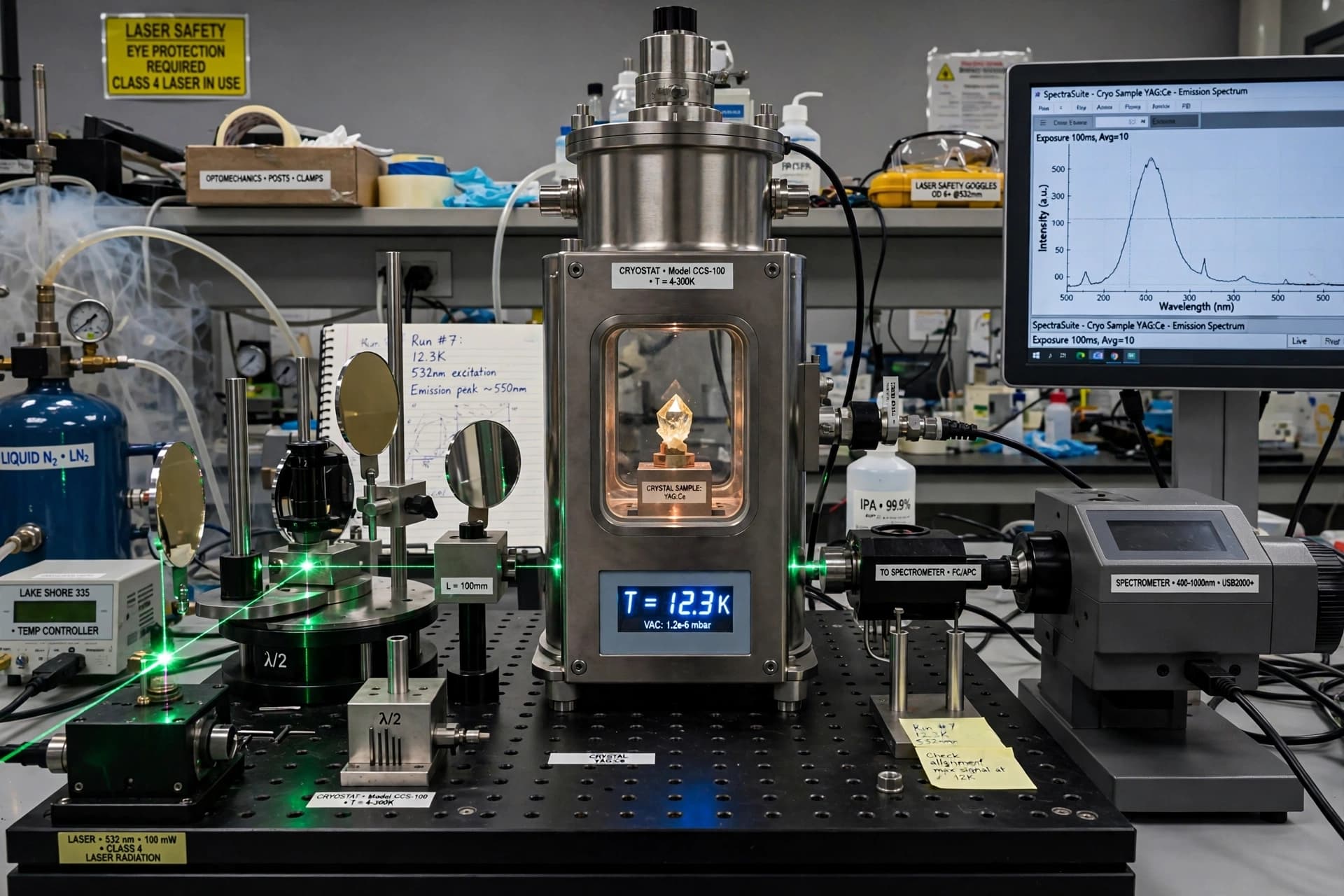
The work, accepted for publication in Physical Review B, proposes a protocol for measuring strain shifts of ground-state hyperfine transitions in non-Kramers rare-earth-ion doped materials . These are crystals containing ions like praseodymium or europium, whose nuclear spins can store quantum information for relatively long periods. The hyperfine transitions—the energy differences between nuclear spin states—are sensitive to strain, but that sensitivity is difficult to measure directly with conventional methods .
The proposed approach uses the long-lived hyperfine coherences in these crystals as controlled phase evolution windows. The protocol begins by optically preparing a selected hyperfine class, using a phase-controlled radio-frequency pulse to create a sensing coherence, and then applying synchronized dynamical decoupling pulses during the phase evolution interval . This sequence allows a coherent alternating-current strain drive to accumulate phase rather than averaging away—hence the term “phase-accumulating.” The accumulated phase is then retrieved by Raman heterodyne readout .
The theoretical framework relates the strain response to effective quadrupole and Zeeman tensors, including changes in electronic wave functions, virtual electronic admixtures, and the bare nuclear quadrupole interaction . In simpler terms, the researchers have developed a mathematical description of how strain affects the hyperfine energy levels in these materials, and a way to measure that effect using optical and radio-frequency techniques.
The work is theoretical, a proposal rather than a demonstration. But it builds on established capabilities of rare-earth-ion crystals, which have been used for optical quantum memories and precision spectroscopy. The long coherence times of hyperfine transitions in these materials make them attractive for sensing applications, where the signal must be accumulated over time to be detected. The phase-accumulation approach is designed to exploit that coherence, allowing weak strain signals to build up into measurable phase shifts.
If realized experimentally, the protocol could provide a new tool for studying strain at the microscopic scale. It could also contribute to the broader field of quantum sensing, where quantum systems are used to measure physical quantities with sensitivity beyond classical limits. The rare-earth-ion platform offers a different set of tradeoffs than other quantum sensors, such as nitrogen-vacancy centers in diamond, and may be suited to particular applications where its unique properties are advantageous.
For now, the work remains a proposal, a roadmap for an experiment yet to be performed. But it offers a pathway toward measuring something that has been difficult to access—the subtle strain-induced shifts of nuclear spin transitions in rare-earth crystals. In the quiet world of hyperfine coherences, where phase accumulates slowly and precisely, there may be a new way to sense the strain of the world.
AI Image Disclaimer: This article includes AI-generated imagery intended for illustrative purposes only.
Sources: Physical Review B, arXiv, Inspire HEP
Published by Banx Network. This article is part of the Banx decentralized media programme, powered by the BXE token on the XRP Ledger.