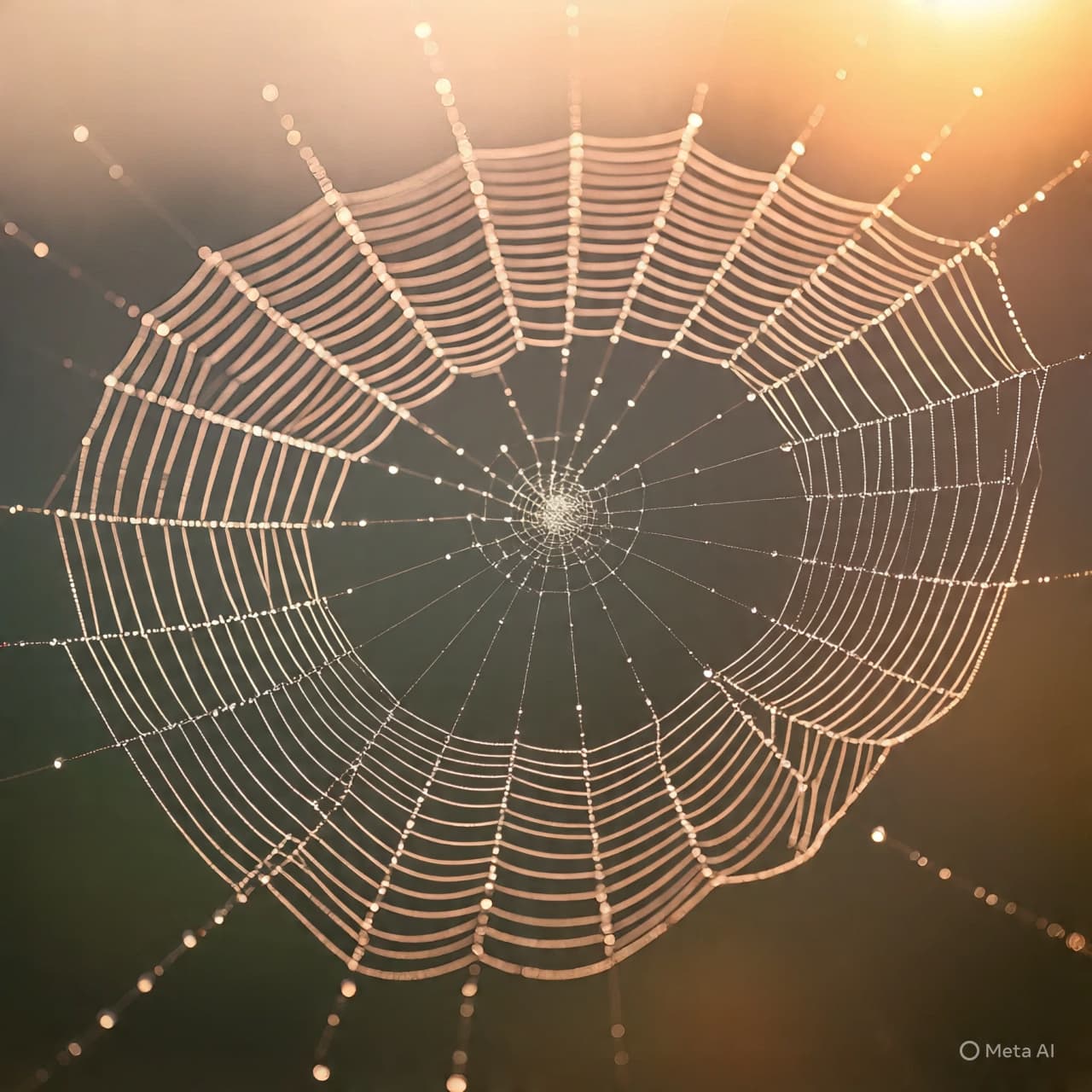
Imagine walking through a garden at dawn, the dew glinting on a spider’s web stretched between two branches. Amid its fine spiral threads you spot a bold zigzag line—almost as if the spider had taken a felt-tip pen and drawn a “W” across its trap. For decades, these striking zigzags—known as the stabilimentum—have puzzled observers. Are they decoration, camouflage, prey-magnets, or something else entirely? A new study now suggests they may serve as a kind of alarm system, enhancing the spider’s ability to sense its web and its world.
These zigzags are most commonly seen in orb-weaving spiders of genera like Argiope bruennichi, whose webs often include conspicuous white-silk patterns at the hub. Previously, scientists proposed functions ranging from strengthening the web to making the spider less visible to predators, or even attracting insects.
In the latest research, scientists led by Gabriele Greco and colleagues examined how these stabilimenta affect vibration transmission in the web. Webs function as mechanical sensors: when prey lands, struggles or flies into the trap, the silk carries vibrations which the spider senses. The team modelled several types of stabilimentum geometry—thick zigzags, single-side strands, partial zigzags—on webs of Argiope and tracked how vibrations travelled through them.
They found that, when disturbances occurred parallel to the spiral threads (as when prey flaps or skitters), the presence of a stabilimentum spread the vibration across a greater portion of the web, increasing the number of detection points for the spider. In other words: the zigzag seems to amplify or distribute the “signal” of movement more widely, making it easier for the spider to locate prey or detect intrusion.
This suggests the stabilimentum acts like a mechanical amplifier or sensor network—an evolved alarm system in the spider’s architecture. Of course, the effect is subtle: the study flagged that stabilimenta did not significantly change response to perpendicular landings (i.e., direct hits). Their impact emerged chiefly when the disturbance followed the spiral threads.
Importantly, this new insight doesn’t mean the other theories (prey attraction, camouflaging from predators, visibility to large animals) are invalid. As the review of decoration-functions explains, different web decorations may serve different functions in different species, and stabilimenta likely evolved several times independently.
Published by Banx Network. This article is part of the Banx decentralized media programme, powered by the BXE token on the XRP Ledger.