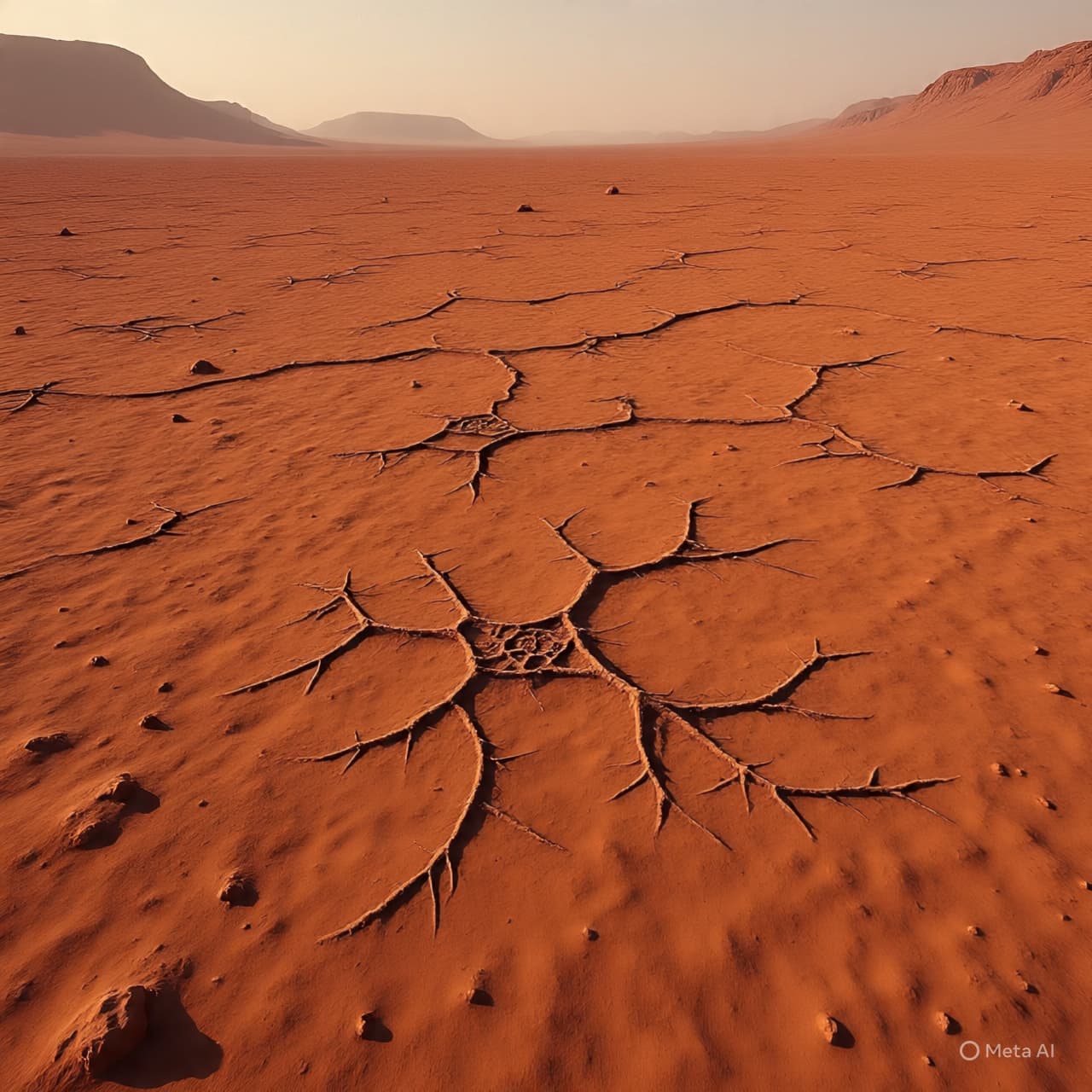
On Mars, even the ground can appear to whisper. In images sent across millions of miles, patterns emerge from the rust-colored dust — delicate, branching shapes that resemble spiderwebs pressed into stone. They are not the work of living creatures, nor the remnants of some hidden Martian colony. Yet as cameras peer closer, the formations seem almost intricate enough to suggest intention.
Recently, Curiosity Rover transmitted detailed images of these so-called “spider” features, offering one of the clearest views yet of a geological phenomenon that has intrigued scientists for years. The rover, operated by NASA, continues its steady exploration of Gale Crater, examining rock layers that hold clues to the planet’s ancient climate.
The formations resemble radial cracks spreading outward from central points, creating web-like networks across the surface. On Earth, similar patterns can form when materials expand and contract or when fluids escape from beneath the ground. On Mars, the leading explanation involves seasonal processes linked to carbon dioxide frost.
During the Martian winter, carbon dioxide from the thin atmosphere freezes onto the surface, forming a layer of dry ice. When spring sunlight returns, that frozen layer warms from below. Gas trapped beneath the ice builds pressure and eventually bursts through weak points, carving branching channels in the soil as it escapes. The result is a pattern etched into the terrain — what scientists sometimes call “araneiform” features, from the Latin word for spider.
While orbiters have previously spotted such patterns from above, the rover’s close-up imagery offers new detail. Grain size, texture, and layering within the rock help researchers determine how often these processes occur and how they reshape the Martian landscape over time. The patterns are not biological, but they are dynamic — evidence that Mars remains an active planet, shaped by cycles of frost and thaw.
The spider-like formations also speak to the broader story of Martian climate. Mars today is cold and dry, with an atmosphere far thinner than Earth’s. Yet geological evidence suggests it once held flowing water and perhaps even lakes. By studying modern surface processes — including carbon dioxide ice activity — scientists refine their understanding of how the planet transitioned from a wetter past to its present state.
Curiosity’s mission has always been rooted in careful observation rather than spectacle. Since landing in 2012, the rover has analyzed soil chemistry, detected organic molecules, and documented ancient sedimentary layers. Each new image, including these intricate web patterns, adds a small piece to a vast planetary puzzle.
There is something quietly poetic about finding shapes that resemble webs on a world without insects. The resemblance is accidental, a trick of physics and seasonal change. Yet it reminds us that patterns repeat across nature, shaped by pressure, temperature, and time.
In straightforward terms, NASA’s Curiosity Rover has captured high-resolution images of spider-like surface formations on Mars. Scientists attribute the patterns to seasonal carbon dioxide frost processes rather than biological activity. The findings contribute to ongoing research into Martian geology and climate cycles.
On a distant planet, beneath a pale salmon sky, the ground continues to trace its own designs — delicate, temporary, and entirely its own.
AI Image Disclaimer Visuals are created with AI tools and are not real photographs.
Sources (Media Names Only): NASA Space.com BBC News The Guardian National Geographic
Published by Banx Network. This article is part of the Banx decentralized media programme, powered by the BXE token on the XRP Ledger.