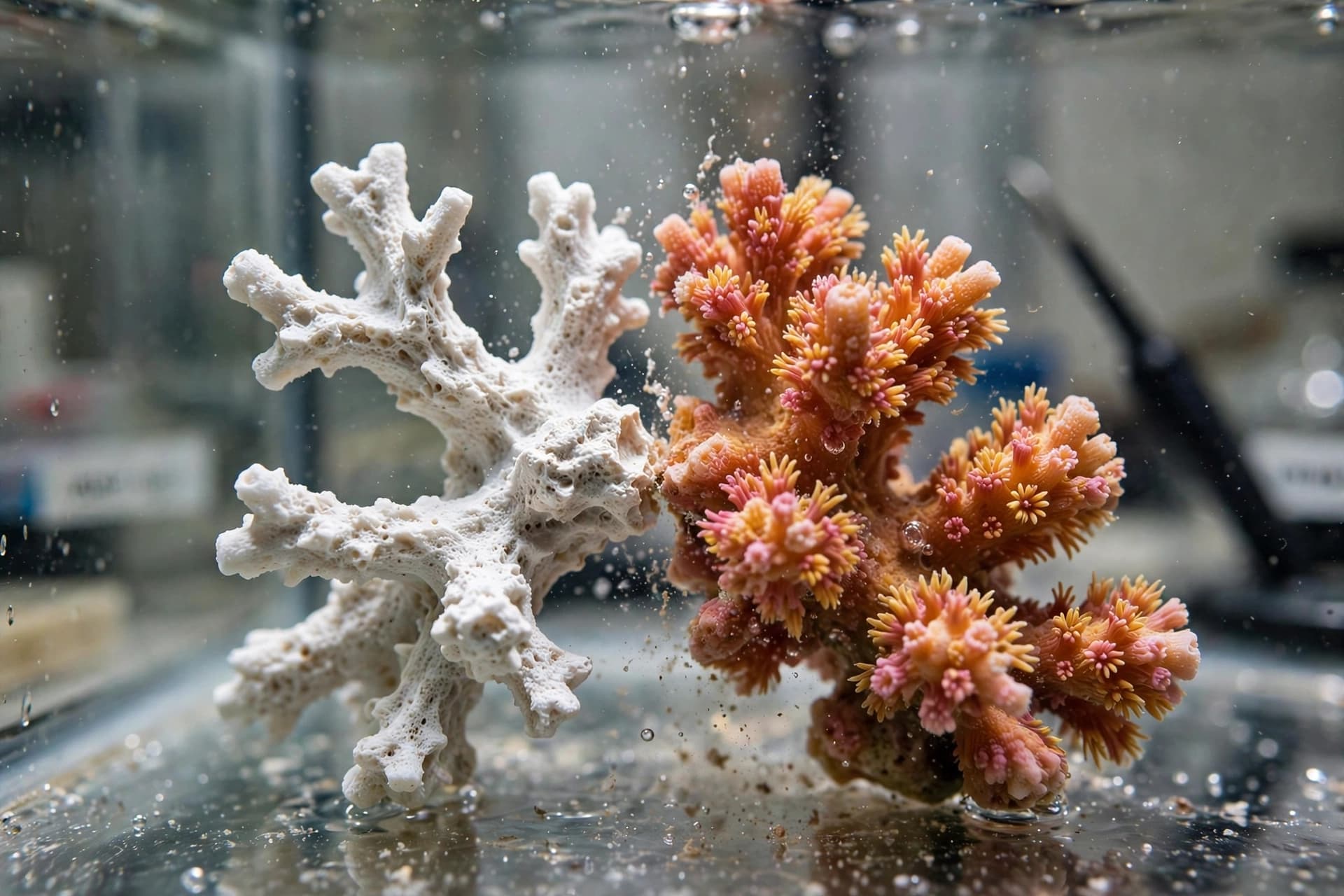
In the quiet of a laboratory tank, something extraordinary happened that no one had planned. Two fragments of coral—one healthy, one bleached and fading—drifted into contact. Where their tissues met, color began to return to the dying one. It was a small thing, easy to overlook. But what Danny Collins saw through his microscope would open a door that scientists had not known was there.
New research from Stanford University has demonstrated that brief physical contact between a healthy coral and a bleached one can transfer symbiotic algae from the healthy coral to the bleached one, triggering a full recovery in as little as one week of contact . The study, published in Science Advances, offers a potential lifeline for reefs facing the growing threat of bleaching events.
Coral bleaching occurs when heat stress causes corals to expel the symbiotic dinoflagellate algae that live within their tissues and provide them with energy through photosynthesis. Without these algae, corals turn white and begin to starve . Recovery in the wild can take months—often too slow to prevent death.
What Collins and his colleagues found is that healthy corals can actively "jump-start" the recovery of bleached ones. When placed in contact, the corals' tissues fuse, creating a nutrient bridge that allows the flow of algae and nutrients from the healthy coral to the bleached one . "I was blown away watching the actual color of this healthy coral slowly spread over into this bleached coral," Collins said .
The details matter. Symbiont transfer requires direct contact—even a few millimeters of separation prevented it entirely . The transfer only works between corals of the same genetic background, as tissue fusion requires compatibility . After one week of contact, bleached corals achieved complete recovery within seven weeks, an order of magnitude faster than typical recovery times in the wild . Critically, corals separated after one week of contact recovered just as well as those left in continuous contact, indicating that the transferred algae replicate within the recipient coral to sustain recovery .
"We can take away the healthy coral, and the bleached coral can now recover itself," Collins explained . The research showed that symbiont density in recovering corals increased from nearly zero to over 70 percent of healthy levels within twelve days of contact .
The technique has only been tested in laboratory conditions with genetically identical coral fragments. Whether it can be applied on natural reefs, at scale, remains an open question . The researchers note that while this offers a form of "emergency medicine" for individual corals, it cannot address the systemic threat of warming oceans and repeated bleaching events .
Still, the discovery offers something that has been in short supply in coral conservation: a mechanism for rapid recovery that nature itself provides. "These new insights into how corals can naturally recover give us hope for the future," said marine ecologist Fiorenza Micheli . The next step, the researchers say, is to explore whether contact-based recovery can be adapted for use in the field.
For reefs teetering on the edge, the possibility is not a solution to the climate crisis. But it is a hand extended—a small, living bridge between what is healthy and what is struggling, and a reminder that recovery sometimes begins with the simplest of gestures.
The images accompanying this article are AI-generated and are intended only to illustrate the subject matter.
Sources: Science Advances, EurekAlert!, ScienceAlert, The New York Times, Stanford University
Published by Banx Network. This article is part of the Banx decentralized media programme, powered by the BXE token on the XRP Ledger.