Key Highlights
- Voyager 1 is set to become the first human-made object to reach a distance where its signal takes one day to arrive on Earth.
- Launched in 1977, Voyager 1 has traveled over sixteen billion miles and continues to send data back to Earth.
- The spacecraft's journey symbolizes human ingenuity and the relentless pursuit of knowledge in space exploration.
Voyager 1, launched by NASA in 1977, is on the brink of a remarkable milestone: it will soon be the first human-made object to reach a distance from Earth where its radio signals take a full day to arrive. This distance, known as a light-day, is over sixteen billion miles away. As Voyager 1 crosses this threshold, it will mark a significant moment in the history of space exploration, demonstrating the vastness of our universe and the limits of human-made technology.
The journey of Voyager 1 is not merely a scientific endeavor; it is a testament to human perseverance and curiosity. After sweeping past Jupiter in 1979 and Saturn in 1980, Voyager 1 continued its journey into interstellar space, crossing the heliopause—the boundary where the sun's influence wanes—in 2012. Currently traveling at a speed of 38,000 miles per hour, it remains operational, sending back valuable data about the environment beyond our solar system.
NASA estimates that it will take another 18,000 years for Voyager 1 to travel a full light-year, and even longer before it approaches another star. The engineers who designed and built Voyager were aware that it would not return to Earth, and they anticipated the eventual decay of its power supply. By the 2030s, the instruments aboard will likely fall silent, leaving behind a legacy of data that has fascinated scientists and the public alike.
The story of Voyager 1 is imbued with a sense of melancholy and reflection. It serves as a metaphor for the human experience—an exploration of the unknown, a message sent into the void. Yet, it is also a story of resilience. Voyager 1 has endured the harsh conditions of space, including micrometeorite impacts and radiation, while being reprogrammed and maintained by engineers who were not even born when it was launched. Its continued operation is a testament to human competence and the dedication of those who have worked tirelessly to keep it functioning.
The concept of a light-day is a human construct, a way to measure the vast distances in space in terms that we can comprehend. While the heliopause does not present a clear boundary, the crossing of this threshold by Voyager 1 provides a tangible marker of its journey. The idea that a signal from Voyager will take a full day to reach Earth is a profound realization, allowing us to grasp the enormity of its journey.
As Voyager 1 continues to drift through the cosmos, its signal will gradually weaken, and its power will diminish. In the coming years, it will become silent, yet it will persist in its journey through the Oort Cloud and into the vastness of interstellar space. Carrying with it the golden record—a time capsule of humanity—Voyager 1 will serve as a silent ambassador of our civilization, traversing a galaxy that may never notice its passage. For as long as it can communicate, Voyager 1 will remain the farthest object humanity has ever sent into the universe.
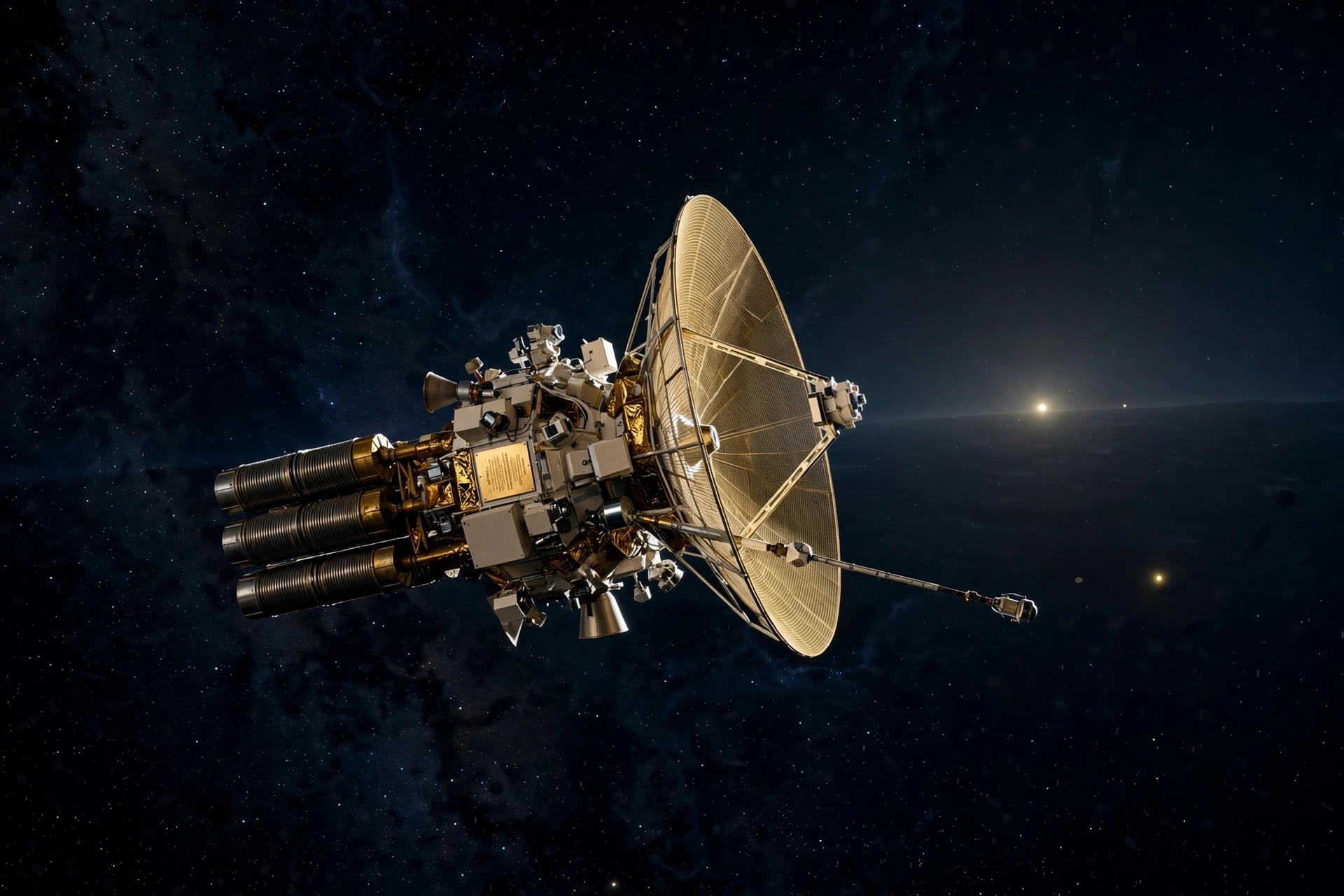
The images in this article are AI-generated illustrations and are not actual photographs of Voyager or its environment.
Published by Banx Network. This article is part of the Banx decentralized media programme, powered by the BXE token on the XRP Ledger.