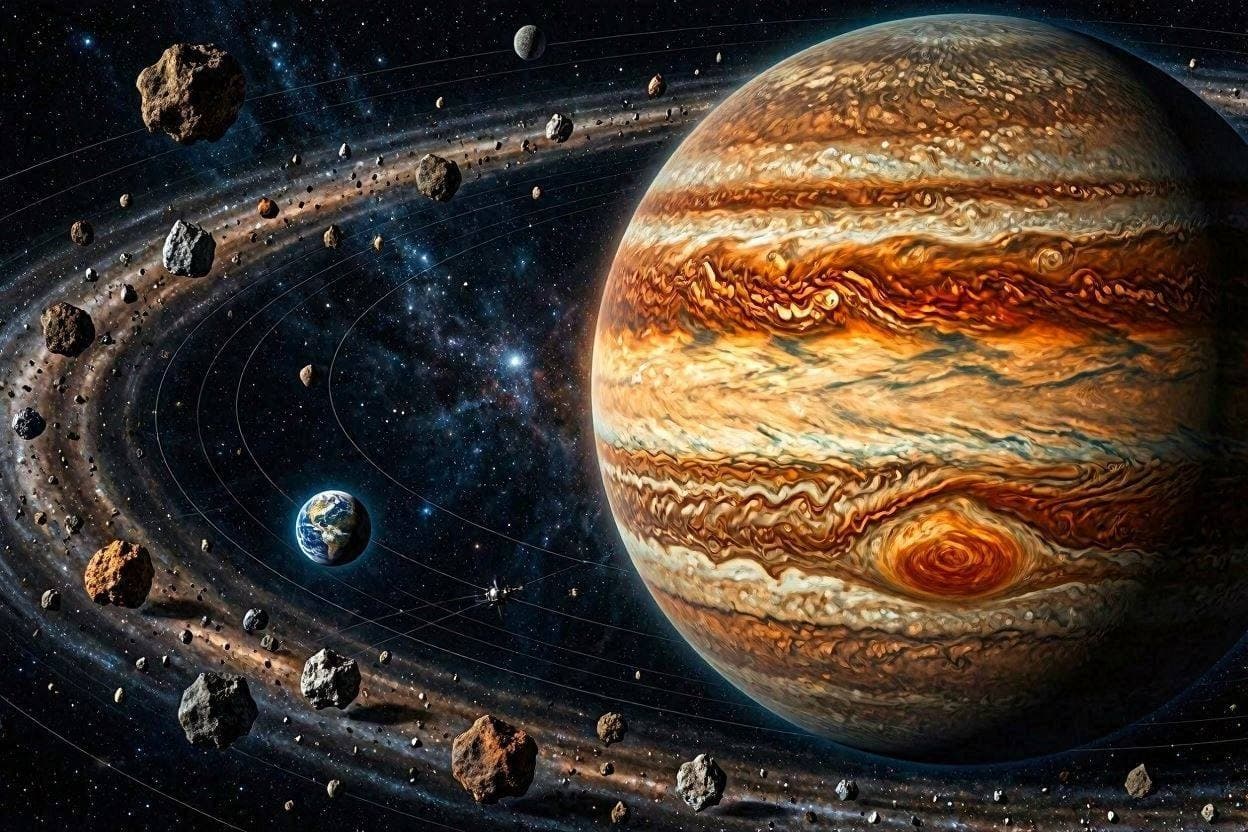
Opening: In the silent expanse of space, gravity acts as both a sculptor and a guardian, shaping the destiny of celestial bodies. Recent scientific findings suggest that Jupiter, the giant of our solar system, played a pivotal role in directing a barrage of asteroids toward Earth billions of years ago. This "gravity gate" mechanism, once a source of ancient bombardment, remains a potential threat today. It is a discovery that invites reflection on our place in the cosmos and the delicate balance of forces that protect and endanger our planet.
Body: Researchers have identified a specific orbital resonance involving Jupiter that acted as a conduit for asteroids from the main belt to cross paths with Earth. During the late heavy bombardment period, this gravitational interaction funneled a significant number of space rocks toward the inner solar system. The evidence, derived from computer simulations and crater analysis, paints a picture of a chaotic early Earth, constantly under siege from above. This historical context helps scientists understand the formation of our planet and the origins of water and organic materials.
The term "gravity gate" refers to the precise alignment of orbits that allows asteroids to escape the stabilizing influence of the main belt. Jupiter’s immense mass creates gravitational wells that can alter the trajectory of smaller bodies, sending them on collision courses with terrestrial planets. While this process was intense in the past, it has not ceased entirely. Today, the same mechanisms continue to operate, albeit at a slower rate, posing a lingering risk to Earth.
Understanding these dynamics is crucial for planetary defense. By mapping the orbits of near-Earth objects and identifying potential gravity gates, astronomers can better predict future impacts. This knowledge allows for the development of mitigation strategies, such as deflection missions, to protect humanity from catastrophic events. The study of ancient bombardments thus serves a practical purpose, informing our preparedness for future threats.
The role of Jupiter is complex. While it can direct asteroids toward Earth, it also acts as a shield, capturing or ejecting many comets and asteroids that might otherwise hit us. This dual nature makes Jupiter both a friend and a foe in the cosmic dance. Scientists are working to quantify this balance, seeking to understand how often Jupiter protects us versus how often it endangers us. The answer lies in the intricate mathematics of orbital mechanics.
Public interest in asteroid threats has grown in recent years, fueled by movies and news reports. This new research provides a scientific basis for those concerns, grounding them in historical reality. It reminds us that Earth is not isolated in space but part of a dynamic system where interactions are constant. Awareness of these risks fosters a sense of global responsibility to monitor and respond to potential hazards.
Technological advancements in telescope arrays and data processing have made these discoveries possible. Large-scale surveys of the sky are identifying more near-Earth objects than ever before, filling in the gaps in our knowledge. Each new detection adds to the database, improving our models and predictions. The collaboration between international space agencies and academic institutions is key to this ongoing effort.
Closing: The revelation of Jupiter’s gravity gate offers a deeper understanding of Earth’s history and future. While the threat of asteroid impacts remains, so does our capacity to detect and mitigate them. By studying the past, we prepare for the future, ensuring that our planet remains a safe haven in the vastness of space.
AI Image Disclaimer: Visuals in this piece are artificially generated and should be viewed as artistic interpretations rather than factual documentation.
Sources: Nature Astronomy Science Daily NASA Jet Propulsion Laboratory Space.com
Published by Banx Network. This article is part of the Banx decentralized media programme, powered by the BXE token on the XRP Ledger.