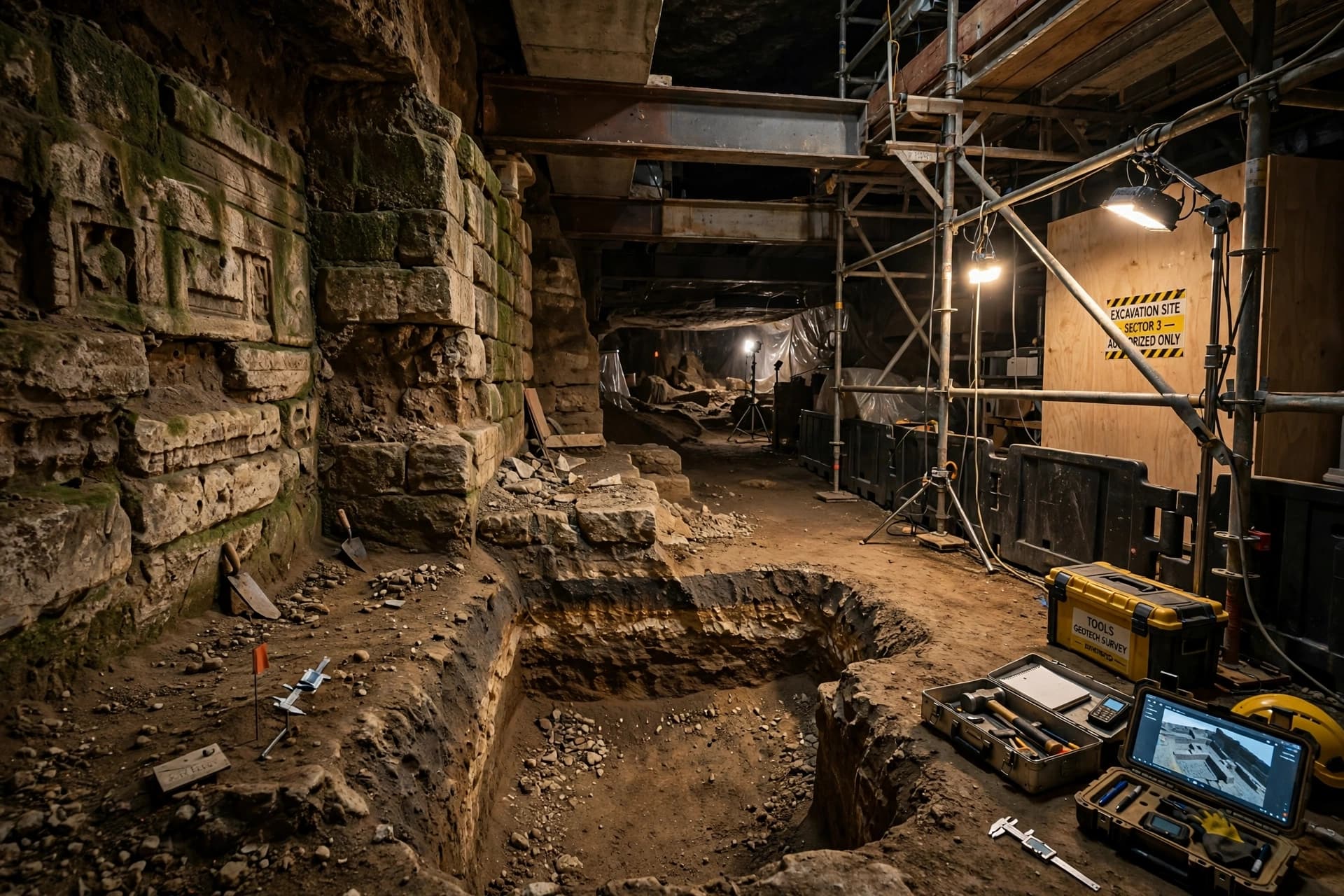
Beneath the bustling streets of Paris, where the echoes of centuries past often whisper through the cobblestones, a recent archaeological discovery has shed new light on the city’s earliest days. During renovations at a historic hotel in the Latin Quarter, workers unearthed a section of an ancient wall that experts believe may date back to the Roman era. This find is being hailed as a major breakthrough, potentially confirming long-held theories about the origins of Lutetia, the Roman settlement that would eventually become the City of Light.
The wall was discovered during routine maintenance work at the Hotel Lutetia, a landmark on the Left Bank known for its Art Deco elegance and rich history. As crews dug deeper into the foundation, they encountered a structure made of large stone blocks, distinct from the medieval and modern layers above. Archaeologists from the National Institute for Preventive Archaeological Research (INRAP) were called in to assess the find, and their initial analysis suggests the wall could be part of the original Roman fortifications or public buildings from the first few centuries AD.
For historians, the significance of this discovery cannot be overstated. While fragments of Roman Paris have been found before, including the famous baths at Cluny and the arena at Arènes de Lutèce, a well-preserved wall in such a central location offers a rare glimpse into the urban planning of the ancient city. It provides tangible evidence of how Lutetia expanded from its initial foothold on the Île de la Cité to the left bank of the Seine, where the forum and other civic structures were located.
The term "major breakthrough" used by lead archaeologists reflects the potential of this find to rewrite parts of Parisian history. By studying the construction techniques and materials, experts hope to determine the exact period of the wall’s creation and its function within the Roman city. This information could help clarify the timeline of Lutetia’s development and its role as a regional capital in Gaul.
The discovery also highlights the importance of preventive archaeology in urban environments. In a city as old and densely built as Paris, every construction project carries the potential for historical revelations. The collaboration between developers and archaeologists ensures that these hidden treasures are not lost to progress but are instead integrated into our understanding of the past. The Hotel Lutetia, itself a symbol of Parisian heritage, now adds another layer to its story by preserving this ancient secret beneath its floors.
Public interest in the find has been immense, with many Parisians expressing pride in their city’s deep roots. The wall serves as a physical connection to the ancestors who walked these streets two millennia ago, reminding us that history is not just something read in books but something that lies beneath our feet. Plans are already underway to incorporate the site into a small museum or viewing area, allowing visitors to see the wall in situ.
As research continues, the focus remains on preserving the integrity of the structure while making it accessible to the public. The findings will be shared with the broader academic community, contributing to the global understanding of Roman urbanization. For now, the wall stands as a silent testament to the enduring legacy of Lutetia, waiting to tell its full story to those who listen.
The discovery of the ancient wall beneath the Hotel Lutetia is a reminder of the layers of history that define Paris. It offers a unique opportunity to connect with the city’s Roman origins and appreciate the continuity of human settlement in this iconic location. As further studies unfold, the wall promises to enrich our knowledge of Lutetia and solidify its place in the narrative of Paris’s birth.
AI Image Disclaimer: The illustrations in this article are AI-generated visualizations designed to represent the concept of archaeological discovery, not actual photographs of the excavated wall.
Sources: The Art Newspaper, France 24, INRAP
Published by Banx Network. This article is part of the Banx decentralized media programme, powered by the BXE token on the XRP Ledger.